Statue of Liberty
The broken chains at Liberty’s feet are invisible from the ground. Nobody sees them without a helicopter, and that is not an accident. In Bartholdi’s first design the figure held a broken shackle in her raised hand — an unmistakable reference to the abolition of slavery. The American fundraisers found that too pointed, seven years after the Civil War. The chain was moved to her feet, where it disappeared.
Quick Facts
- Full title: La Liberté éclairant le monde — Liberty Enlightening the World
- Sculptor: Frédéric Auguste Bartholdi (1834–1904)
- Engineer: Gustave Eiffel; pedestal by Richard Morris Hunt
- Dedicated: 28 October 1886
- Medium: repoussé copper, 2.4 mm thick, over an iron and steel armature
- Dimensions: figure 46 m; 93 m to the torch including pedestal; copper c. 31 tonnes, total c. 225 tonnes
- Movement: Neoclassicism
- Location: Liberty Island, New York Harbor
What you cannot see
This is the most interesting thing about the monument.
The idea came in 1865 from Édouard de Laboulaye, a French jurist and abolitionist. France was to commemorate American liberty — specifically, the abolition of slavery, which had just been achieved.
In Bartholdi’s early studies the figure held a broken chain in her raised hand. The meaning was unambiguous.
The American side was not enthusiastic. The Civil War was recent, Reconstruction was already unravelling, and a monument to emancipation risked alienating donors.
So the chain went to her feet, broken, half-hidden beneath the robe — invisible from the island and from the ferry. The raised hand received a tablet with the date of the Declaration of Independence instead.
That change shifted the meaning of the whole monument: from the end of slavery to a general celebration of liberty and Franco-American friendship.
The poem that came later
Another thing that was not in the plan.
The statue was not meant to be about immigration. It was about the centenary of independence and republican ideals.
In 1883 the poet Emma Lazarus wrote the sonnet The New Colossus for an auction raising money for the pedestal. It contains the lines about tired, poor, huddled masses yearning to breathe free.
The poem attracted no attention at the time. Lazarus died in 1887, a year after the dedication, without seeing it recognised.
The bronze tablet bearing the sonnet was only installed in 1903, sixteen years after her death, through the efforts of a friend.
Only then — and particularly from the 1930s onwards — did the statue become, in the popular imagination, a symbol of immigration. That meaning is secondary, added by a poem and by history rather than by design.
What makes it remarkable
The engineering was without precedent.
The copper skin is 2.4 millimetres thick — less than two coins stacked together. It was made by repoussé: sheets hammered over wooden forms.
Inside, Eiffel designed the crucial solution. The skin is not rigidly fixed to the frame. Flexible iron bars connect the two, allowing the copper to move with wind and temperature. The statue sways several centimetres in a strong wind; the torch moves considerably more.
It is the same principle Eiffel later applied to his tower.
What to look for
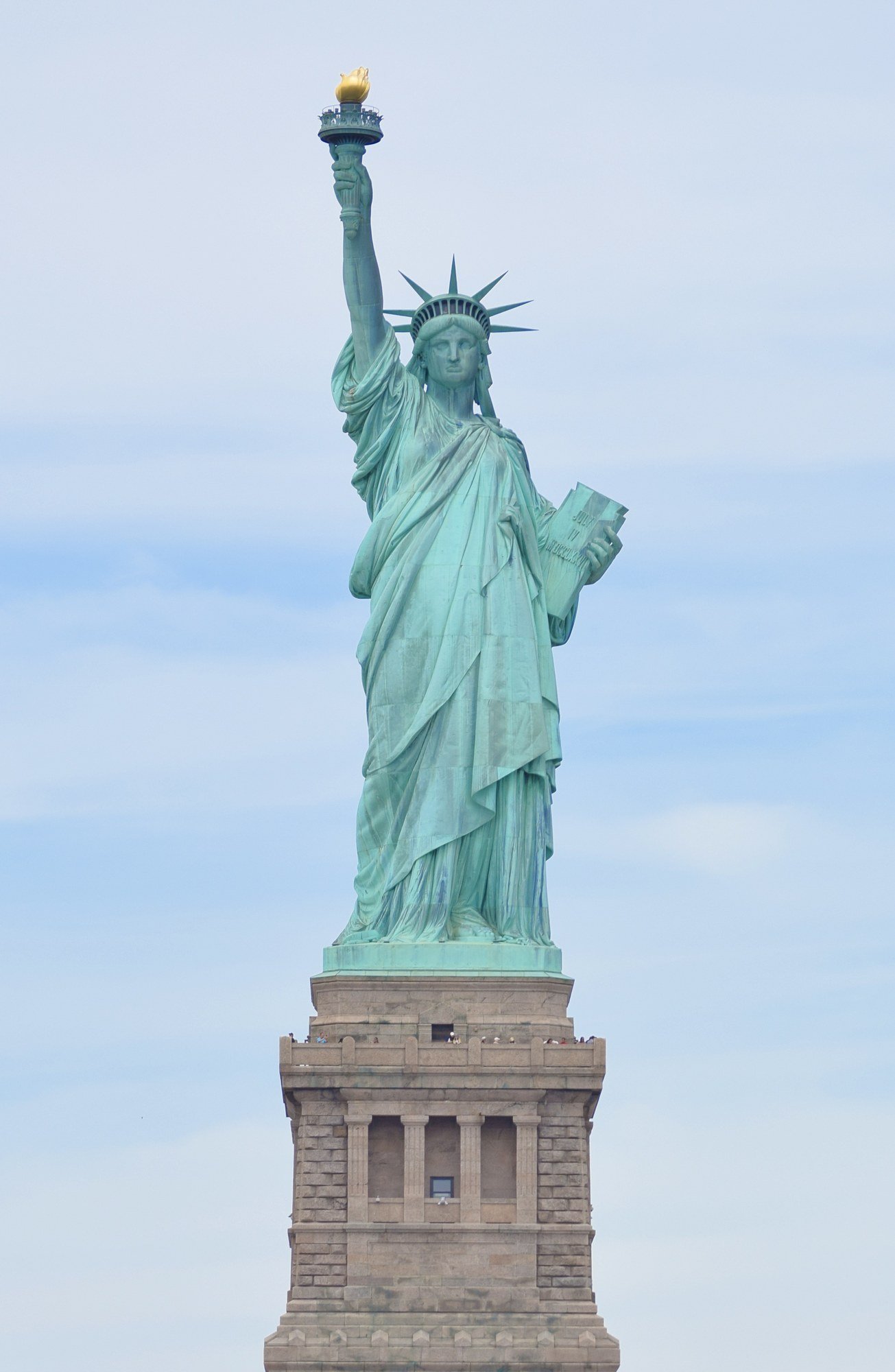
The crown. The seven rays are solar rays, an attribute of the Roman goddess Libertas and part of the iconography of the radiate crown. The familiar explanation about seven seas and seven continents is a later gloss, not Bartholdi’s intention.
The feet. The right heel is raised — she is not standing, she is stepping forward. An easily missed detail that changes the reading: Liberty is in motion.
The chains. Broken, beneath the robe. Only visible from the air.
The tablet. The date in Roman numerals: JULY IV MDCCLXXVI.
The colour. The patina took about thirty years to form. Until roughly 1920 the statue was brown. Cleaning it was considered and rejected once it became clear the patina protects the copper beneath.
The face. Family tradition holds that Bartholdi modelled it on his mother, Charlotte. There is no documentary proof, but sources close to the sculptor repeat it.
Historical context
The statue was built in Paris over roughly a decade and assembled there in full, towering over the neighbourhood, before being taken apart into 350 pieces and packed into 214 crates.
The arm and torch crossed the Atlantic early — in 1876, for the Centennial Exhibition in Philadelphia. It then stood in Madison Square in New York for several years, and visitors could climb to the balcony around the torch. It was a fundraising device.
The Americans had committed to building the pedestal and were failing. The campaign stalled, and Boston offered to take the statue instead.
Joseph Pulitzer rescued it. In 1885 he announced in his newspaper The World that he would print the name of every donor, however small the gift. In five months the campaign raised over $100,000 from roughly 120,000 people. More than three quarters of the donations were under a dollar. The pedestal was paid for by ordinary people.
At the dedication in 1886 there were essentially no women among the official guests. Suffragists chartered a boat, circled the island and shouted that it was absurd to represent liberty as a woman in a country where women could not vote.
The Egyptian question
A popular story says the Statue of Liberty is a rejected design for a lighthouse at the Suez Canal.
There is something in it, but not everything.
Between 1867 and 1869 Bartholdi did propose a monumental lighthouse for Egypt in the form of a woman holding a torch, titled Egypt Carrying the Light to Asia. The figure was to evoke a fellah, an Egyptian peasant woman. The project was rejected on cost.
Bartholdi consistently denied that he had reworked the Egyptian design into the American one, insisting they were separate conceptions.
The surviving drawings, however, show a clear resemblance in silhouette and gesture. Art historians now generally treat the Egyptian project as a stage in the development of the same idea, rather than a straightforward copy.
About Bartholdi
Born in Colmar in Alsace in 1834. He travelled to Egypt as a young man and the colossal statuary of the pharaohs left a permanent mark on his sense of scale.
After France’s defeat in 1870 and the loss of Alsace to Germany, his patriotism sharpened. He produced the Lion of Belfort, a monumental rock-cut sculpture commemorating the siege of that town.
He was also an effective operator — travelling to America repeatedly to lobby politicians and patrons. Without that persistence the statue would not exist.
He died in Paris in 1904.
Legacy and influence
The silhouette is one of the most reproduced images in the world — on stamps, coins, posters and in film, usually as shorthand for America itself.
There are dozens of replicas, from Paris to Tokyo. One stands on the Île aux Cygnes in Paris, facing towards New York.
The torch was replaced during the restoration for the centenary. The original, damaged by decades of alterations and water ingress, is now displayed in the museum on the island. The new one is covered in gold leaf.
The monument has been a UNESCO World Heritage Site since 1984.
Visiting
The statue stands on Liberty Island and is reachable only by ferry.
- There is one authorised ferry operator, departing from Battery Park in Manhattan and Liberty State Park in New Jersey. Buy tickets only from them — touts around Battery Park sell harbour cruises that do not land on the island.
- Crown access requires a separate ticket booked months ahead. It is 162 steps up a narrow spiral staircase, with no lift and restrictions on what you can carry.
- The ferry ticket includes Ellis Island and its immigration museum. Allow half a day for both.
- Free alternative: the Staten Island Ferry runs at no charge and passes close to the statue. It does not stop, but the view is good.
- The museum on the island, opened in 2019, holds the original torch and the construction history.
Frequently asked questions
What do the seven rays of the crown mean?
They are solar rays — a classical attribute of the goddess Libertas and a standard element of the radiate crown. The widespread explanation about seven seas and seven continents is a later interpretation, not the sculptor’s.
Where are the broken chains?
At her feet, beneath the robe, and invisible from ground level. In the original design the figure held a broken shackle in her raised hand, but this was judged too direct a reference to the abolition of slavery and was moved out of sight.
Why is she green?
Patina — the natural product of copper oxidising. It took about three decades; until roughly 1920 the statue was brown. The patina was left in place because it protects the metal underneath.
Was it really designed for Egypt?
Partly. Bartholdi did propose a similar lighthouse figure for the Suez Canal, and it was rejected. He denied reworking that design for America, though surviving drawings show a strong resemblance.
Who paid for it?
France paid for the statue, America for the pedestal. The American fund stalled until Joseph Pulitzer’s 1885 newspaper campaign, in which over three quarters of donations were under a dollar.
Can you go up to the crown?
Yes, with a separate ticket booked well in advance. It is 162 steps up a narrow spiral staircase with no lift.
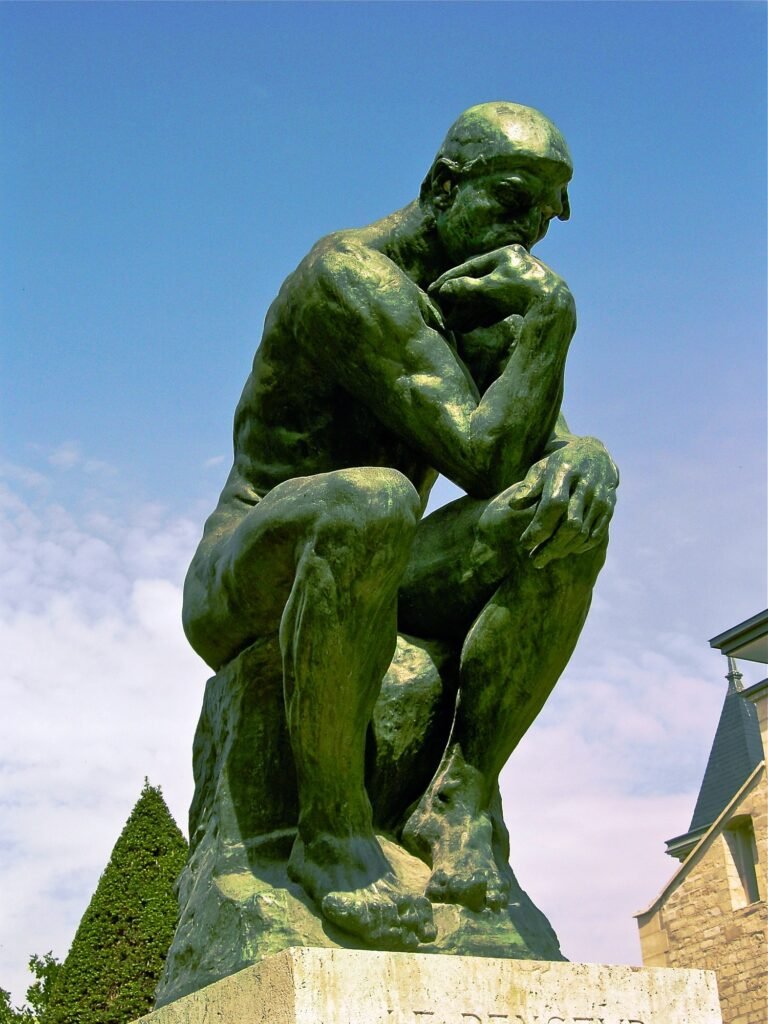
If the Statue of Liberty has caught your interest, look next at The Thinker by Rodin — a sculpture from the same era and the same country, made with an entirely opposite intention: not to announce something, but to show someone in silence.
Image: Statue of Liberty – Frédéric Auguste Bartholdi (1886). License: Public Domain. Source: Wikimedia Commons.