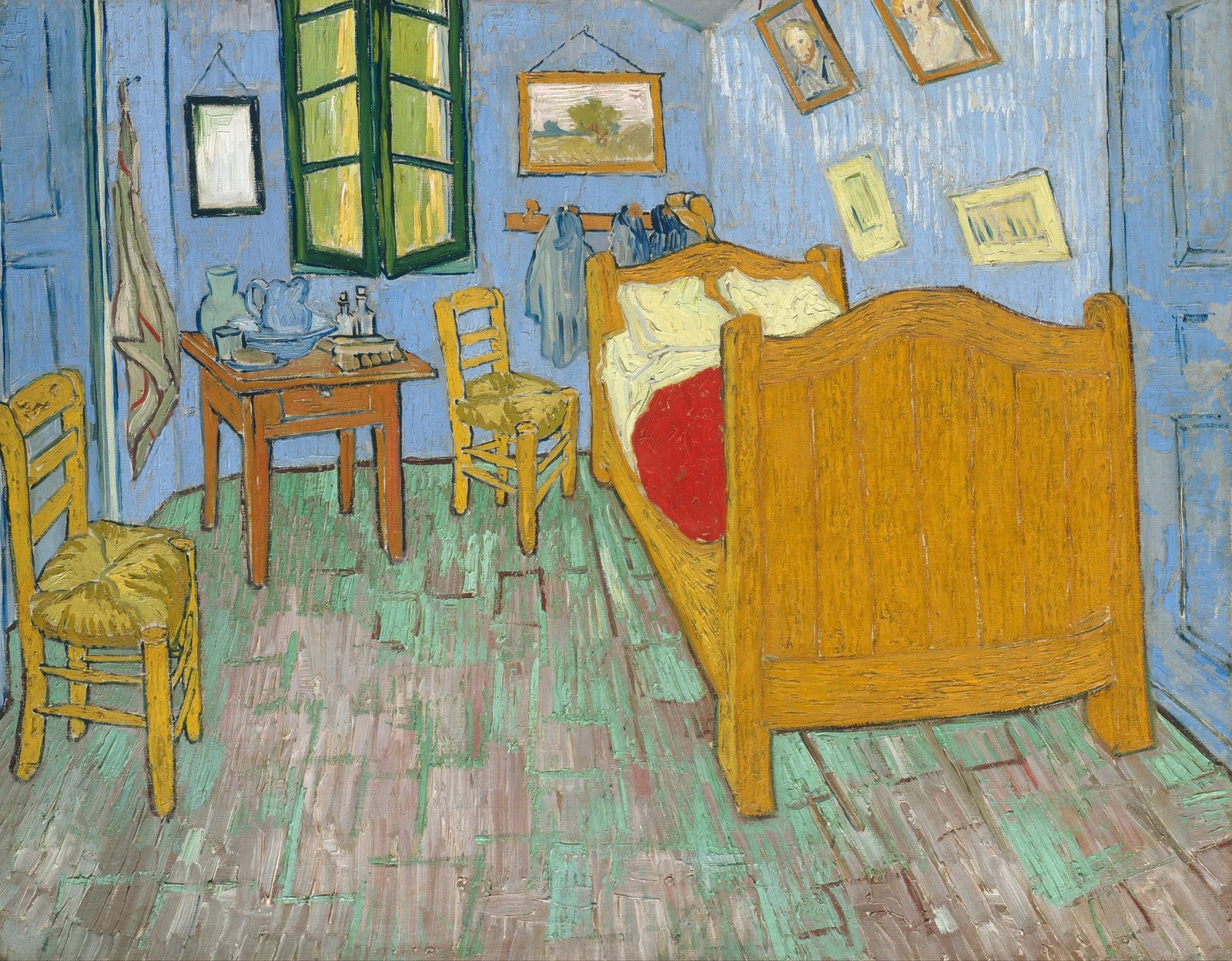
The Bedroom
Here is a striking fact that stops most visitors cold: when Vincent van Gogh painted The Bedroom, he was so exhausted from work and illness that he intended the painting to rest the mind — yet the result is one of the most psychologically charged rooms in all of Western art.
Quick Facts
- Artist: Vincent van Gogh
- Year: 1889
- Medium: Oil on canvas
- Dimensions: 73.6 cm × 92.3 cm (29 in × 36.3 in)
- Movement: Post-Impressionism
- Current location: Art Institute of Chicago
What Makes The Bedroom So Unforgettable?
Most paintings invite you to look at something. The Bedroom does something different — it pulls you physically into the space. The tilted floor, the off-kilter perspective, and those two modest wooden chairs feel less like artistic choices and more like symptoms of a mind working at full intensity.
What sets this work apart from thousands of interior scenes in art history is its refusal to be comfortable. Van Gogh wanted the painting to feel restful. He said so himself in letters to his brother Theo. However, the result buzzes with a quiet, almost feverish energy. The walls seem to lean. The bed seems to float. Everything is slightly wrong in a way that feels completely true.
This is not a room you observe. It is a room you feel. That gap between intention and emotional effect is precisely what makes The Bedroom one of the most discussed paintings of the nineteenth century.
Historical Context
Van Gogh painted this version in 1889 while he was a voluntary patient at the Saint-Paul-de-Mausole asylum in Saint-Rémy-de-Provence, France. He had already created the first version in October 1888, at the now-famous Yellow House in Arles, in anticipation of Paul Gauguin’s arrival. That original version was damaged by flooding. Van Gogh made two later copies — this Chicago version being one of them.
The late 1880s were a period of enormous upheaval, both for van Gogh personally and for European art more broadly. Impressionism had already transformed how painters approached light and color. However, a younger generation was pushing further — asking not just what the eye sees, but what the soul feels.
Van Gogh stood at the center of that shift. He corresponded with Gauguin, admired Émile Bernard, and absorbed the lessons of Japanese woodblock prints. In addition, he was battling mental illness, isolation, and poverty. The Bedroom was born from all of that tension — a private space made into a universal statement about shelter, solitude, and the longing for peace.
The Walls Were Never Blue
This is the single most important thing to know about the painting, and almost nobody does.
Van Gogh described the bedroom walls to Theo as pale lilac. Pigment analysis carried out by the Art Institute of Chicago confirms why: he mixed a red lake pigment into blue to produce violet. Red lakes are notoriously light-sensitive. Over 130 years the red component has faded almost entirely, leaving behind the blue that everyone now assumes he intended.
The same applies elsewhere in the room. The doors and skirting boards, which today read as a cool blue, were originally a violet-pink. The floor was pinker. The overall effect was warmer and softer than anything you can see on the canvas today.
In other words, the painting he made to convey rest has become measurably colder over time. The Art Institute has published digital reconstructions of the original colour scheme — worth looking up before you visit, because you will not be able to unsee the difference.
This is one of several cases where the most famous facts about a painting turn out to be artefacts of age rather than intention. See the full list.
Symbolism and What to Look For
Stand in front of The Bedroom and resist the urge to take it all in at once. Look at the colors first. Van Gogh chose flat, unmodulated tones — lilac walls, a vivid blue bed frame, yellow and orange furniture. These are not naturalistic colors. They are emotional ones. He was deliberately simplifying, stripping away shadow to create a sense of calm that never quite arrives.
Next, look at the perspective. The floor slopes upward toward the back wall. The two chairs angle away from each other. Nothing is perfectly parallel. Van Gogh was not making a mistake — he was expressing something. The slight distortion suggests a mind that cannot fully settle, even in its most private space.
Notice the portraits on the back wall. Two small framed images hang above the bed. They are the most reliable way to tell the three versions apart: the pictures differ in each one. In the Chicago version they are portraits; in the Amsterdam original they are different works again. If you ever need to identify which version you are looking at, start there.
Finally, look at what is absent. There are no books, no food, no tools of work. This is a space stripped to its essentials. For van Gogh, that simplicity was aspirational — a dream of rest he could rarely achieve in waking life.
About Vincent van Gogh
Vincent Willem van Gogh was born on March 30, 1853, in Zundert, Netherlands. He worked as an art dealer, a teacher, and a lay preacher before turning seriously to painting in his late twenties. He produced more than 2,100 artworks in roughly a decade — an astonishing output for someone who only began painting around 1881.
He moved to Paris in 1886, where he encountered the Impressionists and completely transformed his palette. He then relocated to Arles in 1888, seeking light and warmth. His friendship with Gauguin ended in crisis — it was during this period that van Gogh famously severed part of his own ear.
He died on July 29, 1890, at the age of 37, just two days after suffering a gunshot wound. The familiar claim that he sold only one painting in his lifetime is not quite accurate: The Red Vineyard, bought by Anna Boch, is the famous sale, but the Van Gogh Museum documents several other transactions, including a commission from his uncle. He was a commercial failure rather than an absolute one. Today, his works rank among the most valuable and beloved in the world.
Legacy and Influence
The Bedroom has had a reach far beyond the walls of the Art Institute of Chicago. Its bold color choices and expressive distortion directly influenced the Expressionist movement of the early twentieth century. Artists like Ernst Ludwig Kirchner and Edvard Munch drew on van Gogh’s willingness to use form and color as emotional language rather than mere description.
In popular culture, The Bedroom has been reproduced on everything from coffee mugs to Airbnb listings — the Art Institute famously listed a real-life recreation of the room on Airbnb in 2016. That campaign reached millions of people and showed how genuinely this painting speaks to modern ideas about home, rest, and personal space.
Therefore, the painting’s legacy is double: it is both an art-historical touchstone and a living cultural reference that continues to evolve.
Where to See The Bedroom Today
The Chicago version of The Bedroom resides permanently at the Art Institute of Chicago, located at 111 South Michigan Avenue in Chicago’s Grant Park. It sits within the museum’s outstanding collection of nineteenth and early twentieth century European paintings.
Plan to arrive early on weekdays to avoid the largest crowds. The Art Institute is closed on Tuesdays. General admission currently runs around $25 for adults, though pricing can vary — always check the museum’s official website before your visit.
If you want to see all three versions, you will need three cities. The 1888 original is at the Van Gogh Museum in Amsterdam; the third and smallest version, at 57 × 74 cm, is at the Musée d’Orsay in Paris. The three were shown together only once, in Chicago in 2016.
While you are there, seek out Georges Seurat’s A Sunday on La Grande Jatte, which hangs in the same building and offers a fascinating contrast in Post-Impressionist approaches. Together, the two works give an exceptional picture of how radically different artists were exploring new visual languages at the same historical moment.
Frequently Asked Questions
Where is The Bedroom located?
The 1889 version of The Bedroom is held at the Art Institute of Chicago, Illinois. The first version (1888) is at the Van Gogh Museum in Amsterdam, and a third version is at the Musée d’Orsay in Paris.
When was The Bedroom created?
This particular version was painted in 1889, while van Gogh was residing at the Saint-Paul-de-Mausole asylum in Saint-Rémy-de-Provence. The original version dates to October 1888.
Were the bedroom walls really blue?
No. Van Gogh described them in a letter as pale lilac, and pigment analysis confirms he mixed a light-sensitive red lake into blue to make violet. The red has faded over 130 years, leaving the blue we see today. The doors and skirting, now reading as blue, were originally violet-pink.
What does The Bedroom represent?
The Bedroom represents van Gogh’s longing for rest, peace, and a stable home. He intended the colors and simplified forms to convey calm, though the emotional intensity of the brushwork and composition suggests something far more complex beneath the surface.
Why is The Bedroom so famous?
Its fame comes from its raw psychological honesty. Few paintings capture the feeling of a private space so vividly. In addition, the bold color choices and skewed perspective were revolutionary at the time and directly shaped how later artists approached emotional expression.
Why did van Gogh paint The Bedroom three times?
The first version was damaged by moisture after flooding at the Yellow House in Arles. While it was in Paris for restoration, van Gogh painted a full-size copy for himself and a smaller one for his mother and sister — demonstrating how personally significant this image was to him.
How do you tell the three versions apart?
Look at the two framed pictures above the bed. They are different works in each version. Size helps too: the Amsterdam and Chicago canvases are close in dimension, while the Orsay version is noticeably smaller at 57 × 74 cm.
If The Bedroom has sparked your curiosity about Post-Impressionism and the artists who changed painting forever, explore our related posts on other landmark works by van Gogh and his contemporaries. There is always another extraordinary artwork waiting to be discovered.
Image: The Bedroom – Vincent van Gogh (1889). License: Public Domain. Source: Wikimedia Commons.