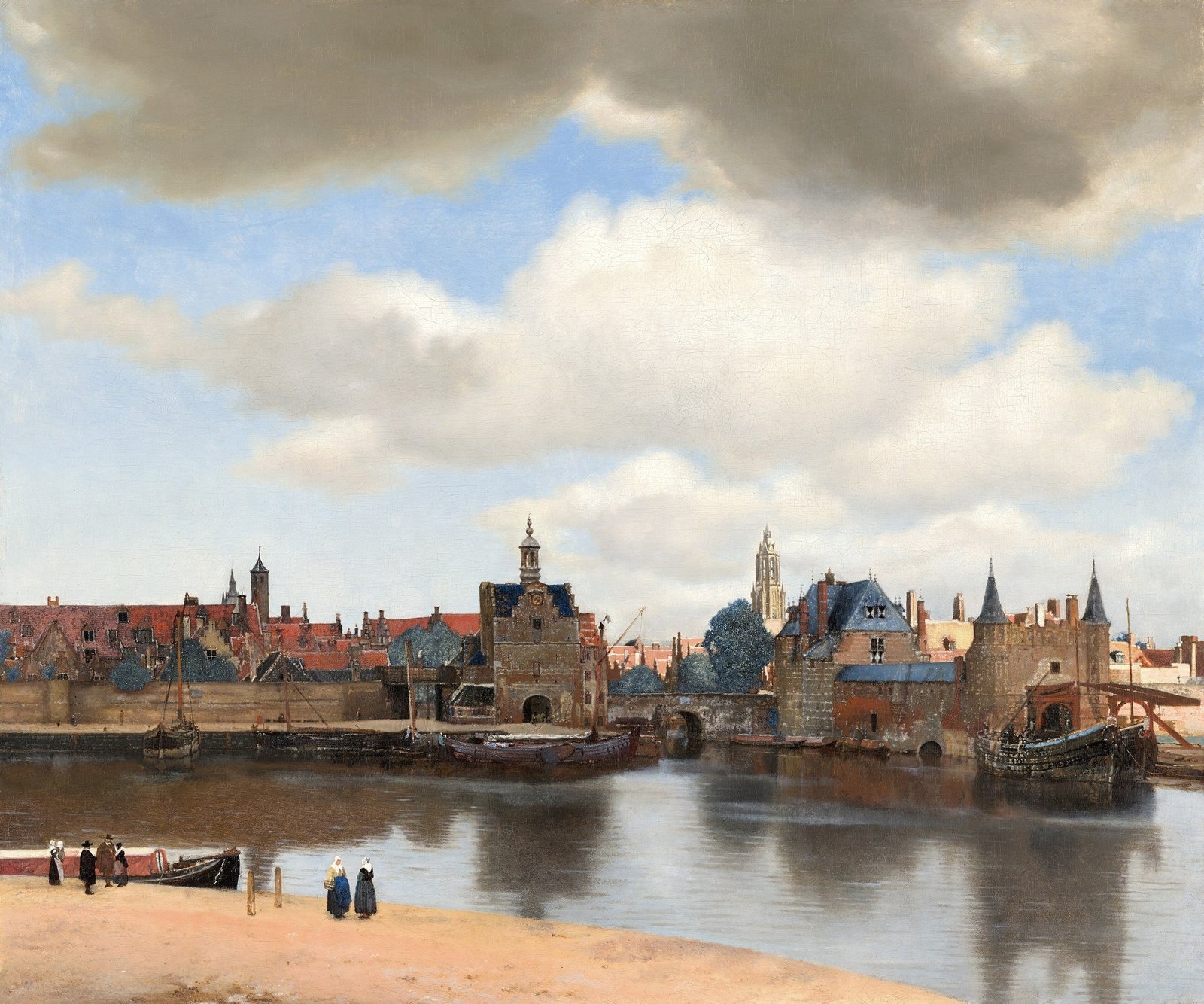
View of Delft
In Proust, the writer Bergotte dies in front of this painting, staring at “a little patch of yellow wall.” The trouble is that nobody knows which patch he meant. Scholars have proposed a roof, a stretch of masonry by the gate, a band of sand. Some argue that no such wall exists on the canvas at all. Proust saw the painting in 1902 and again in 1921, by then gravely ill and carried up the stairs. He died the following year.
Quick Facts
- Artist: Johannes Vermeer (1632–1675)
- Date: c. 1660–1661
- Medium: Oil on canvas
- Dimensions: 96.5 × 115.7 cm
- Movement: Dutch Golden Age
- Location: Mauritshuis, The Hague
What makes it unforgettable?
This is one of only two surviving outdoor scenes by Vermeer. Everything else he painted is interior.
It is routinely described as the finest cityscape in European painting, and not because of its accuracy. The reason is different: Vermeer painted the air. Humidity, temperature, the particular quality of light just after rain. The city is the setting; the subject is the light falling on it.
Notice something easy to miss: two thirds of the town lies in shadow cast by a cloud, while a shaft of sun reaches only the tower of the Nieuwe Kerk and a few roofs on the right. That is not a record of the weather. It is a decision.
What you are actually looking at
The view is from the south, across the harbour basin known as the Kolk, where the Schie canal entered the town.
On the left stands the Schiedam Gate with its clock, which reads around seven in the morning. Beside it is the Rotterdam Gate with its two turrets, the main entrance to Delft from the water. The bridge between them is the Kapelsbrug.
The lit tower in the distance is the Nieuwe Kerk — the New Church, where William of Orange is buried and where members of the Dutch royal family are still interred.
Both gates were demolished in the nineteenth century. Of what you see in the painting, essentially only the church tower still stands.
The viewpoint itself survives. It is marked in Delft with a plaque, and you can stand exactly where Vermeer stood.
Is it accurate?
The answer is more interesting than the question.
Topographical study confirms that the arrangement of buildings is right — Vermeer did not invent the town. But he altered the proportions. He widened the stretch of water, lowered the roofline and stretched the composition horizontally.
The effect is that Delft appears broader and flatter than it is, and the sky gets more room.
Analysis of the shadows and the sun’s position has established the time: early morning, around seven, in summer. The clock on the Schiedam Gate agrees.
The city that survived an explosion
This is context that changes the reading.
On 12 October 1654 the town’s gunpowder magazine exploded. The blast flattened an entire quarter of Delft, killed several hundred people, and was heard on the island of Texel, a hundred kilometres away.
Among the dead was Carel Fabritius — Rembrandt’s most gifted pupil, painter of The Goldfinch, and the artist generally considered Vermeer’s closest predecessor. He died in his studio along with most of his work.
The Delft that Vermeer painted six years later is a rebuilt city. The calm of this painting is not innocent. It comes after something.
What to look for
The sky. More than half the canvas. The clouds are built in layers with real depth, not laid in as a flat backdrop.
The reflections. Blurred, trembling, without sharp edges. This is one of the arguments for Vermeer’s use of a camera obscura — the device produces exactly that softening at the boundaries.
Points of light. On the hulls of the boats and on the brickwork there are small raised dots of lighter paint, known as pointillés. They resemble the circles of confusion produced by a lens. The same effect appears on the bread in The Milkmaid.
The figures. A handful of small figures on the near quay — two women, a group by a boat. Barely indicated, and there purely for scale.
The texture of the wall. By the Rotterdam Gate the paint is applied thickly and roughly, imitating brick. It is the only passage on the canvas with pronounced relief.
The signature. Lower left, on a boat, barely legible: “IVMeer.”
About Johannes Vermeer
Born in Delft in 1632, he never lived anywhere else for any length of time. He ran the inn he inherited from his father and dealt in other painters’ work.
He left around thirty-five paintings — one of the smallest surviving outputs of any major artist. He worked slowly, and a single Delft patron, Pieter van Ruijven, bought most of what he made.
He died in 1675, aged forty-three, leaving a wife and eleven children in debt. His widow had to settle a baker’s bill with paintings.
For nearly two centuries his name effectively did not exist. It returned through the French critic Théophile Thoré-Bürger, who wrote a series of articles about him in the 1860s and called him the Sphinx of Delft.
How it reached The Hague
The painting’s early history is short but has one striking moment.
It appeared at the Dissius auction in Amsterdam in 1696, where twenty-one works by Vermeer were sold. It fetched the highest price of the group — two hundred guilders. Even then it was recognised as his best painting.
Then it disappeared from view for 130 years.
In 1822 it surfaced at auction in The Hague. The Dutch state bought it for 2,900 guilders — a considerable sum at the time, even though almost nothing was known about the painter. It has been in the Mauritshuis ever since.
That purchase was among the first acts that rescued Vermeer from oblivion — two decades before Thoré-Bürger wrote a word about him.
Proust and the yellow wall
This is the episode that built the painting’s modern fame, and it is worth telling properly.
Marcel Proust saw the painting in The Hague in October 1902. He wrote afterwards that from that moment he knew he had seen the most beautiful painting in the world.
In May 1921, by then seriously ill, he went to an exhibition of Dutch painting at the Jeu de Paume in Paris, where the picture was on loan. He had a dizzy spell on the stairs. He went in anyway.
The scene returned in the fifth volume of In Search of Lost Time. The dying writer Bergotte comes to see “a little patch of yellow wall” and realises that he should have written the way Vermeer painted — layer upon layer, until the prose acquired substance.
Which patch he meant is unresolved. A roof on the right, masonry by the gate and a strip of sand have all been proposed; some scholars believe Proust merged memories and that no such wall is there.
Proust died in November 1922, eighteen months after that visit.
Legacy and influence
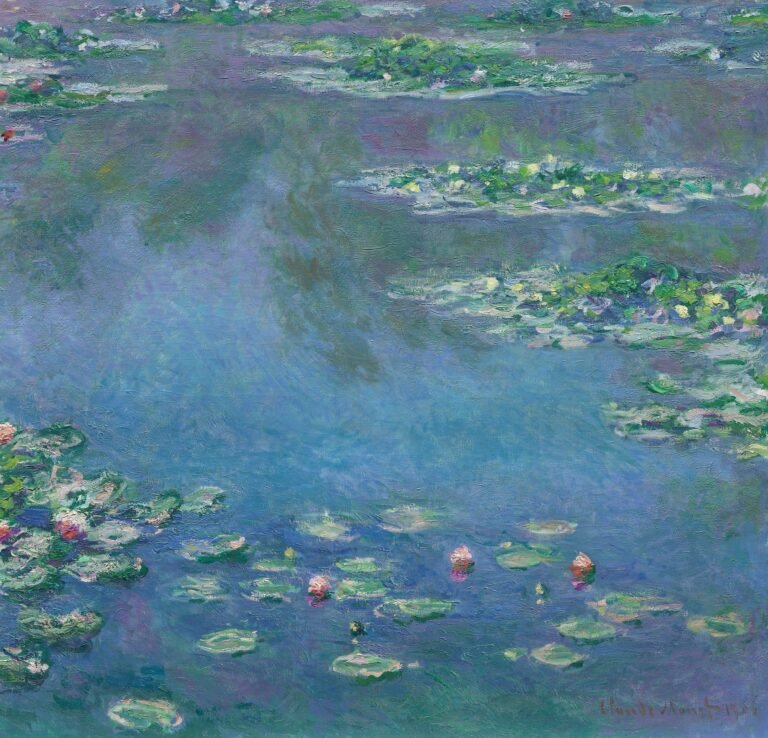
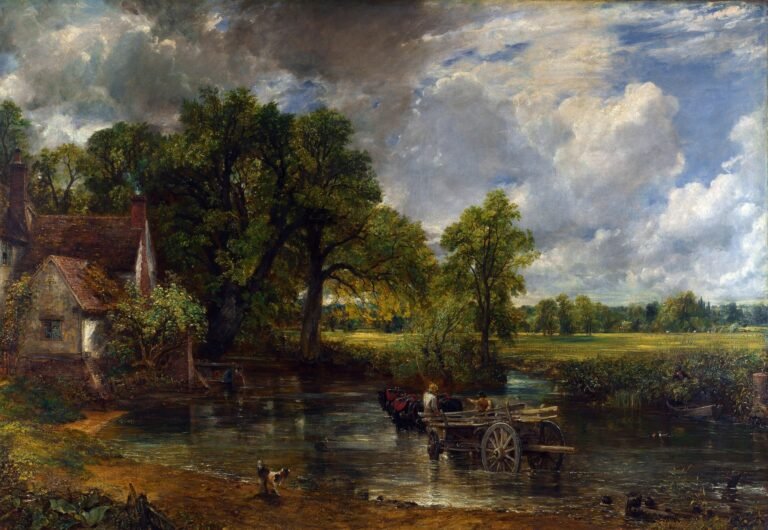
The painting set a benchmark for the depiction of atmosphere. Its echo can be traced in Constable, in the Impressionists’ concern with water and light, and in twentieth-century urban photography.
For the Dutch it is a national icon. During the great Vermeer exhibition at the Rijksmuseum in 2023, the Mauritshuis declined to lend this particular canvas, on the grounds that it should not leave The Hague.
Where to see it today
The painting is at the Mauritshuis, Plein 29, The Hague, a few minutes’ walk from the central station.
- Book online. The museum is small and caps admissions.
- Step back several metres. Close to, the picture breaks into patches; only at a distance does it resolve into air and moisture.
- Then go close and look for the pointillés on the boat hulls.
- Also here: Girl with a Pearl Earring, Rembrandt’s Anatomy Lesson of Dr Nicolaes Tulp, and Fabritius’s The Goldfinch — painted in the year its author was killed by the explosion.
- Two hours is enough for the whole museum. It is dense rather than large.
Delft is worth the trip — fifteen minutes by train. The spot Vermeer painted from is marked with a plaque and a reproduction. The gates are gone, but the tower of the Nieuwe Kerk stands exactly where it does in the painting.
Frequently asked questions
Is this a faithful view of Delft?
The arrangement of buildings is correct, but Vermeer changed the proportions — widening the water and lowering the roofline to gain more sky. Shadow analysis places the scene on a summer morning, around seven o’clock.
What survives of this view today?
Essentially only the tower of the Nieuwe Kerk. Both city gates were demolished in the nineteenth century. The spot Vermeer painted from is marked in Delft.
Did Vermeer use a camera obscura?
There is no direct evidence, but several things point that way: the blurred edges of reflections, the small points of light resembling lens defocus, and the absence of underdrawing. Philip Steadman and David Hockney have both argued the case.
What is the story about Proust?
In In Search of Lost Time the writer Bergotte dies in front of this painting, looking at “a little patch of yellow wall.” Proust saw the picture in 1902 and again in 1921. Which passage he had in mind remains disputed; some scholars think no such wall is there.
How many cityscapes did Vermeer paint?
Two survive: this one and The Little Street, also in Delft. Everything else in his output is an interior.
How did it enter the museum?
The Dutch state bought it at auction in 1822 for 2,900 guilders. It had previously fetched the highest price of the twenty-one Vermeers sold at the Dissius sale of 1696.
If this painting has caught your interest, look next at The Milkmaid and Girl with a Pearl Earring — two paintings by the same artist in which the city is replaced by a single person and the sky by a wall.
Image: View of Delft – Johannes Vermeer (c. 1660–1661). License: Public Domain. Source: Wikimedia Commons.