
Nine Things We Learned About Famous Paintings After Your Textbook Was Printed
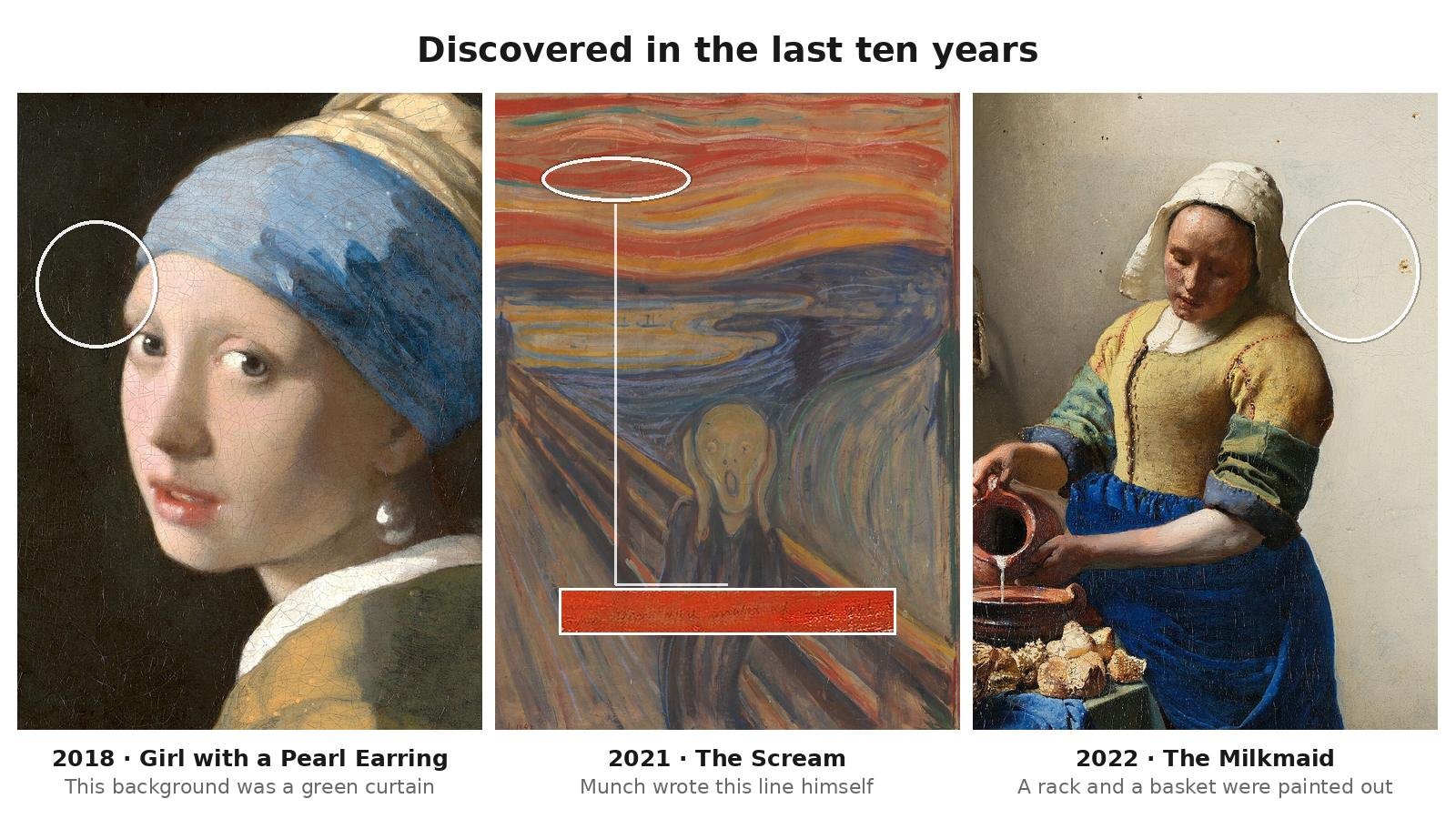
The background of Girl with a Pearl Earring is not black. It was a green curtain, and we have only known this since 2018. The inscription on Munch’s Scream is not vandalism — it is Munch’s own handwriting, confirmed in 2021. The woman in the Mona Lisa was identified beyond reasonable doubt in 2005, in a library in Heidelberg. If you learned about these paintings at school, you learned an earlier version.
Art history is usually presented as settled. It is not. Conservation laboratories, infrared cameras and pigment analysis keep producing findings that overturn what catalogues said a decade earlier — and the reproductions in circulation take years to catch up, if they ever do.
Here are nine cases from the last two decades where the answer changed.
2005 — We finally know who she was
The sitter’s identity in the Mona Lisa was debated for four centuries. Candidates included Isabella of Aragon, Leonardo’s mother, and Leonardo himself in drag.
In 2005 Armin Schlechter, a manuscript specialist at Heidelberg University Library, was cataloguing an incunabulum — a 1477 edition of Cicero’s letters. In the margin, a Florentine official named Agostino Vespucci had written a note dated October 1503, comparing Leonardo to the Greek painter Apelles and mentioning what he was currently working on. One of the works named is a portrait of Lisa del Giocondo.
Vespucci was a clerk in the Florentine chancery and knew Leonardo personally. The note is contemporary, incidental and had no reason to lie.
The question is closed. Most popular writing has not noticed.
Read more: Mona Lisa
2014 — The exact minute Monet started painting
The Musée Marmottan asked Donald Olson, an astrophysicist at Texas State University, to date Impression, Sunrise precisely. He treated the painting as data.
The sun’s height above the horizon puts the moment twenty to thirty minutes after sunrise. The harbour gates are open, which means high tide — large sailing ships could only pass then. Cross-referencing tide tables left nineteen candidate days. Weather records eliminated the stormy ones. The direction of smoke from the chimneys in the painting gave the wind bearing, narrowing it to two.
The answer: 13 November 1872, around 7.35 a.m.
The same analysis settled an old argument. It is sunrise, not sunset.
Read more: Impression, Sunrise
2014 — Someone played the music written on a buttock
In the hell panel of Bosch’s Garden of Earthly Delights, a figure lies crushed beneath a harp. Musical notation is tattooed across his backside — clearly legible, and ignored for five centuries.
In 2014 Amelia Hamrick, an undergraduate at Oklahoma Christian University, transcribed it into modern notation and recorded it. The audio spread rapidly online and prompted several competing transcriptions, since the reading depends on assumptions about fifteenth-century notation.
Nobody had thought to play it.
Read more: The Garden of Earthly Delights
2018 — The background was a green curtain
The Mauritshuis ran a two-week technical investigation on Girl with a Pearl Earring called The Girl in the Spotlight, led by Abbie Vandivere, with the painting on public display inside a glass laboratory.
The findings changed several things:
- The dark background was originally a green curtain, with visible folds. The pigments have degraded, flattening it to near-black
- She has eyelashes. Invisible to the naked eye, they are there
- The pearl has no hook. It is a few strokes of white paint, unattached to anything
- The order of work was established: face first, headscarf and pearl last
- Brush hairs from Vermeer’s own brush remain embedded in the paint
Read more: Girl with a Pearl Earring
2021 — Munch wrote it himself
On the 1893 Scream in Oslo’s National Museum, a pencil line runs across the sky: can only have been painted by a madman.
The standard explanation was vandalism — an outraged visitor, some time after the first showing. In 2021 curator Mai Britt Guleng used infrared imaging to lift the line clearly and compared the letterforms with Munch’s letters and diaries.
It is his handwriting. The museum dates it to 1895, after a medical student named Johan Scharffenberg publicly argued at a discussion evening that Munch’s paintings proved he was not of sound mind.
The artist wrote the accusation onto his own picture.
Read more: The Scream
2021 — AI put back what scissors cut off
In 1715 The Night Watch was moved to Amsterdam’s town hall and did not fit. Strips were cut from all four sides — most heavily from the left, removing two figures entirely. The pieces were never found.
A seventeenth-century copy by Gerrit Lundens, made before the cutting, records what was lost.
In 2021 the Rijksmuseum trained neural networks on Rembrandt’s brushwork using 528 photographs of the original, then had the system generate the missing strips in his manner rather than Lundens’. The results were printed and mounted around the canvas.
The painting is now displayed at its original proportions for the first time since 1715. The added panels are clearly marked.
Read more: The Night Watch
2022 — Two objects Vermeer painted out
The Rijksmuseum examined The Milkmaid using macro X-ray fluorescence, infrared reflectography and hyperspectral imaging ahead of its 2023 Vermeer exhibition.
Beneath the paint surface: a jug rack on the back wall and a fire basket at the woman’s feet. Both were painted by Vermeer and both were painted out by him.
The bare wall that reads as austere restraint is the result of removal, not of a minimal plan.
The same study found underdrawing — bold, quick black strokes laying out the composition. Vermeer had long been assumed not to make them.
Read more: The Milkmaid
2024 — The colours came back
Delacroix’s Liberty Leading the People returned to the Louvre wall on 2 May 2024 after six months of treatment. Layers of yellowed varnish and accumulated grime were removed.
Sébastien Allard, head of the Louvre’s painting department, put it plainly at the time: this is the first generation to rediscover the colour of the painting.
Every reproduction printed before 2024 — which is effectively every reproduction you have seen — shows the earlier state.
Read more: Liberty Leading the People
2024 — The sky is turbulent in the physical sense
The swirls in The Starry Night have been discussed as expression, as symptom, as pure invention.
A study published in Physics of Fluids in September 2024 measured them. Researchers analysed the scale and brightness distribution of the eddies and compared them with Kolmogorov’s theory of turbulent flow, which describes how energy cascades from large vortices to small ones in real fluids.
The distribution matches. At the smaller scales it also fits Batchelor scaling, which governs the mixing of passive scalars in turbulent flow.
Van Gogh had no access to this theory — Kolmogorov published in 1941. He painted from observation, at night, from memory, and produced a mathematically consistent turbulent field.
Read more: The Starry Night
What keeps being revised
Three patterns run through these cases.
Colour is the least stable thing about old paintings. Red lakes fade, chrome yellows brown, varnish yellows, green copper pigments turn dark. The palette you see is rarely the palette that was applied. Van Gogh’s bedroom walls were violet, not blue. His sunflowers were brighter.
Artists painted things out, and we are now able to see them. Imaging technology has made the discarded stages of a picture visible — which turns a finished work back into a record of decisions.
The reproduction lags behind. Museums publish their findings. Textbooks, posters and stock image libraries do not update. The gap between what is known and what circulates runs to decades.
Related: Which version are you looking at? Famous artworks that exist in multiples
What you learned about these paintings was true when it was written. That is a different thing from being true now.
