Which Version Are You Looking At? Famous Artworks That Exist in Multiples
Van Gogh painted The Bedroom three times. Munch made four versions of The Scream, and only one of them carries the pencil inscription in the clouds. Rodin’s The Thinker exists in twenty-eight authorised bronzes and no single original. If you have travelled to see a famous painting and found something slightly different from the reproduction you knew, this is usually why.
Reproductions flatten a problem that museums live with daily: a great many famous artworks are not single objects. They exist in multiples – repeated by the artist, cast after his death, printed in editions, or copied in the same workshop. The differences are often small enough to miss and large enough to matter.
This guide sorts them into six kinds, with the specific details that let you tell one version from another.
Quick reference
| Work | Versions | Where |
|---|---|---|
| The Bedroom | 3 paintings | Amsterdam, Chicago, Paris |
| The Scream | 2 paintings, 2 pastels, 1 lithograph | Oslo (two museums) |
| Sunflowers (Arles) | 7 painted, 6 survive | London, Amsterdam, Munich, Philadelphia, Tokyo, private |
| The Tower of Babel | 2 surviving, 1 lost | Vienna, Rotterdam |
| The Thinker | 28 large bronzes | Worldwide |
| Little Dancer | 1 wax, some two to three dozen bronzes | Washington + worldwide |
| Maja | 2 paintings, a pair | Madrid, same room |
| Mona Lisa | 1 + a workshop copy | Paris, Madrid |
1. Paintings the artist made more than once
Van Gogh’s Bedroom – three, and the walls were never blue
The first version of The Bedroom was painted in Arles in October 1888, while Van Gogh was preparing the Yellow House for Gauguin’s arrival. In 1889, while he was in hospital, the canvas was damaged by damp. It went to Theo in Paris for restoration, and Vincent – by then in the asylum at Saint-Rémy – painted two replicas from it: one the same size, one smaller for his mother and sister.
- Amsterdam, Van Gogh Museum – the original, October 1888
- Chicago, Art Institute – September 1889, same size
- Paris, Musée d’Orsay – 1889, noticeably smaller at 57 × 74 cm
How to tell them apart: the wall colour and the floor differ, but the reliable marker is the pair of framed portraits above the bed. They are different pictures in each version.
One thing applies to all three. The walls were not blue. Pigment analysis shows Van Gogh mixed a red lake into the blue to make violet, and in a letter written in French he described the walls as violet pâle – pale violet. The red component is light-sensitive and has faded. The doors and skirting, now reading as blue, were originally violet-pink.
The Scream – four, and only one is inscribed
Munch made two paintings, two pastels and a lithograph of The Scream between 1893 and 1910. All are in Oslo, split between two institutions: the National Museum and the Munch Museum. Neither holds the complete set, and neither shows everything at once.
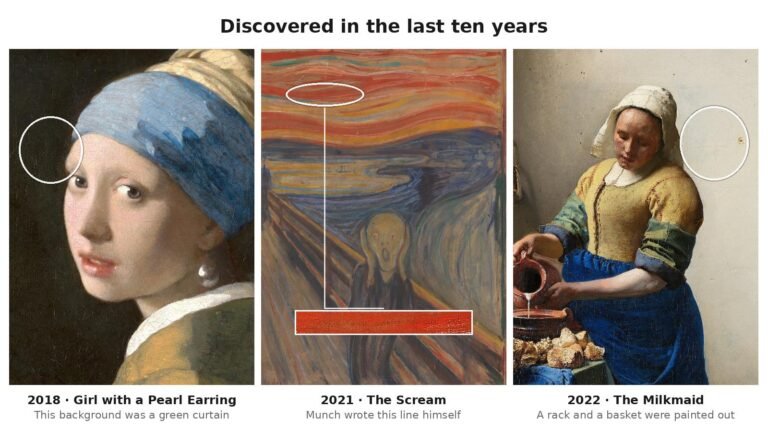
The 1893 painting in the National Museum carries a pencil line in the sky, upper left: can only have been painted by a madman. For decades it was assumed to be graffiti by an offended visitor. Infrared analysis published in 2021 compared the handwriting with Munch’s letters and diaries. He wrote it himself, most likely in 1895, after a medical student publicly questioned his sanity.
No other version has it.
Sunflowers – seven, one burned
The Arles series of Sunflowers runs to seven canvases. Six survive.
The seventh, Five Sunflowers, was bought in 1920 by the Japanese businessman Koyata Yamamoto and kept at his house in Ashiya, near Kobe. On 6 August 1945 the house was destroyed in an air raid. The painting was lost with it. It is known today only from black-and-white photographs taken before the war.
A different version, Vase with Fifteen Sunflowers, was bought at Christie’s in 1987 by Yasuda Fire & Marine Insurance for £24.75 million – then a record for any painting. It hangs in the Sompo Museum of Art in Tokyo.
The Tower of Babel – two sizes, two moods
Bruegel painted The Tower of Babel at least three times. A miniature on ivory, made in Rome with Giulio Clovio, is lost. Two panels survive:
- Vienna, Kunsthistorisches Museum – 114 × 155 cm, with a king and kneeling stonemasons in the foreground
- Rotterdam, Museum Boijmans Van Beuningen – 60 × 74.5 cm, without the large foreground scene: the tower is further advanced and fills more of the panel, the figures are tiny, the palette darker and redder, the sky already turning
The Rotterdam museum has been closed for renovation; check before travelling.
2. Different paintings with confusingly similar names
Starry Night is not Starry Night Over the Rhône
These are two separate works, made ten months apart, in different towns, by different methods.
- Starry Night Over the Rhône – September 1888, Arles. Painted outdoors at night on the riverbank by gaslight. Musée d’Orsay, Paris.
- The Starry Night – June 1889, Saint-Rémy. Painted indoors, in daytime, from memory and sketches; Van Gogh was not permitted to paint in his bedroom. Museum of Modern Art, New York.
The Rhône painting is a night view of a real place. The famous one, The Starry Night, is a reconstruction.
Degas painted The Dance Class twice
Both versions of The Dance Class grew out of a single commission from the singer Jean-Baptiste Faure, agreed in 1872. Degas first began the picture now in Paris, set it aside after several revisions, and in the autumn of 1874 turned to the one now in New York, which he delivered to Faure that November. He finished the Paris version later.
- New York, Metropolitan Museum – 1874, 83.5 × 77.2 cm
- Paris, Musée d’Orsay – 1873–76, 85 × 75 cm
The compositions are close, and both include the ballet master Jules Perrot. The quickest way to tell them apart: in Paris, Perrot stands at the centre; in New York, he stands at the right, watching a dancer in a pink sash.
3. Prints, where no original exists at all
This is the category most often misunderstood. A Japanese woodblock print is not a reproduction of something else. The print is the work – and it was made by four people, not one.
The artist supplied a drawing. A carver cut the blocks. A printer inked and pressed them. A publisher commissioned and sold the result. Hokusai and Hiroshige never touched the woodblocks.
Impressions from the same blocks differ considerably:
- Early impressions have sharp lines; later ones are blurred by block wear
- Gradations were rubbed by hand on the block for each pull, so no two skies are identical
- Colour schemes changed between print runs
Hokusai’s Fine Wind, Clear Morning is the clearest case. Collectors distinguish the rare early Pink Fuji from the familiar Red Fuji. The scholar Roger Keyes considered the pink impressions the earliest, and closest to Hokusai’s intention, and a scientific study published in 2019 confirmed that they were printed first. In the later state the sky became a strong, even blue, an additional block tinted the white clouds at the horizon light blue, and the mountain was printed in a strong red earth pigment called bengara. The image everyone knows may be the commercial revision.
The same logic applies to The Great Wave off Kanagawa, from the same series: dozens of impressions survive in museums around the world, and none of them is the original.
4. Sculpture, where casting is the whole question
The Thinker – 28 bronzes, two sizes
The Thinker began in 1880 as a 70 cm element of The Gates of Hell, seated on the lintel. Rodin enlarged it to roughly 180 cm in 1904.
Twenty-eight large bronzes exist. Around ten were cast under Rodin’s supervision; the rest were made after his death by the Musée Rodin, to which he had left his reproduction rights.
One of them stands on Rodin’s own grave at Meudon. Another, outside the Cleveland Museum of Art, was bombed in March 1970 and has been left damaged ever since.
Little Dancer – the original is wax, and it is in Washington
What Degas exhibited in 1881 as Little Dancer of Fourteen Years was a wax figure with real hair, a fabric bodice, a tutu, ballet slippers and a ribbon. It is the only sculpture he showed publicly in his lifetime.
He never had it cast. After his death in 1917, his heirs – with the help of his friend, the sculptor Albert Bartholomé – commissioned the Hébrard foundry in Paris to cast bronzes from the waxes found in his studio. The Little Dancer was cast from the 1920s onwards; sources disagree on the exact number, but it is usually put at two to three dozen, including proofs.
The wax is at the National Gallery of Art, Washington. Everything else is posthumous – and the fabric skirts on the bronzes are periodically replaced, so they are not nineteenth-century textiles.
5. Pairs designed to be seen together
The two Majas were never painted as a set
This is the common assumption and it is wrong. The Nude Maja was already in Godoy’s private cabinet in 1800, recorded on its own. The Clothed Maja appears in the records only in 1808, in the inventory of Godoy’s confiscated property.
The most famous story about them – that the clothed version hung in front of the nude, on a pulley mechanism that slid it aside – is repeated almost everywhere. No contemporary document supports it. The inventories list the two paintings; they say nothing about a device.
Both are now in the Prado, hanging side by side – the only arrangement in which we know for certain they were meant to be compared.
6. Versions you cannot see
Some exist and are simply unavailable.
Renoir’s second Bal du moulin de la Galette – 78 × 114 cm, not a sketch – sold at Sotheby’s on 17 May 1990 for $78.1 million to Ryoei Saito, chairman of Daishowa Paper. Two days earlier the same buyer had paid $82.5 million for Van Gogh’s Portrait of Dr Gachet. He later said he wanted both cremated with him, a remark he withdrew after international protest. He died in 1996. The Renoir was sold privately and has not been publicly exhibited since. Its location is not disclosed.
The Prado Mona Lisa is a different case. Long dismissed as a later copy, it was restored in 2011–12 and the black overpaint removed from the background. Underdrawing analysis showed that its corrections track Leonardo’s own, stroke for stroke – meaning it was painted alongside the original, in the same studio, by a pupil. It is the closest thing we have to seeing the Mona Lisa without four centuries of varnish.
What this means before you travel
- Check which version a museum actually holds. Three institutions can all legitimately claim to have The Bedroom.
- Works on paper are not on permanent display. Prints, drawings and pastels are shown for limited periods. This applies to every Japanese print in this guide.
- Loans happen. Major works travel, sometimes for months.
- For prints, compare online first. Museum image archives let you set impressions side by side – something you cannot do in any single gallery.
The reproduction you carry in your head came from somewhere. It is worth knowing where.