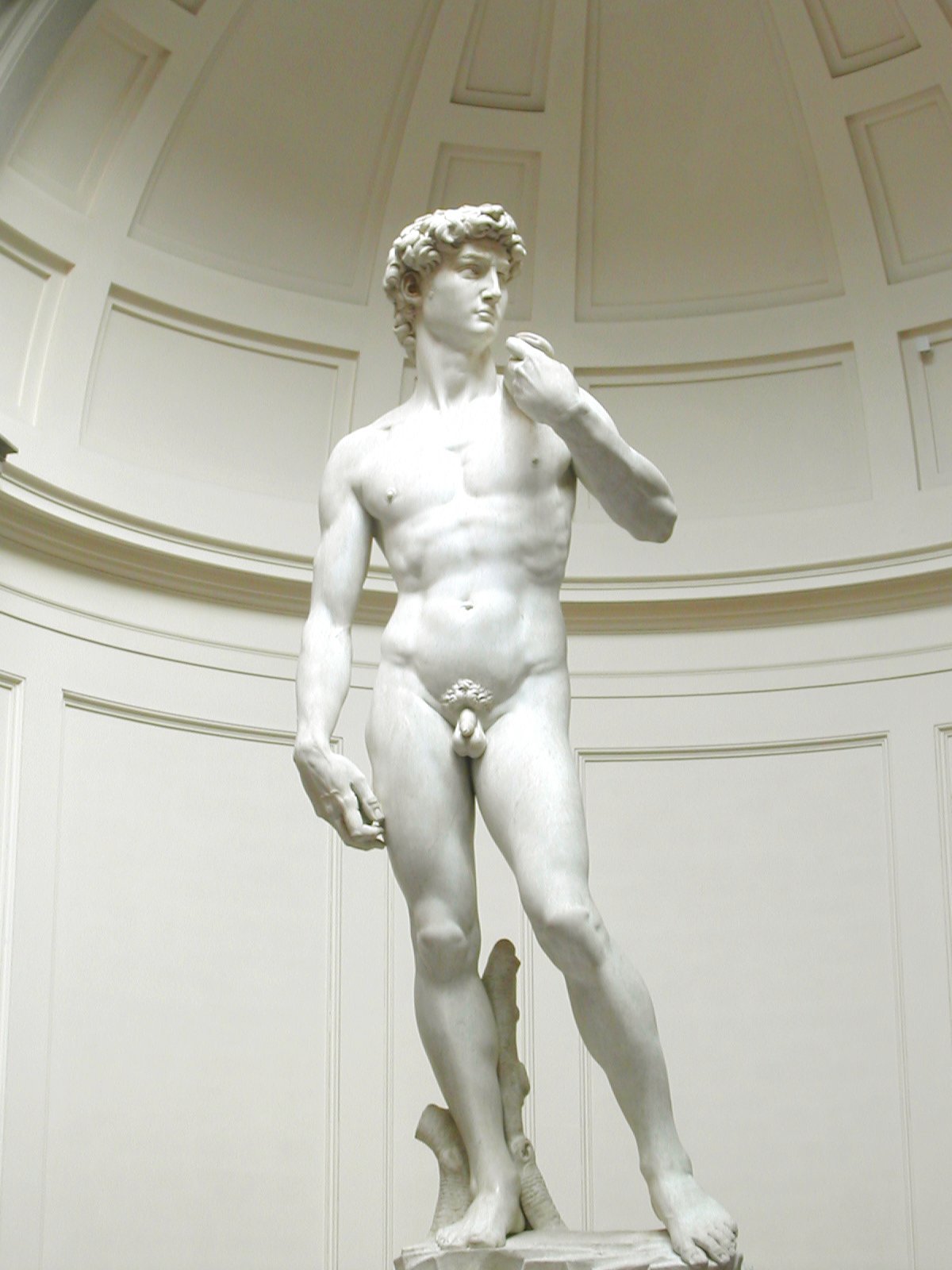
Michelangelo’s David
Most people assume Michelangelo’s David depicts a triumphant hero standing over a defeated giant – but the sculpture actually captures the moment before the battle, when David is tense, calculating, and weighing what he is about to do.
Quick Facts
- Artist: Michelangelo
- Year: 1501–1504
- Medium: Carrara marble
- Dimensions: 5.17 metres (approximately 17 feet) tall, weighing around 5.5 tonnes
- Movement: Renaissance
- Current location: Galleria dell’Accademia, Florence
What Makes Michelangelo’s David So Unforgettable?
Plenty of sculptures show warriors after their victories. Every earlier Florentine David did exactly that – Donatello’s, Verrocchio’s, Ghiberti’s, each with Goliath’s severed head underfoot. Michelangelo chose something far more daring. He froze David in the seconds before the sling flies – muscles coiled, jaw set, eyes locked on an enemy we cannot see. That psychological intensity is what separates this work from everything that came before it.
At 5.17 metres tall, Michelangelo’s David is physically overwhelming. However, sheer scale alone never made a masterpiece. What keeps visitors rooted to the spot is the combination of raw physical power and visible inner tension – and standing still in front of it is exactly the right response, because the research on how people actually look at art suggests the works that stay with us are the ones we return to rather than pass. The veins on the hands are raised. The brow is furrowed. The body leans almost imperceptibly forward. Every detail whispers that something enormous is about to happen.
In addition, Michelangelo carved this figure from a single block of marble that other sculptors had already attempted – and abandoned. The block was famously narrow and awkward. The fact that he pulled a figure of this complexity from such a compromised piece of stone is, in itself, a jaw-dropping achievement.
Historical Context
Florence in 1501 was a city in political flux. The powerful Medici family had been expelled in 1494, and the republic was working hard to project strength and civic pride. A colossal statue of the biblical hero David – a young underdog who defeated a mighty oppressor – carried obvious political meaning.
Michelangelo was only 26 years old when he accepted the commission. The original plan placed the statue high on the roofline at the east end of Florence Cathedral, alongside a series of twelve prophets. However, once city officials saw what Michelangelo had created, they changed course entirely. In January 1504 the city convened a committee of around thirty people – Leonardo da Vinci, Botticelli and Giuliano da Sangallo among them – which debated nine possible locations. Moving the finished statue the half mile from Michelangelo’s workshop took forty men and four days. On 8 September 1504, Michelangelo’s David was unveiled in the Piazza della Signoria, the very heart of Florentine civic government.
This was also a pivotal moment in the High Renaissance. Artists were pushing beyond medieval conventions, rediscovering classical Greek and Roman ideals of the human body, and exploring human emotion with new ambition. Michelangelo’s David became the defining statement of that movement – the first colossal marble statue made since classical antiquity.
Symbolism and What to Look For
When you stand in front of Michelangelo’s David, start by looking at the hands. They are oversized – far larger than strict anatomical proportion would dictate, and so is the head. The main reason is practical rather than symbolic: the statue was designed to sit more than twelve metres up on the cathedral roofline, where a viewer craning from street level would lose ordinary proportions to the angle. Michelangelo enlarged what mattered most. When the placement changed to ground level, he left the proportions alone rather than reworking the marble. Some scholars add a second reading on top of that – that the outsized right hand deliberately signals the pondered action, and echoes the traditional epithet for David, manu fortis, strong of hand.
Next, notice the eyes. David is not looking at you. His head turns sharply to his own left – your right, as you face him – fixed on something distant and threatening. The pupils are carved out as deep, heart-shaped hollows that catch the light and give the gaze an almost living intensity. It is one of the most arresting faces in all of sculpture.
Look at the contrapposto stance – the classical pose where the weight shifts onto one leg, creating a subtle S-curve through the body. David’s weight rests on his right leg, braced against the tree stump behind it; the left leg is relaxed and set slightly forward, the hip and shoulder tilting in response. This imbalance makes the figure feel alive, as though he might shift his weight at any moment.
Finally, look for the sling. It runs over David’s left shoulder and down his back – easy to miss at first glance. The stone sits ready in his right hand. These small details anchor the narrative and remind us exactly what is about to happen.
About Michelangelo
Michelangelo di Lodovico Buonarroti Simoni was born in 1475 in Caprese, a small town in Tuscany. He trained in Florence under the painter Ghirlandaio before entering the orbit of Lorenzo de’ Medici, where he absorbed classical sculpture and humanist philosophy in equal measure.
He considered himself primarily a sculptor, even though the Sistine Chapel ceiling – painted between 1508 and 1512, and home to The Creation of Adam – is arguably his most famous single work. He also worked as an architect, designing the Laurentian Library and contributing to St. Peter’s Basilica in Rome.
Michelangelo lived to the age of 88, working almost until his final days. His influence on Western art is simply immeasurable. He raised the bar for what the human body could express in stone, and no sculptor since has entirely escaped his shadow.
Legacy and Influence
Michelangelo’s David set a new standard for monumental sculpture that echoed through the centuries. Artists from Bernini to Rodin studied it closely. Therefore, its influence appears not just in later sculpture but in the way painters began to approach the male figure – with greater psychological depth and physical specificity.
Culturally, the statue became a symbol of Florence itself, and later a global icon of Renaissance achievement. Today, reproductions appear everywhere – from art schools and public squares to tourist shops and cultural shorthand for artistic perfection. A marble replica has stood in the Piazza della Signoria since 1910, on the spot where the original stood for 369 years.
For example, when nineteenth-century artists sought to push beyond academic convention, many did so precisely by reacting against the idealized perfection that Michelangelo’s David represented. Its influence, in other words, shaped even the art made in opposition to it.
The Statue Has Not Had an Easy Life
For a figure carved to embody invulnerability, David has taken a remarkable amount of punishment. Stones were thrown at it during its first year in the square. On 26 April 1527, during an anti-Medici uprising, rioters occupying the Palazzo Vecchio hurled furniture from the windows at the soldiers below; a bench struck David and broke his left arm into three pieces. The fragments lay in the piazza for days before they were gathered up, and the arm was reattached. Giorgio Vasari, who wrote the story down, claimed he was one of the boys who ran into the fighting to collect them.
Lightning struck the statue in 1512. Weather, pigeons and three and a half centuries outdoors did the slow damage that finally prompted the move indoors. And in September 1991 a man smuggled a hammer into the Accademia and shattered the second toe of the left foot before visitors wrestled him down; the fragments were recovered and the toe repaired.
The current worry is quieter. David leans very slightly forward, and almost six tonnes of marble rest on two slender ankles that carry fine fractures. The vibration from millions of pairs of feet crossing the gallery floor each year is monitored for exactly this reason.
Where to See Michelangelo’s David Today
The original statue has lived in the Galleria dell’Accademia in Florence since 1873, when it was moved indoors to protect it from weather damage. The museum built a purpose-designed tribune – a domed rotunda – specifically to house it. The effect of walking toward it down that long gallery is genuinely theatrical.
Book tickets well in advance, especially in summer. The queues without reservations can run several hours. First thing in the morning or late afternoon tends to be quieter. The museum also holds a remarkable collection of Michelangelo’s unfinished “Prisoners” sculptures, which line the corridor leading to David – a perfect warm-up for the main event.
Nearby, the Uffizi Gallery is a short walk away and holds masterworks by Botticelli, Leonardo, and Raphael. The Bargello Museum, also close by, displays Donatello’s earlier bronze David – a fascinating comparison that shows how radically Michelangelo reimagined the same subject.
Frequently Asked Questions
Where is Michelangelo’s David located?
The original statue is permanently housed in the Galleria dell’Accademia in Florence, Italy. A replica stands in the Piazza della Signoria, where the original was displayed from 1504 to 1873.
When was Michelangelo’s David created?
Michelangelo worked on the sculpture from September 1501 to early 1504. It was publicly unveiled on 8 September 1504.
Why are David’s hands and head so large?
Because of where the statue was supposed to end up. The commission called for it to stand more than twelve metres above the ground on the roofline of Florence Cathedral, seen from street level at a steep angle. Michelangelo enlarged the head and hands so they would still read correctly from that distance. The statue never went up there, and he never adjusted the proportions – which is why they look slightly heavy at eye level.
What does Michelangelo’s David represent?
On a biblical level, it depicts the young shepherd David from the Old Testament, moments before his battle with the giant Goliath. For Renaissance Florence, it symbolized civic courage, republican virtue, and the triumph of intelligence over brute force.
Why is Michelangelo’s David so famous?
Its fame comes from a combination of extraordinary technical skill, psychological realism, and cultural timing. It was the first colossal marble statue since antiquity, it redefined what sculpture could express emotionally, and it arrived at a moment when Florence was hungry for a powerful civic symbol.
Has Michelangelo’s David ever been damaged?
Several times. A bench thrown from the Palazzo Vecchio during the anti-Medici riot of April 1527 broke his left arm into three pieces, which were later recovered and reattached. Lightning hit the statue in 1512. In September 1991 a vandal with a hammer shattered the second toe of the left foot, which was repaired. The ankles carry fine fractures and are monitored to this day.
What happened to the original marble block before Michelangelo used it?
The block had been quarried in Carrara decades earlier and was nicknamed “the Giant.” Two earlier sculptors – Agostino di Duccio and Antonio Rossellino – had both attempted to work with it and given up. Michelangelo took on the damaged, awkward block in 1501 and transformed it into one of the greatest sculptures ever made.
Michelangelo’s David is just one of countless works waiting to reshape how you see the world. Explore our guides to other Renaissance masterpieces, iconic sculptures, and the museums that house them – there is always more to discover right here on the site.
Image: Michelangelo’s David – Michelangelo (1504). License: Public Domain. Source: Wikimedia Commons.