Pantheon
This dome is still the largest unreinforced concrete dome in the world. Not “was” — is. After nineteen centuries, nobody has built a bigger one without steel inside it. The Romans managed it by varying the concrete as they went: heavy travertine aggregate at the base, and at the crown, pumice light enough to float on water.
Quick Facts
- Architect: unknown
- Date: c. 113–125 AD, under Hadrian
- Medium: Roman concrete (opus caementicium), brick, granite, bronze
- Dimensions: dome diameter 43.3 m; floor to oculus 43.3 m
- Oculus: 8.8 m across, open to the sky
- Movement: ancient Roman architecture
- Location: Piazza della Rotonda, Rome
What makes the Pantheon unforgettable?
This is not a ruin. You walk in through the original bronze doors and stand where Romans stood under Hadrian. Most ancient temples survive as foundations and reconstruction drawings; this one survives as a building.
The geometry is the key. Diameter and height to the oculus are identical — 43.3 metres — which means a perfect sphere fits inside the rotunda, touching the floor and the crown simultaneously. That is not a by-product of construction. It is the design.
At the apex is the oculus, nearly nine metres across, the only source of light in the building. There is no glass in it. There never has been.
How it stands up
The dome weighs around 4,500 tonnes and contains no steel at all. The Romans solved the load problem several ways at once.
Graduated aggregate. The foundations use heavy travertine. Higher up it becomes tuff, then light brick, and at the oculus, pumice. The material gets lighter exactly where the structure needs it to.
Graduated thickness. The dome is more than six metres thick at the base and under one and a half at the crown.
Coffers. The 140 recessed panels are not only decorative — they remove mass without compromising the shell.
The oculus as structure. The opening relieves the weakest point of a dome and creates a compression ring that holds the whole thing together.
It is worth adding that Roman concrete still surprises researchers. Analysis published in 2023 by a team at MIT found that the lime clasts in Roman mortar — long dismissed as sloppy mixing — act as a self-healing mechanism. When a crack forms and water reaches them, they release calcium that seals the gap. It is one reason this dome is still standing.
Historical context
The Pantheon was built under Hadrian, an emperor who travelled his empire, took a serious interest in architecture, and probably had a hand in the design himself. Brick stamps push the start of construction back to around 113–115 AD, under Trajan.
This was not the first building on the site. Agrippa built a temple here around 27 BC; it burned, was rebuilt by Domitian, and burned again.
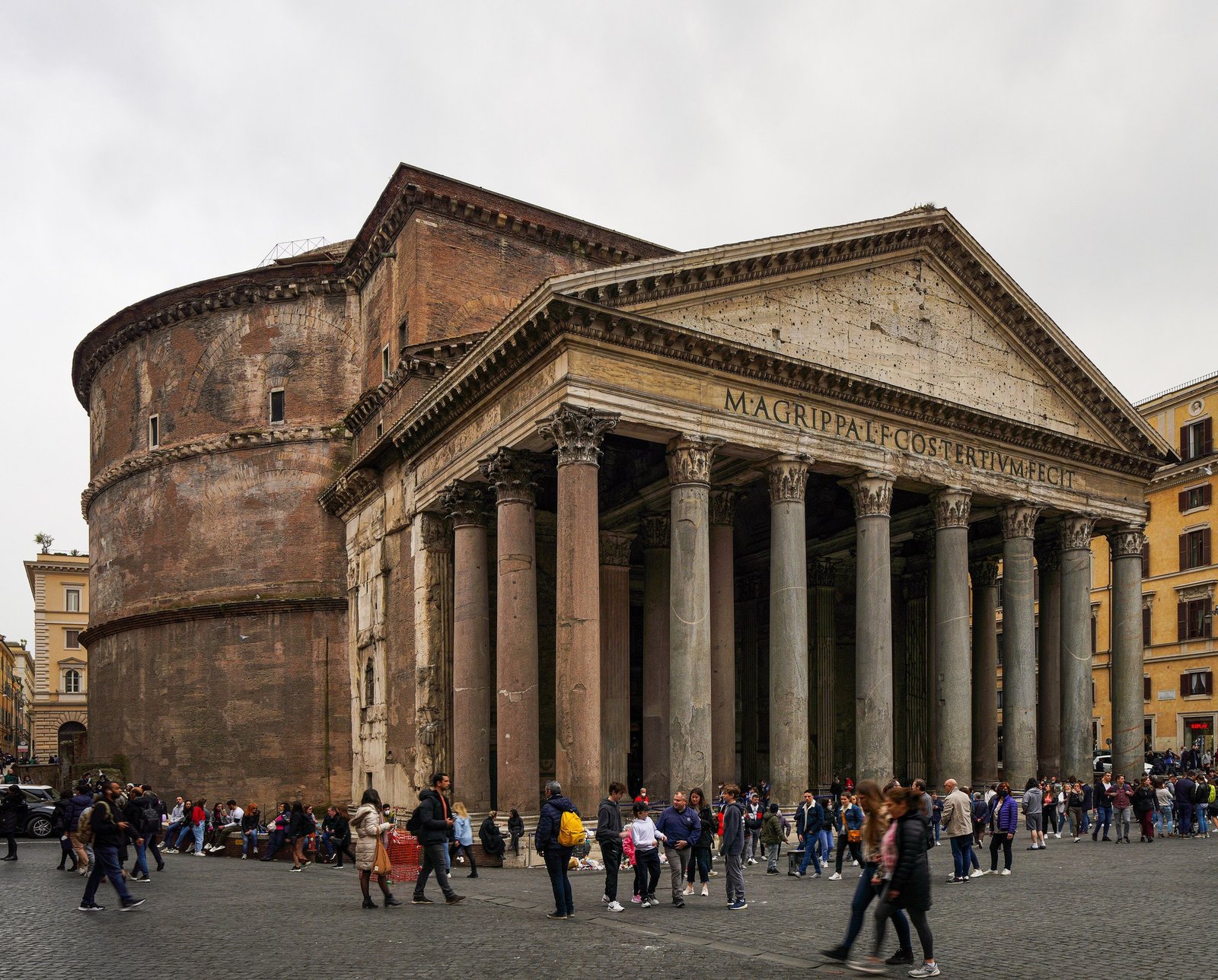
The façade carries the inscription M·AGRIPPA·L·F·COS·TERTIUM·FECIT — “Marcus Agrippa, son of Lucius, consul for the third time, built this.” Hadrian kept his predecessor’s inscription on a building he had raised from nothing. For fifteen centuries this misled everyone about the date.
In 609 AD Pope Boniface IV consecrated it as the church of Santa Maria ad Martyres. That decision saved it — Roman temples were being quarried for building material at the time. The Pantheon survived by ceasing to be pagan.
It did not escape unharmed. In 663 the emperor Constans II stripped the gilded bronze tiles from the roof. In 1626 Pope Urban VIII removed the bronze from the portico and had it melted down — by tradition, for Bernini’s baldachin in St Peter’s. That gave Rome the saying: what the barbarians did not do, the Barberini did.
What to look for
The portico columns. Sixteen monoliths of Egyptian granite, twelve metres tall, weighing around sixty tonnes each. They were quarried at Mons Claudianus in the Eastern Desert, dragged over a hundred kilometres to the Nile, floated to Alexandria and shipped to Ostia. Each column was a separate logistical operation.
The oculus as a clock. The beam of light tracks across the interior through the day and up the walls through the year. On 21 April — the traditional founding date of Rome — it falls at midday directly on the entrance. If you are in Rome that day, it is worth seeing.
The rain. There is no glass in the oculus, so it rains inside. The floor is slightly convex and contains twenty-two concealed drainage holes. The system has worked for nineteen centuries.
The floor. Largely original, in porphyry, granite and yellow Numidian marble.
Raphael’s tomb. Third niche on the left. The epitaph by Bembo says that while he lived, nature feared to be outdone, and when he died, feared to die with him. The tomb was opened in 1833 to confirm he was actually in it.
The royal tombs. Victor Emmanuel II and Umberto I, the first kings of unified Italy. Monarchist volunteers still keep watch there.
Who designed it
We do not know. This is one of the paradoxes of architectural history: the best-preserved building of antiquity has no attributed architect.
Apollodorus of Damascus is the usual candidate — Trajan’s architect, who built Trajan’s Forum and the bridge over the Danube. The scale and daring fit, and construction began under Trajan. There is no proof.
Cassius Dio records an anecdote in which Apollodorus criticised a temple design by Hadrian himself, saying the statues would hit their heads on the vault if they stood up — and that the emperor had him executed for it. Historians treat the story cautiously, but it says something about how the relationship between emperor and architect was perceived.
Legacy and influence
Brunelleschi studied it before designing the dome of Florence Cathedral. Palladio modelled façades on it. Its echo runs through Jefferson’s Rotunda at the University of Virginia, the Panthéon in Paris, the US Capitol, and hundreds of banks, museums and libraries worldwide.
Michelangelo is said to have described it as the work of angels rather than men.
The record for dome span fell in 1436, when Brunelleschi closed the vault in Florence. But that dome is octagonal and built of brick. In unreinforced concrete, the Pantheon has never been beaten.
Visiting
The Pantheon stands in the Piazza della Rotonda in central Rome. Nearest metro: Barberini or Spagna, then fifteen minutes on foot.
- Admission has been charged since 2023 — a few euros, with timed online booking. Residents of Rome and anyone attending Mass enter free. Check current prices and hours on the official site before you travel.
- Come at opening. By eleven the rotunda is crowded.
- Come in the rain. This sounds perverse, but watching water fall through the oculus and vanish into the floor is one of the more extraordinary architectural experiences available anywhere.
- Stand directly beneath the oculus and look up. The coffers taper towards the crown, which exaggerates the height.
- At Pentecost, rose petals are dropped through the oculus. Book well in advance.
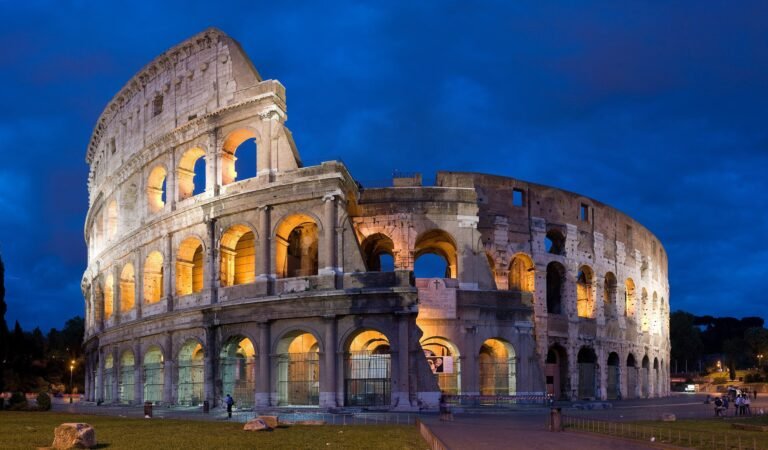
Nearby: Piazza Navona with Bernini’s fountain (five minutes), Campo de’ Fiori, and Borromini’s Sant’Ivo alla Sapienza. If you want to compare how Romans built for crowds and how they built for gods, the Colosseum is twenty minutes’ walk.
Frequently asked questions
Who built the Pantheon?
The present building was raised under Hadrian, around 113–125 AD. The architect is unknown; Apollodorus of Damascus is the most frequent suggestion. The inscription names Agrippa, but refers to an earlier temple that burned down.
Does rain come through the oculus?
Yes. There is no glass. The floor is slightly convex and has twenty-two concealed drains that have been carrying the water away since Roman times.
Why hasn’t the dome collapsed?
A combination of things: the concrete gets lighter towards the top (travertine to pumice), the shell thins from six metres to under one and a half, the coffers remove mass, and the oculus relieves the crown. Research published in 2023 also showed that Roman mortar can self-heal cracks.
Is it still the largest dome in the world?
In its category, yes — it remains the largest unreinforced concrete dome ever built. Larger domes exist, but all of them rely on steel or another supporting structure.
Who is buried there?
Raphael, the painters Annibale Carracci and Baldassare Peruzzi, and two kings of unified Italy: Victor Emmanuel II and Umberto I.
Is admission free?
No longer. Since 2023 there is a small charge, though the Pantheon was one of Rome’s few free major sites before that. Booking online is advisable.
If the Pantheon has caught your interest, look next at the Colosseum — built in the same era from the same concrete, but for the opposite purpose: not to make you look at the sky, but to make fifty thousand people look down.
Image: The Pantheon, Rome (c. 113–125 AD). License: Public Domain. Source: Wikimedia Commons.