The Starry Night
Most people don’t realize that when Vincent van Gogh painted The Starry Night in June 1889, he was doing so from the confines of a psychiatric asylum — and that the tranquil, swirling village below those famous heavens never actually existed.
Quick Facts
- Artist: Vincent van Gogh
- Year: 1889
- Medium: Oil on canvas
- Dimensions: 73.7 cm × 92.1 cm (29 in × 36¼ in)
- Movement: Post-Impressionism
- Current Location: Museum of Modern Art (MoMA), New York City
What Makes The Starry Night So Unforgettable?
There are thousands of paintings of night skies. So why does this one stop people cold? The answer isn’t simply beauty — it’s emotional honesty rendered visible. Van Gogh didn’t paint what the sky looks like. He painted what the sky feels like when your mind is alive with energy, dread, wonder, and longing all at once.
Here is the detail that reframes everything: the night in this painting was never painted at night. Van Gogh worked on the canvas across several daytime sessions, under ordinary Provençal daylight, reconstructing a pre-dawn sky from memory. The most famous night scene in Western art is a work of recollection, not observation.
The swirling brushwork creates a sky that genuinely moves. Stand in front of the original at MoMA and the atmosphere seems to breathe. That dynamic quality isn’t decorative — it’s deeply psychological. Van Gogh found a visual language for inner turbulence at a time when most painters were still focused on outer appearances. That’s the real revolution hiding inside this iconic canvas.
It also manages to feel both deeply personal and universally human. Everyone has stood beneath an overwhelming night sky and felt simultaneously small and electrified. The Starry Night names that feeling without a single word.
Historical Context
By 1889, the art world was in the middle of a quiet earthquake. Impressionism had already cracked open the idea that painting needed to faithfully document reality. Artists like Monet and Renoir had proven that light, mood, and sensation could carry a canvas. But a new generation — the Post-Impressionists — wanted to go further, using color and form as tools for emotional and symbolic expression rather than mere observation.
Van Gogh was painting at Saint-Paul-de-Mausole, the asylum near Saint-Rémy-de-Provence in southern France, where he had voluntarily admitted himself on 8 May 1889, following the breakdown in Arles that ended with the mutilation of his left ear. Despite his fragile mental state, this period produced some of the most vital work of his career. He painted prolifically — roughly 150 canvases in that single asylum year — driven by an almost desperate creative energy.
Meanwhile, Europe was industrializing rapidly, cities were swelling, and a creeping anxiety about modernity and meaning was spreading through intellectual and artistic circles. Van Gogh’s inward turn — painting from emotion and memory rather than from direct observation — was a radical response to that collective unease. The Starry Night wasn’t just a personal document; it was a cultural signal.
Symbolism and What to Look For
When you first encounter The Starry Night, your eye is pulled immediately to the sky — and that’s intentional. Here’s what to slow down and actually examine:
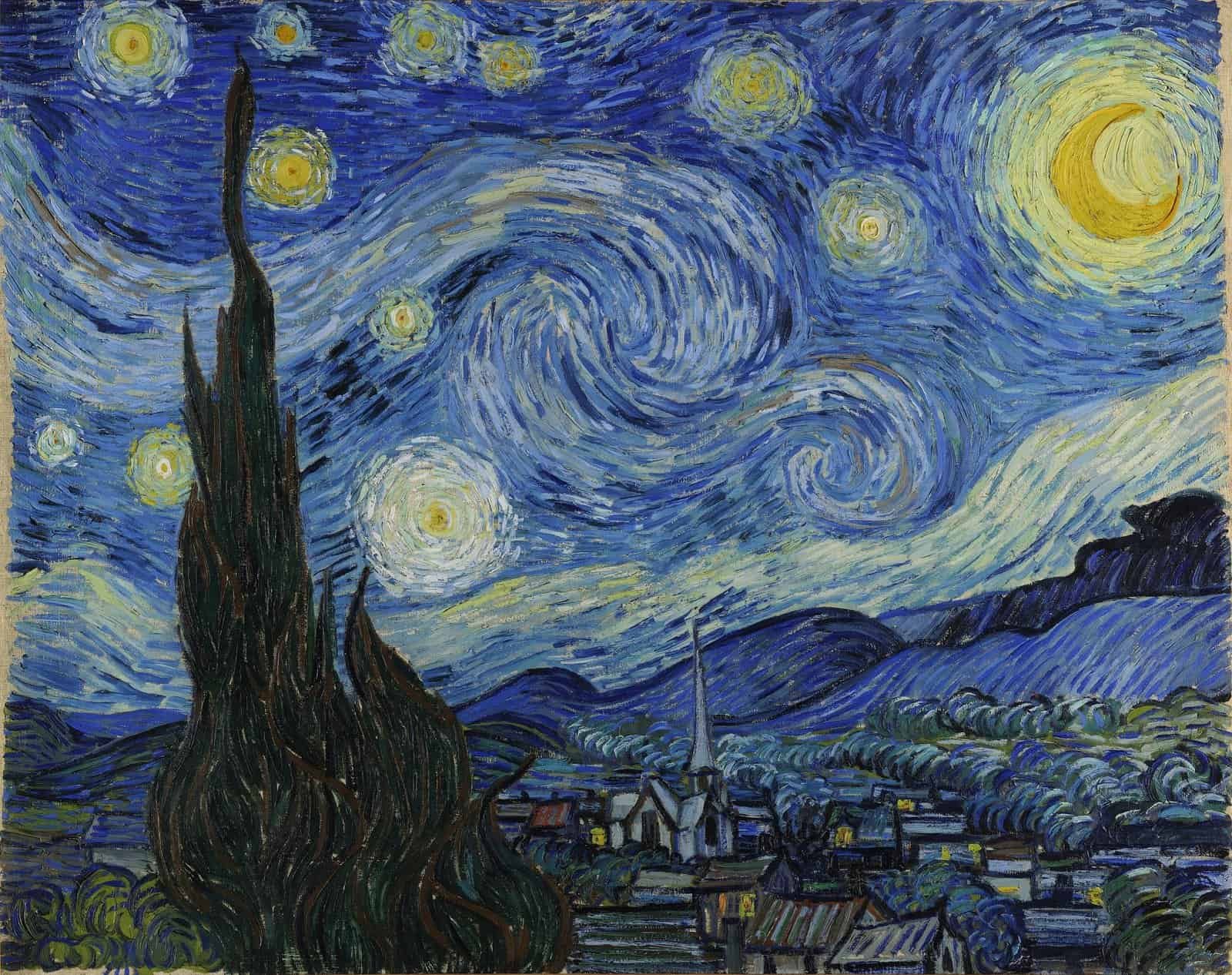
- The swirling sky: Those spiraling, circular brushstrokes aren’t random. They form distinct, almost scientific-looking vortices that some researchers have compared to turbulent fluid dynamics. Van Gogh captured something about the movement of air and light that feels physically accurate even while being expressively exaggerated.
- Venus, left of centre: The large, nearly white orb to the left of the picture’s centre is not a star at all. It is Venus, the morning star — and we know this because Van Gogh told us. He wrote to his brother Theo that he had watched the countryside from his window long before sunrise, with nothing in the sky but the morning star, which looked very big.
- The crescent moon, far right: The glowing crescent sits at the opposite edge of the canvas from Venus, and the two anchor the composition between them. Its halo of concentric yellow rings is a visual effect Van Gogh was fascinated by and returned to repeatedly.
- The cypress tree: Dominating the left foreground, the dark, flame-shaped cypress was traditionally associated in European culture with mourning and death. Yet here it reaches upward into the cosmic swirl, as if trying to connect earth to heaven. It also stands far closer to the viewer than any cypress actually stood to that window — another quiet departure from the real view.
- The village: Look closely at those peaceful, small houses with glowing windows nestled in the valley. Van Gogh invented this village; it was not visible from his room. The sharply pointed church steeple resembles the Dutch Reformed churches of his childhood far more than anything in Provence, suggesting a longing for home woven into an imaginary landscape.
- The color palette: Deep cobalt blues and blue-greens dominate, punctuated by burning yellows and whites. This isn’t the natural color of a night sky — it’s an emotional temperature. The warmth of those star-halos against the cold blue darkness creates an almost unbearable tension between comfort and vastness.
About Vincent van Gogh
Born in Zundert, Netherlands, on March 30, 1853, Vincent Willem van Gogh spent most of his adult life wrestling with poverty, mental illness, and a burning need to make art that mattered. He didn’t begin painting seriously until his late twenties, and his entire prolific output — roughly 860 paintings and more than 1,300 drawings and works on paper — was compressed into just the last decade of his life.
He was largely unrecognized during his lifetime, though the popular claim that he sold only one painting is not quite true. The Red Vineyard, bought by Anna Boch for 400 francs, is the famous sale, but a letter from Theo to the London dealers Sulley & Lori documents an earlier one, and the Van Gogh Museum notes further transactions including a commission from his uncle Cor. He was a commercial failure, not an absolute one — a smaller distinction, but a truer one.
He moved restlessly across Europe — the Netherlands, Belgium, England, France — absorbing influences from Millet, Delacroix, and the Japanese woodblock prints he collected obsessively. His time in Arles with Paul Gauguin ended in crisis, but also in some of his greatest work.
Van Gogh died on July 29, 1890, at the age of 37, just over a year after painting The Starry Night. His legacy, once almost entirely posthumous, now places him among the most beloved and influential artists in human history.
Legacy and Influence
The Starry Night entered MoMA’s permanent collection in 1941 through the Lillie P. Bliss Bequest, and it has been a cornerstone of the museum ever since. But its cultural reach stretches far beyond gallery walls.
The painting has inspired everything from Don McLean’s 1971 song Vincent, whose opening line has become almost as widely quoted as the painting itself, to countless films, novels, and fashion collections. Its swirling motif is one of the most reproduced images in the world, appearing on everything from coffee mugs to high-end couture.
More seriously, The Starry Night helped establish a new standard for what painting could do: give form to interior psychological states. That legacy runs directly through Expressionism, Abstract Expressionism, and into contemporary art practices that prioritize emotional and conceptual content over realistic depiction. Without van Gogh’s example, the path to artists like Edvard Munch, Franz Marc, or Mark Rothko looks considerably harder to trace.
There is also a question this painting raises more sharply than most: why does a canvas of a sky reach people so directly? Research on art and the brain has a partial answer, and it involves the parts of the brain normally reserved for thinking about yourself.
Where to See The Starry Night Today
The Starry Night is housed at the Museum of Modern Art (MoMA), located at 11 West 53rd Street in Midtown Manhattan, New York City. It is displayed in the museum’s fifth-floor collection galleries covering 1880s–1940s and is almost always on view.
A few practical tips for your visit: arrive early on weekday mornings if you want any chance of seeing it without a crowd. The painting is smaller than many visitors expect — that intimate scale makes the swirling energy even more surprising in person. MoMA also holds a remarkable collection of Post-Impressionist and early modern works nearby, so plan to spend at least half a day. Don’t miss works by Cézanne, Gauguin, and Picasso just steps away. MoMA’s café and rooftop terrace (seasonal) make for a full cultural day out; check the museum’s website for current opening hours and any extended evenings.
Frequently Asked Questions
Where is The Starry Night located?
The Starry Night is part of the permanent collection at the Museum of Modern Art (MoMA) in New York City, where it has been held since 1941.
When was The Starry Night created?
Van Gogh painted The Starry Night in June 1889 while staying at the Saint-Paul-de-Mausole asylum in Saint-Rémy-de-Provence, France.
Did van Gogh paint The Starry Night at night?
No. Although the painting depicts a pre-dawn sky, Van Gogh worked on it during the day, across several sessions, reconstructing the scene from memory rather than painting it in front of the view.
What does The Starry Night represent?
The painting is widely interpreted as an expression of van Gogh’s emotional and spiritual inner world — a swirling, dynamic vision of the cosmos that blends observation with imagination. The cypress tree, invented village, and turbulent sky all carry symbolic weight relating to life, death, longing, and transcendence.
Why is The Starry Night so famous?
Its fame comes from a rare combination: technical brilliance, emotional rawness, and universal resonance. It captures a feeling — awe mixed with vulnerability beneath an infinite sky — that almost everyone can recognize. Its influence on modern art and popular culture over more than a century has only deepened its iconic status.
Did van Gogh paint The Starry Night from a real view?
Partly. The orientation of the sky and hills does reflect the actual view from the east-facing window of his asylum room, and Venus really was visible in that position before dawn. However, the village below was not visible from his room — van Gogh invented it, likely drawing on memories of Dutch towns from his homeland.
If The Starry Night has sparked your curiosity about the Post-Impressionist world, you’re in the right place. Explore Starry Night Over the Rhone, painted outdoors under the actual stars a year earlier, and Café Terrace at Night, in which van Gogh rendered a night scene without using any black at all.
Image: The Starry Night – Vincent van Gogh (1889). License: Public Domain. Source: Wikimedia Commons.