A Bar at the Folies-Bergère
We can prove the mirror is deliberate. A preparatory oil study survives in Amsterdam, and in it the geometry works: the barmaid stands at an angle, and her reflection falls where it should. Manet had the correct version in front of him and chose the impossible one for the finished painting.
Quick Facts
- Artist: Édouard Manet (1832–1883)
- French title: Un bar aux Folies-Bergère
- Years: 1881–1882
- Medium: Oil on canvas
- Dimensions: 96 × 130 cm
- Exhibited: Paris Salon, 1882
- Movement: Impressionism
- Location: The Courtauld Gallery, London
What is wrong with the mirror
It is worth itemising, because vague descriptions of “impossible perspective” do the painting a disservice.
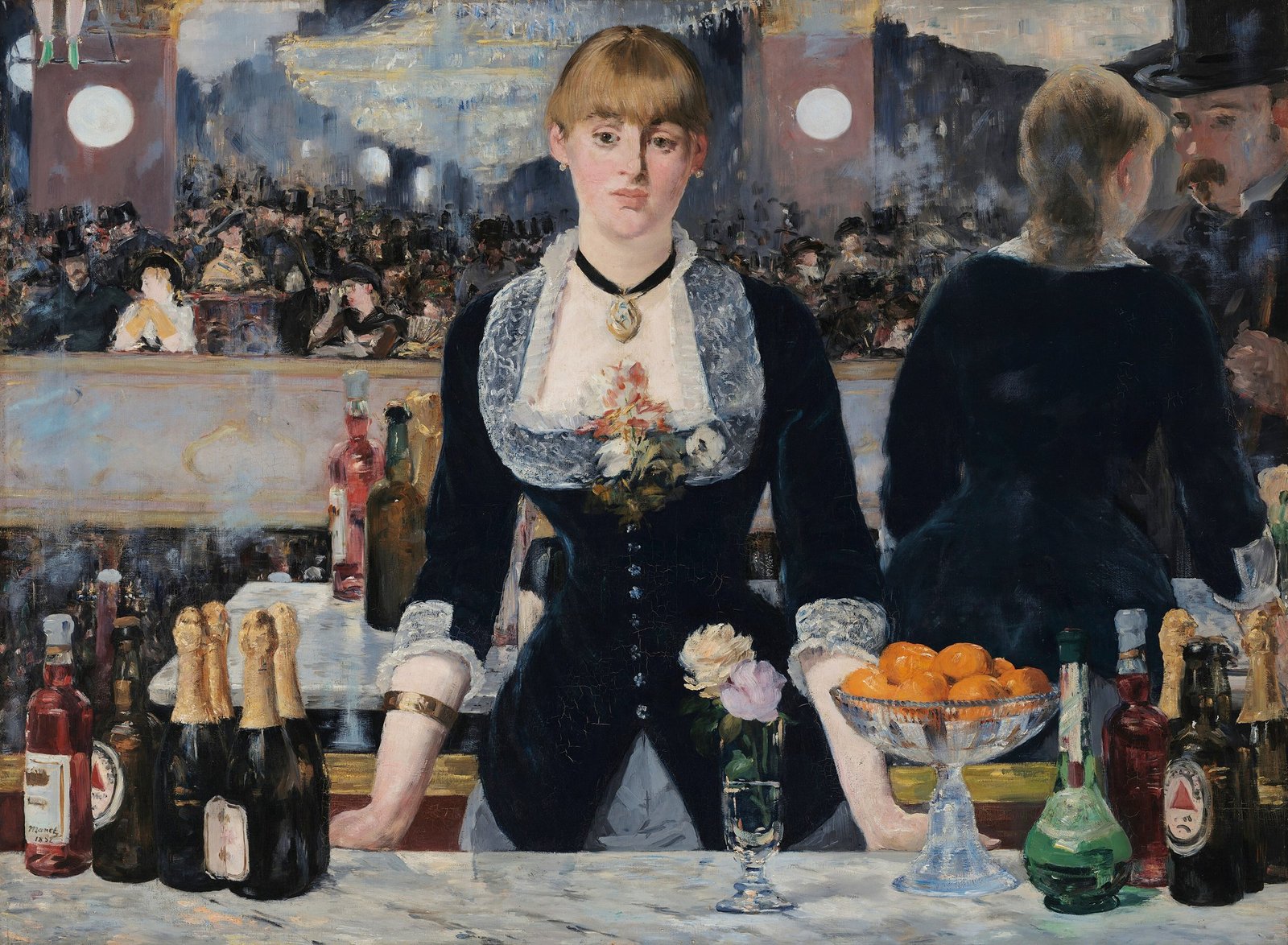
One. Her reflection is displaced far to the right. With a mirror parallel to the counter, it should sit directly behind her.
Two. The reflection is turned. We see the back of a woman leaning forward, while the figure in front of us stands upright.
Three. A man in a top hat faces her in the mirror. If we can see his reflection, he must stand between us and her — blocking our view. He does not.
Four. The bottles on the counter and the bottles in the reflection differ in number and arrangement.
In 2000, researchers at the University of Arizona reconstructed the scene physically, with a model, a mirror and props. They concluded the image is only possible if the painter stood to one side and slightly above — while painting the barmaid as though standing directly in front of her.
Manet combined two viewpoints in one canvas.
Why he did it
Several readings, none conclusive.
The viewer as customer. The most popular: the man in the top hat is us. Manet places the viewer in the position of a buyer — and what the bar sells does not stop at drinks.
Two states of one woman. The figure in front is motionless, with a blank expression. The reflection leans towards the client, engaged. The same person, professionally attentive and privately absent.
A critique of spectacle. T. J. Clark devoted a long analysis to the painting, reading it as an image of commodity capitalism: everything reflected, everything for sale, nothing stable.
Simply composition. Some scholars hold that Manet moved the reflection because the symmetrical version was dead — correct and dull.
Historical context
The Folies-Bergère on the rue Richer was among the best-known entertainment venues in Paris. The programme mixed operetta, acrobatics, ballet and circus acts, and the audience ran from aristocrats to labourers.
It also had a reputation. The promenade around the auditorium was a recognised place for arranging paid company, and barmaids, who sold drinks, were often part of that economy. Contemporary viewers read the painting knowing this.
Manet showed it at the Salon in May 1882. The response was divided — some praised it, others complained of carelessness and faulty drawing.
He was seriously ill. He had suffered for years from locomotor ataxia, a complication of syphilis, and had increasing difficulty walking. He painted seated, in sessions.
He reconstructed the setting in his studio: a table, bottles, a mirror, and the barmaid coming to pose. He did not paint in the venue.
He died eleven months after the exhibition, in April 1883.
What to look for
The face. Suzon — the name of the barmaid who modelled — looks in our direction but not at us. The gaze is absent.
The hands. Flat on the counter, locked, taking her weight. The posture of someone who has been standing for hours.
The bottles. Count them and compare with the reflection. Neither number nor arrangement agrees. On the left stand bottles of English Bass ale with the red triangle — one of the world’s first registered trademarks, and a clear sign of modern commerce.
The flowers. A small posy at her neckline, painted in a few strokes.
The oranges. In a glass bowl. Usually read as a pointer to the barmaids’ additional source of income.
The trapeze artist’s legs. Upper left corner, in green boots, hanging from a trapeze. Easily missed — and the best proof that the mirror shows the whole hall.
The man in the top hat. Upper right. The model was the painter Gaston Latouche.
The marble. Painted cold and hard against the dissolved background. It is the barrier between her and us.
About Édouard Manet
Born in 1832 into a prosperous Parisian family; his father was a judge. He failed the naval entrance examination, after which he was allowed to study painting under Thomas Couture.
In 1863 he showed Le Déjeuner sur l’herbe at the Salon des Refusés, and two years later Olympia at the official Salon. Both caused scandals.
He never exhibited with the Impressionists, though he was close to them and served as their point of reference. He kept submitting to the official Salon, whose approval he wanted.
He died in April 1883, aged fifty-one. His left leg had been amputated eleven days earlier.
Where it went afterwards
The painting’s ownership has a pleasing shape.
Its first owner was the composer Emmanuel Chabrier, a friend of Manet, who hung it above his piano and kept it until his death in 1894.
It passed through several hands and in 1926 was bought by Samuel Courtauld, the textile industrialist whose collection formed the basis of the institute and gallery that bear his name.
It has been in the Courtauld ever since and is the collection’s best-known work.
Legacy and influence
The painting set a benchmark for figurative painting that refuses to resolve. Instead of narrative, a fragment. Instead of idealisation, a tired woman at work.
It is among the most analysed paintings in Western art. T. J. Clark devoted substantial writing to it; it has generated conferences and physical reconstructions.
In 2002 the British artist Jeff Wall made Picture for Women, a large photograph built on the same arrangement of mirror, model and observer.
The Folies-Bergère is still operating at 32 rue Richer in Paris, in a building with a 1926 facade, and still stages revues.
Where to see it today
The painting is at The Courtauld Gallery in Somerset House on the Strand, London. Nearest tube: Temple or Covent Garden.
- The gallery is small and very dense; two hours covers it, but it deserves longer.
- Check prices and hours before travelling. Booking online is advisable.
- Stand directly in front of it and try to locate yourself in the scene. It is the only way to feel what the painting is doing.
- Then move left and right. The reflection reads differently from an angle.
- Also here: Van Gogh’s Self-Portrait with Bandaged Ear, Gauguin’s Nevermore, works by Cézanne, Degas and Renoir, and Manet’s own earlier, smaller version of Le Déjeuner sur l’herbe — the principal version is in the Musée d’Orsay.
Frequently asked questions
Why is the reflection impossible?
Because it combines two viewpoints. The barmaid is painted frontally; her reflection as though the painter stood to one side and above. The man visible in the mirror should also be blocking our view, and is not. A 2000 reconstruction confirmed the arrangement cannot be staged in reality.
Was it a mistake?
No. A preparatory oil sketch survives in which the geometry is correct — the barmaid stands at an angle and the reflection falls where it should. Manet changed it deliberately in the final version.
Who was the model?
Suzon, a real barmaid at the Folies-Bergère. She posed in Manet’s studio, where he reconstructed the setting. The man in the top hat is the painter Gaston Latouche.
What are the bottles on the counter?
Real products of the period: champagne, liqueur, and English Bass ale with its red triangle — one of the first registered trademarks anywhere. Manet is underlining the commercial character of the place.
Does the Folies-Bergère still exist?
Yes, at 32 rue Richer in Paris. It still operates and still stages revues.
Is this Manet’s last painting?
His last major one. He showed it at the Salon in May 1882, already gravely ill, and died eleven months later.
If this painting has caught your interest, look next at Olympia — painted nineteen years earlier and also built on a woman’s gaze directed straight at the viewer, except that audiences then tried to attack the canvas with umbrellas.
Image: Un bar aux Folies-Bergère – Édouard Manet (1882). License: Public Domain. Source: Wikimedia Commons.