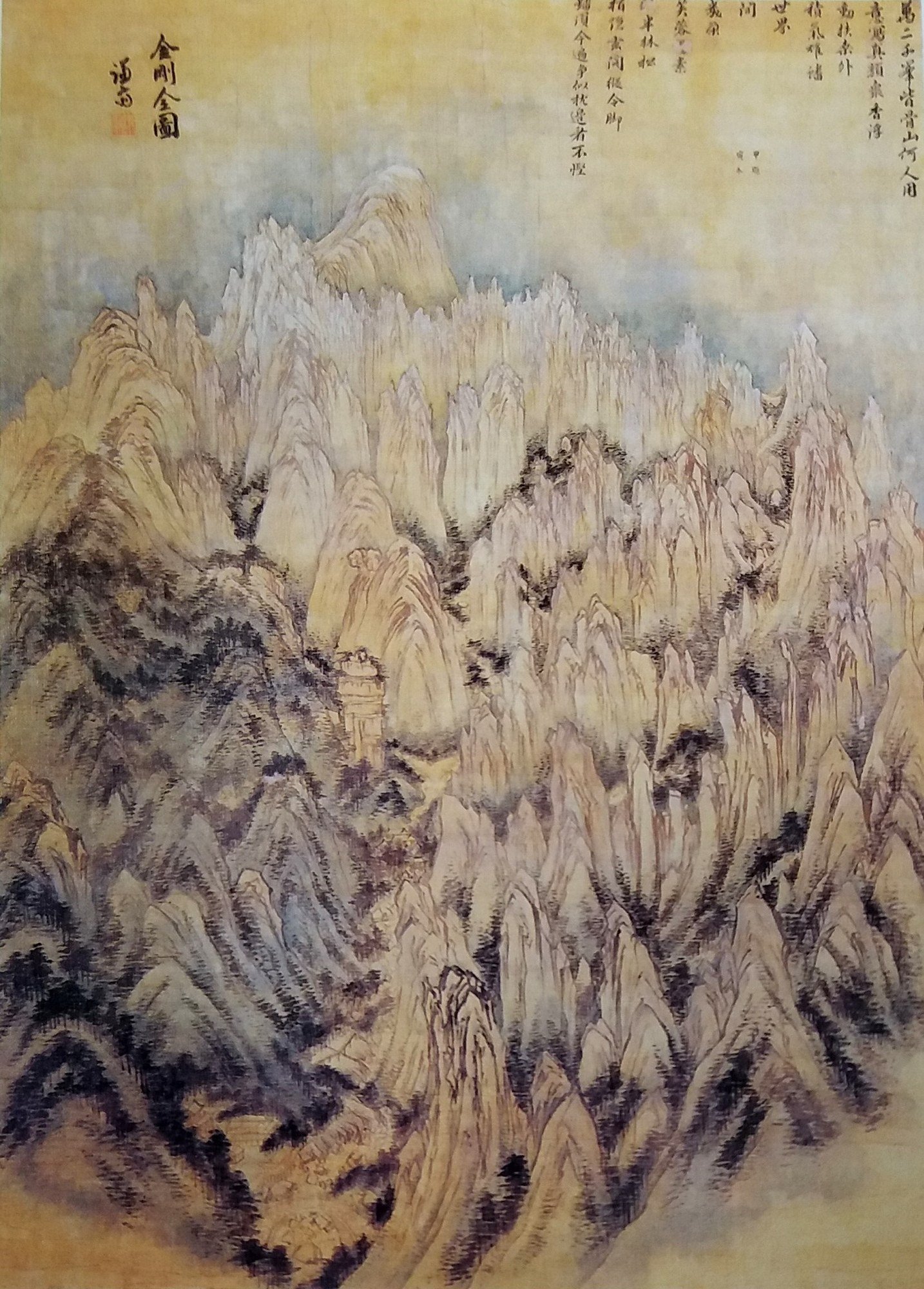
Geumgangjeondo (General View of Mt. Geumgangsan)
Here is a striking thought to consider: a single ink painting created in 1734 helped redefine an entire nation’s relationship with its own landscape. Geumgangjeondo (General View of Mt. Geumgangsan) by Jeong Seon did not merely depict a famous mountain — it declared that Korean scenery was worthy of serious artistic devotion, at a time when most painters still looked to China for inspiration. That bold statement echoes across Korean art history to this day.
Quick Facts
- Artist: Jeong Seon
- Year: 1734
- Medium: Ink and light color on silk
- Dimensions: Unknown
- Movement: Joseon Art
- Current location: National Museum of Korea, Seoul
What Makes Geumgangjeondo (General View of Mt. Geumgangsan) So Unforgettable?
Most landscape paintings invite you to wander through a scene. Geumgangjeondo (General View of Mt. Geumgangsan) does something far more audacious — it overwhelms you with an entire mountain range in a single, panoramic breath. Jeong Seon pulls back to an almost impossible vantage point, showing thousands of jagged granite peaks crowding the composition like a forest of stone needles. The sheer ambition of that vision is breathtaking.
What truly sets this work apart is its technical fearlessness. Jeong Seon used bold, vertical brushstrokes — sometimes called “hemp-fiber strokes” — to convey the raw, splintered texture of Diamond Mountain’s granite. Meanwhile, the rounded, softer peaks nearby receive gentler, wetter ink washes. The contrast is intentional. It is a visual language designed specifically for this landscape, not borrowed from any Chinese manual.
Therefore, this painting is not simply beautiful. It is a declaration of artistic independence. Jeong Seon proved that Korean geography had its own visual grammar, and he had the skill to speak it fluently.
Historical Context
Jeong Seon painted Geumgangjeondo (General View of Mt. Geumgangsan) during the reign of King Yeongjo, one of the most culturally ambitious rulers of the Joseon dynasty. This was a period of remarkable intellectual energy in Korea. Scholars and artists were actively questioning whether Korean culture should continue imitating Chinese models — or forge its own identity. That debate had a name: Silhak, or “practical learning.”
In this climate, painting real Korean places from direct observation became a radical act. The movement Jeong Seon championed — jingyeong sansuhwa, or “true-view landscape painting” — responded directly to this cultural moment. Instead of painting imaginary Chinese mountains, artists traveled to actual Korean sites and recorded what they saw with fresh, honest eyes.
Mt. Geumgangsan, located on the Korean Peninsula, was already legendary. Poets, monks, and scholars had revered it for centuries. However, Jeong Seon transformed reverence into visual mastery. By 1734, he had visited the mountain multiple times, and this late masterpiece reflects decades of observation distilled into a single commanding image.
South Korea later recognized the painting’s national importance by designating it the 217th National Treasure on August 6, 1984 — a testament to how deeply it resonates with Korean cultural identity.
Symbolism and What to Look For
Stand — even metaphorically — in front of Geumgangjeondo (General View of Mt. Geumgangsan), and let your eye do the work. Here is what to notice:
- The granite spires: Look at the sharp, dry, vertical brushstrokes in the central cluster of peaks. They feel almost aggressive — like the mountain is pushing upward with great force. This is deliberate texture, not decoration.
- The ink washes on the wooded slopes: In contrast to the granite, the lower, forested areas dissolve into soft gray washes. This tonal shift creates a sense of depth and atmospheric mist rising from the valleys.
- The circular composition: Jeong Seon arranges the peaks in a sweeping, almost bowl-like curve. This draws your eye around and inward, mimicking the experience of standing inside a vast natural amphitheater.
- The empty sky and ground: Notice how much negative space surrounds the mountain mass. That emptiness is not absence — it amplifies the mountain’s presence and gives it room to breathe.
- Human structures: Tiny temples and pavilions nestled among the peaks remind the viewer of human smallness. They are easy to miss, but they anchor the spiritual meaning of the scene.
In addition, the color palette is restrained — primarily ink black and soft gray, with occasional subtle warm tones. This restraint forces you to focus on brushwork and form rather than color, which is exactly where Jeong Seon’s genius lives.
About Jeong Seon
Jeong Seon (1676–1759) spent most of his long life rewriting the rules of Korean painting. Born into a family of modest means, he rose through artistic talent and determination to become the most celebrated landscape painter of the Joseon dynasty. He lived into his eighties, producing work that grew bolder and more confident with every decade.
His great contribution was the jingyeong style — painting the actual landscapes of Korea with direct, observational honesty. He traveled extensively, sketching mountains, rivers, and valleys, and then distilled those experiences into paintings of extraordinary energy. Mt. Geumgangsan was his lifelong obsession, and he returned to it again and again throughout his career.
Jeong Seon’s influence extends far beyond technique. He gave Korean painters permission to love their own land. For that reason, many scholars consider him the father of distinctly Korean landscape painting.
Legacy and Influence
Geumgangjeondo (General View of Mt. Geumgangsan) did not merely inspire later painters — it set a standard they spent generations trying to match. The jingyeong tradition Jeong Seon pioneered continued to flourish through the late Joseon period, influencing artists such as Kim Hongdo, who absorbed his teacher’s commitment to depicting Korean reality with vivid directness.
Today, the painting carries a weight beyond art history. Mt. Geumgangsan now sits in North Korea, making it physically inaccessible to most South Koreans. As a result, Geumgangjeondo (General View of Mt. Geumgangsan) has become something even more poignant — a preserved memory of a beloved landscape separated by political division. The painting holds grief and longing as much as beauty.
Its designation as a National Treasure of South Korea reflects exactly that emotional depth. This is not merely a great painting. It is a cultural artifact through which an entire nation remembers a mountain it can no longer freely visit.
Where to See Geumgangjeondo (General View of Mt. Geumgangsan) Today
The painting is currently held at the National Museum of Korea in Seoul, one of Asia’s great cultural institutions. The museum sits in Yongsan-gu, conveniently close to the city center, and is easily accessible by subway (Ichon Station, Line 4 and Jungang Line).
Admission to the permanent galleries is free, which makes it one of the best value cultural experiences in Seoul. Plan to spend at least two to three hours exploring the broader Korean art collection — the Joseon painting galleries alone are extraordinary.
While you are there, look out for works by Kim Hongdo and Shin Yunbok, both of whom carry Jeong Seon’s spirit of Korean realism into their own distinctive styles. The museum’s gift shop also stocks excellent art books on Joseon painting if you want to deepen your understanding.
Note that major works like Geumgangjeondo (General View of Mt. Geumgangsan) are sometimes rotated off display to protect fragile materials. Check the museum’s official website before your visit to confirm current exhibition schedules.
Frequently Asked Questions
Where is Geumgangjeondo (General View of Mt. Geumgangsan) located?
The painting is currently held at the National Museum of Korea in Seoul, South Korea, where it is part of the institution’s permanent collection of Joseon-era masterworks.
When was Geumgangjeondo (General View of Mt. Geumgangsan) created?
Jeong Seon completed the painting in 1734, during the reign of King Yeongjo of the Joseon dynasty. By that point, Jeong Seon was already in his late fifties and at the height of his artistic powers.
What does Geumgangjeondo (General View of Mt. Geumgangsan) represent?
The painting represents Mt. Geumgangsan (Diamond Mountain) on the Korean Peninsula, a site of deep spiritual and cultural significance. More broadly, it represents Korea’s natural identity and the artistic movement that insisted Korean landscapes deserved to be painted on their own terms.
Why is Geumgangjeondo (General View of Mt. Geumgangsan) so famous?
It is famous for its technical brilliance, its panoramic ambition, and its cultural importance as a founding work of Korean true-view landscape painting. South Korea designated it the 217th National Treasure in 1984, cementing its status as one of the country’s greatest artistic achievements.
What technique did Jeong Seon use in this painting?
Jeong Seon combined bold, dry vertical brushstrokes to capture the jagged granite peaks with softer ink washes for the forested lower slopes. This layered approach created a dramatic contrast of textures that made the mountain feel physically present and geologically specific — unlike any Chinese landscape convention of the era.
If Geumgangjeondo (General View of Mt. Geumgangsan) has sparked your curiosity about Korean art and its extraordinary depth, we warmly invite you to explore more masterworks right here on the site. From the bold ink paintings of the Joseon dynasty to the sweeping traditions of East Asian landscape art, there is always another world waiting to be discovered — one brushstroke at a time.
Image: Geumgangjeondo (General View of Mt. Geumgangsan) – Jeong Seon (1734). License: Public Domain. Source: Wikimedia Commons.