The Creation of Adam
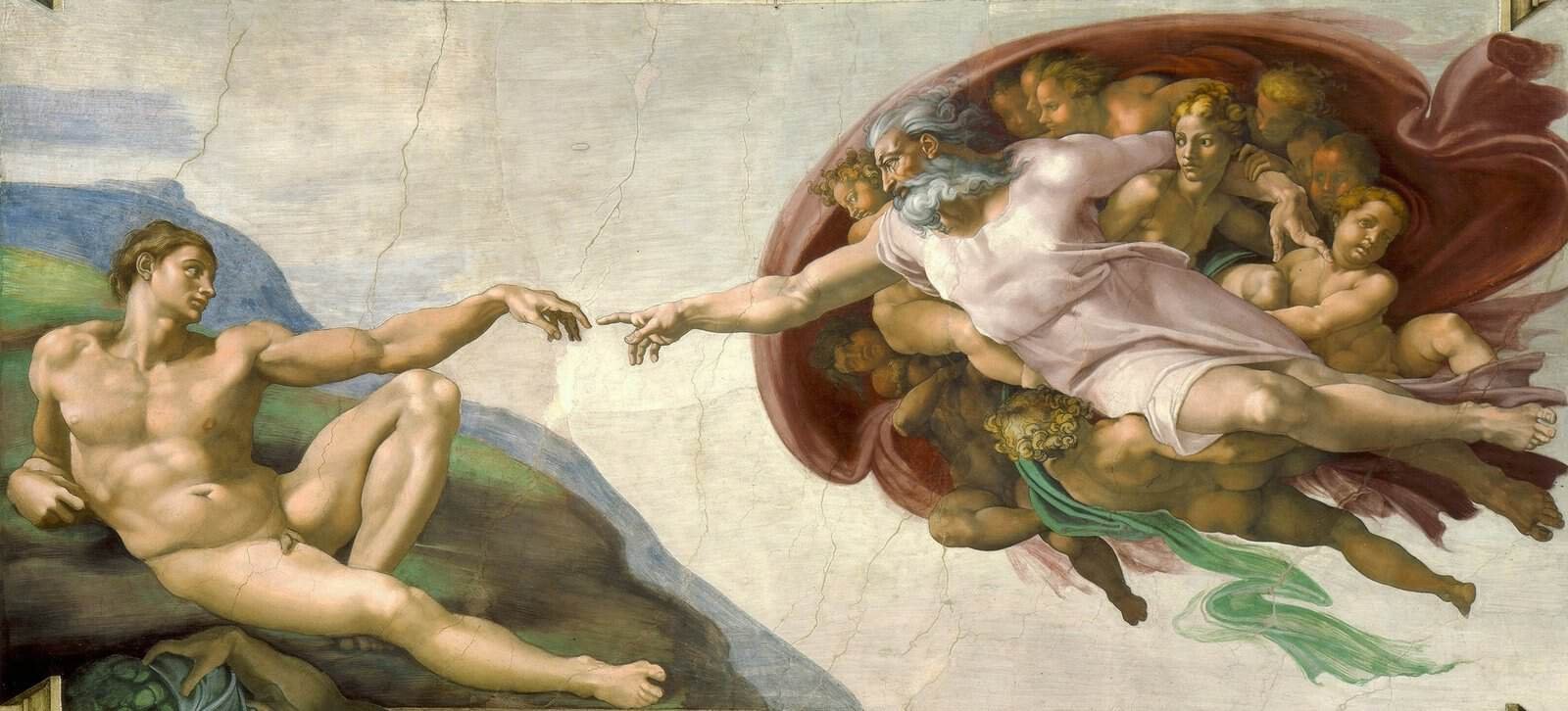
Most people recognize the outstretched fingers at the center of The Creation of Adam — but almost nobody realizes that the swirling red cloak and figures surrounding God in this iconic fresco form a shape that many researchers say mirrors a cross-section of the human brain, a detail that has sparked decades of debate about whether Michelangelo secretly embedded a scientific message inside one of history’s most sacred images.
Quick Facts
- Artist: Michelangelo
- Year: 1512
- Medium: Fresco on plaster
- Dimensions: 280 cm × 570 cm (9 ft 2 in × 18 ft 8 in)
- Movement: Renaissance
- Current location: Sistine Chapel, Vatican
What Makes The Creation of Adam So Unforgettable?
Countless paintings depict divine moments, so why does this one live rent-free in the collective human imagination? The answer lies in what Michelangelo left out. Rather than showing God physically touching Adam, he painted a gap — a tiny, charged sliver of empty air between two fingertips. That space carries more emotional weight than almost any other inch of paint in the Western canon. It is the moment just before everything changes, and the viewer is suspended there indefinitely.
There is also something deeply humanizing about this God. He is not a distant, abstract force. He is an older man with wind-swept white hair, urgent eyes, and an arm thrown out with real physical effort, as if he is straining across the heavens to reach Adam. Meanwhile Adam reclines with an almost lazy elegance, his body just beginning to wake, his own arm raised but still heavy with sleep. The contrast — divine urgency meeting human drowsiness — gives the scene a tenderness that is quietly revolutionary even today.
Historical Context
When Pope Julius II commissioned Michelangelo to paint the Sistine Chapel ceiling in 1508, Michelangelo famously protested. He considered himself a sculptor, not a painter, and the ceiling was an intimidating, curved surface high above the floor. He accepted anyway — and spent four grueling years on scaffolding, working largely alone, frequently uncomfortable, and reportedly sleeping in his clothes.
The early sixteenth century was a period of enormous turbulence. The Catholic Church was navigating political rivalries, the early rumblings of what would become the Protestant Reformation, and a renewed fascination with classical antiquity that was reshaping every corner of European culture. Renaissance artists were reclaiming the human body as worthy of serious artistic study — influenced by ancient Greek and Roman sculpture — and Michelangelo was at the forefront of that shift.
The Creation of Adam was completed around 1512, as the fourth panel in the chronological sequence of Genesis scenes running along the ceiling’s central spine. It appeared during a moment when art was expected to do double duty: inspire spiritual devotion and demonstrate the highest possible level of human skill. Michelangelo achieved both with an almost unsettling ease.
Symbolism and What to Look For
Stand beneath the ceiling (if your neck allows) and let your eye travel first to Adam’s body. Michelangelo modeled this figure on ancient classical sculpture — the proportions, the musculature, the relaxed weight of the pose all echo the Greek ideal. But unlike cold marble, this Adam has warm, yielding flesh. He looks like he is breathing.
Next, follow Adam’s left arm upward toward that celebrated gap. Notice how Adam’s finger droops slightly — it is passive, receiving. God’s finger, by contrast, is firm and extended with intention. The asymmetry between the two hands tells the entire story of creator and creation in a single glance.
Now look at the cluster of figures surrounding God. They are nestled inside a billowing red and green mantle that many art historians and medical researchers have argued mirrors the precise shape of a cross-section of the human brain, complete with a frontal lobe, brain stem, and the telltale folds of the cerebral cortex. Whether intentional or coincidental, it is impossible to unsee once you know to look for it. Michelangelo is known to have studied human anatomy through dissection — so the idea that he hid a tribute to the mind inside a painting about divine intelligence is not as far-fetched as it sounds.
Finally, notice the woman tucked under God’s left arm. She is not identified in Genesis, but some scholars believe she may represent Eve, present in God’s thoughts before she has even been created — a detail that adds a quiet layer of narrative complexity to an already rich scene.
About Michelangelo
Michelangelo di Lodovico Buonarroti Simoni was born in 1475 in Caprese, a small town in Tuscany, and died in 1564 at the remarkable age of 88 — an almost unheard-of lifespan for the era. He was a painter, sculptor, architect, and poet, and he excelled at all of them. His sculptural masterpieces include the David and the Pietà, both of which he completed before he was thirty.
He was famously difficult — proud, solitary, and fiercely protective of his artistic vision. He clashed with patrons repeatedly, including the very pope who gave him the Sistine Chapel commission. Yet his output was staggering in both quantity and quality. By the time he died, he had reshaped what it meant to be an artist, elevating the profession from skilled craftsman to near-divine genius — a reputation that has never really faded.
Legacy and Influence
The Creation of Adam did not just influence later Renaissance painters — it seeped into the entire visual DNA of Western civilization. The image of two hands reaching toward each other has become one of the most universally understood visual metaphors for connection, aspiration, and the sacred. It appears on film posters, album covers, advertisements, tattoos, and memes in numbers that are genuinely impossible to count.
In the art world specifically, the fresco’s treatment of the human figure — monumental, idealized, emotionally charged — set a standard that painters from Raphael to Rubens to the Romantic era were all responding to, consciously or not. Even twentieth-century artists who rebelled against classical tradition were defining themselves partly against the towering shadow this ceiling cast.
The brain-shaped cloak is not the only place where art and neuroscience meet. For the wider picture — what brain scanners actually show when people stand in front of paintings, and which popular claims about it turn out to be wrong — see what art does to the brain.
Where to See The Creation of Adam Today
The fresco is located on the ceiling of the Sistine Chapel, within the Vatican Museums complex in Vatican City, Rome. Tickets must be booked well in advance — the Vatican Museums are among the most visited attractions in the world, and same-day entry is rarely possible during peak seasons. Book directly through the official Vatican Museums website to avoid inflated prices from third-party sellers.
Arrive early. The chapel gets extremely crowded by mid-morning, and visitors are asked to maintain silence inside — which can be difficult to enforce but makes the experience far more powerful when it works. Bring a small pair of binoculars if you can; the ceiling is high and the details are extraordinary up close. Photography without flash is permitted, but honestly, no photo captures it. You need to be in the room.
While you are in the Vatican Museums, do not miss the nearby Raphael Rooms, where you can see how a younger contemporary responded to Michelangelo’s ideas — including a famous portrait of Michelangelo himself tucked into The School of Athens.
Frequently Asked Questions
Where is The Creation of Adam located?
The fresco is painted on the ceiling of the Sistine Chapel, housed within the Vatican Museums in Vatican City, Rome, Italy.
When was The Creation of Adam created?
Michelangelo painted it around 1511 to 1512, as part of the larger Sistine Chapel ceiling project that ran from 1508 to 1512.
What does The Creation of Adam represent?
It depicts the moment from the Book of Genesis when God breathes life into Adam, the first human being. More broadly, it represents the divine origin of humanity and the intimate relationship between creator and creation.
Why is The Creation of Adam so famous?
Its genius lies in its simplicity — two outstretched hands and a tiny gap — combined with extraordinary technical mastery and a deeply human emotional resonance. The image communicates across cultures, languages, and centuries in a way that very few artworks ever achieve.
Did Michelangelo really hide a brain in The Creation of Adam?
The theory was formally proposed in a 1990 paper published in the journal JAMA by physician Frank Meshberger, who argued that the shape surrounding God matches a human brain in cross-section. Given that Michelangelo performed anatomical dissections, many researchers find the idea compelling — though it remains officially unproven and gloriously debated.
If The Creation of Adam has sparked your curiosity about the Renaissance and the artists who defined it, explore our other posts on Michelangelo’s works and the extraordinary world of Italian Renaissance painting — there are more hidden details, fascinating stories, and masterpieces waiting for you throughout the site.
Image: The Creation of Adam – Michelangelo (1512). License: Public Domain. Source: Wikimedia Commons.