Whistler’s Mother
Whistler pawned this painting. In 1878 he sued the critic John Ruskin for libel and won — and the court awarded him one farthing, the smallest coin in circulation, with no costs. The case ruined him. He declared bankruptcy the following year and put his mother’s portrait up as security against his debts.
Quick Facts
- Artist: James McNeill Whistler (1834–1903)
- Proper title: Arrangement in Grey and Black No. 1: Portrait of the Artist’s Mother
- Year: 1871
- Medium: Oil on canvas
- Dimensions: 144.3 × 162.4 cm
- Movement: Aestheticism, on the edge of Realism
- Location: Musée d’Orsay, Paris
What makes it unforgettable?
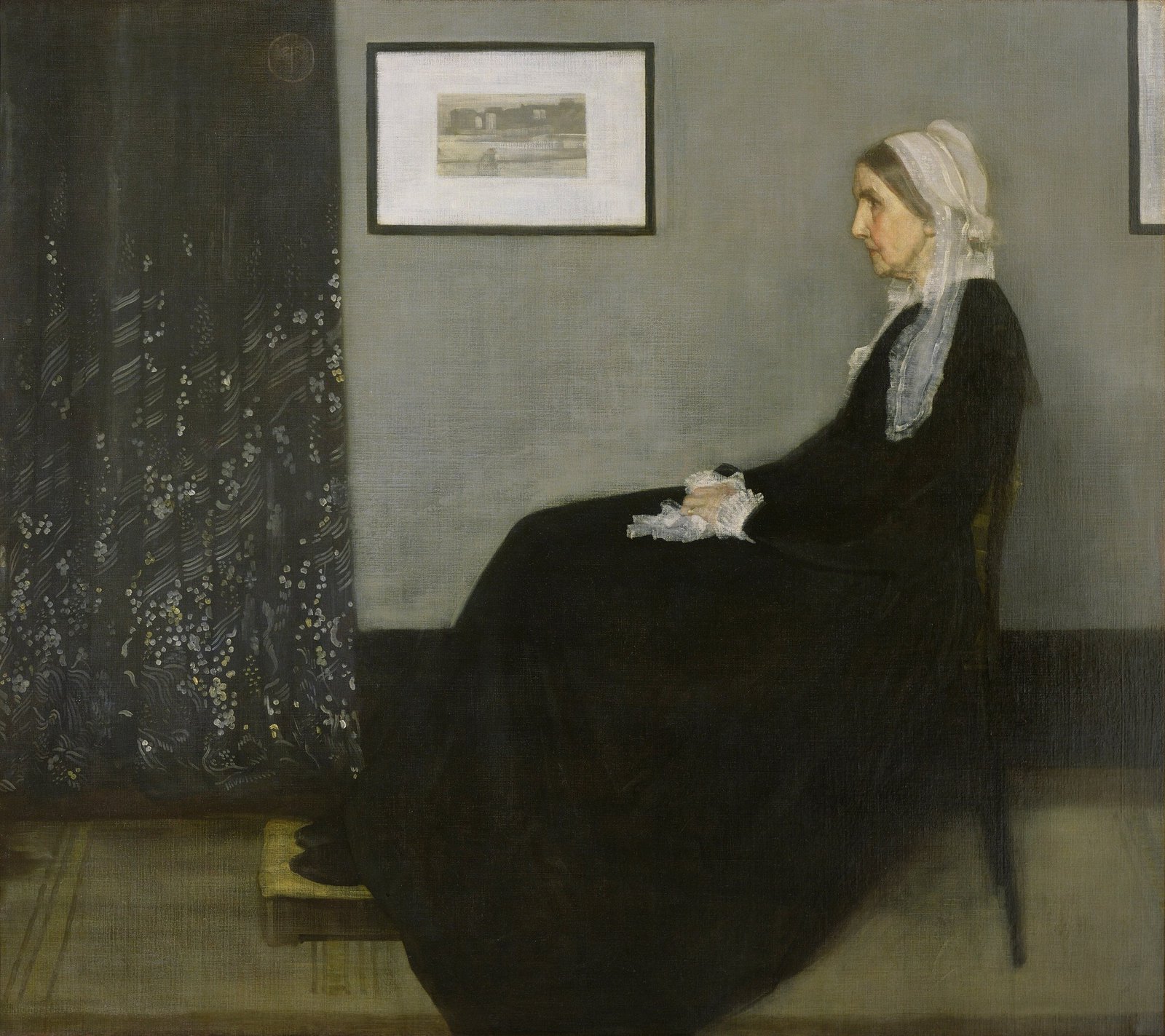
The title tells you the intention. Arrangement in Grey and Black — a composition in two colours. Whistler named his paintings like pieces of music: nocturnes, symphonies, harmonies, arrangements.
He said so directly. The public might be interested in who the woman is, but as a painter he was interested only in the arrangement of tones.
The paradox is that nobody listened. A painting built on a cold formal theory became the most sentimental image in American culture.
The composition is radically reduced. Rectangles: the frame of the etching, the curtain, the skirting board, the shape of the figure. Nothing runs on a diagonal. Everything holds to verticals and horizontals.
The canvas is wider than it is tall — unusual for a portrait, and further evidence that Whistler was thinking about arrangement rather than about a person.
How it came about
The sitting was not planned as it happened. The model who was to pose failed to arrive, and Anna took her place.
She began standing. She was sixty-seven and could not sustain it. Whistler brought a chair and repainted the composition around her.
The picture on the wall behind her is Black Lion Wharf, one of Whistler’s own etchings from 1859 — a view of the London docks with warehouses and workers.
It is a signature and also a statement: beside the portrait of his mother hangs a view of a dirty riverside.
At the left edge is the border of a curtain with a faint dotted pattern, a Japanese note. Whistler collected Japanese prints and carried their flatness into his own painting.
Historical context
Whistler was living in Chelsea, by the Thames, and had shared a house with his mother since 1864.
Anna McNeill Whistler had come to England from the American South during the Civil War. She was a strict Presbyterian, and her arrival forced a change in her son’s domestic arrangements — his mistress had to move out.
When the painting was submitted to the Royal Academy in 1872, the committee wanted to reject it. It was admitted only after Sir William Boxall threatened to resign. It was then hung high and badly placed.
Reception was cool. English critics found it strange and unfinished.
Pawn shop, lawsuit, bankruptcy
The next few years are a financial catastrophe.
In 1877 Ruskin — the most influential critic in Britain — wrote of another Whistler painting that the artist had flung a pot of paint in the public’s face and asked two hundred guineas for it.
Whistler sued for libel. He won and he lost. The jury found for him and awarded damages of one farthing, without costs. The expense of the case destroyed him.
He declared bankruptcy in 1879. The portrait of his mother went to a pawnbroker.
It was redeemed, and in 1891 the French state bought it for the Musée du Luxembourg, the museum of contemporary art, for 4,000 francs — a modest sum for a work of this standing.
It was the first Whistler in any public collection. France bought it; neither America nor Britain did. It reached the Musée d’Orsay only in 1986, with the rest of the nineteenth-century holdings.
How it became a symbol of motherhood
This is the strangest turn in the painting’s history.
In the 1930s, in the middle of the Depression, the picture toured the United States. Around two million people saw it. In a period of widespread poverty, an image of an elderly woman in black became something Americans recognised themselves in.
In 1934 the US Post Office issued a stamp using the image, with a line about the mothers of America. Whistler would have been appalled.
The stamp also cropped the composition and added a vase of flowers that does not exist in the painting.
There is a monument in Ashland, Pennsylvania, showing the same figure, dedicated to mothers.
A painting built on the rejection of sentiment became its principal vehicle.
What to look for
The profile. She is seen entirely from the side, looking at neither the viewer nor the painter. It reads as withdrawal rather than contact.
The hands. Folded in her lap, holding a handkerchief. The most human passage in a picture that is otherwise geometry.
The feet. Resting on a low footstool, barely visible beneath the skirt. Whistler added it when she could no longer stand.
The cap. White lace, the only bright accent in the upper half of the canvas, and the point the eye keeps returning to.
The floor. Horizontal, dark, almost featureless. It steadies everything.
The whites. Look closely at the wall and the curtain — they are not the same grey. The tonal range within a very narrow band is the technical achievement here.
About James McNeill Whistler
Born in Lowell, Massachusetts in 1834. Part of his childhood was spent in Russia, where his father was building a railway for the Tsar.
He went to West Point and was dismissed — he failed chemistry. He said afterwards that had silicon been a gas, he would have been a general.
He left for Paris, then London, and never returned to America. He was a dandy, a provocateur and a habitual litigant. He wore a monocle, kept a white streak in his hair, and signed his paintings with a stylised butterfly — sometimes given a stinging tail.
He died in London in 1903. Anna Whistler had died in 1881, ten years after the portrait was made.
Legacy and influence
Whistler anticipated something specific: that a painting need not depict anything in particular in order to work. Musical titles and colour treated as an autonomous value lead directly towards abstraction.
The painting is among the most parodied images in existence — in cartoons, films and advertising, usually as shorthand for “old mother” or “art museum.”
In American culture it functions as a national icon, despite never having been American property and despite hanging in Paris for more than a hundred and thirty years.
Where to see it today
The painting is at the Musée d’Orsay, Quai Anatole France, Paris, in the former Gare d’Orsay railway station of 1900.
- The museum is closed on Mondays. Check hours and prices before travelling — they change regularly.
- Book online, especially in summer.
- The painting travels. It has been lent to the United States and to Japan. If you are going specifically to see it, check that it is in the building.
- Also here: Starry Night over the Rhône, Olympia and Bal du moulin de la Galette.
- The Impressionists are on the top floor; Whistler hangs lower, among painting of the 1860s and 1870s.
Frequently asked questions
Why is it known by a different name?
Whistler titled it Arrangement in Grey and Black No. 1 to direct attention to composition rather than to the sitter. The public called it “Whistler’s Mother” from the start, and that name won.
Who was Anna Whistler?
Anna Matilda McNeill Whistler (1804–1881), an American from North Carolina and a devout Presbyterian. She moved to London during the Civil War and lived with her son. She died ten years after the portrait was painted.
What is the picture on the wall?
Black Lion Wharf, an etching by Whistler himself from 1859, showing the London docks on the Thames.
Why is it in France rather than America?
Because France bought it. The French state acquired it in 1891 for the Musée du Luxembourg for 4,000 francs. Neither Britain nor the United States showed interest.
Did Whistler really pawn it?
Yes. After the financially disastrous libel action against John Ruskin, he declared bankruptcy in 1879 and pawned the painting. The court had awarded him one farthing in damages and no costs.
How did it become a symbol of motherhood?
Through a 1930s American tour seen by around two million people, and a 1934 postage stamp dedicated to the mothers of America. Whistler, who rejected sentimental readings, had no say in it.
If this painting has caught your interest, look next at Olympia by Manet, in the same museum — painted six years earlier, equally rejected by critics, and equally regarded now as a turning point.
Image: Arrangement in Grey and Black No. 1 – James McNeill Whistler (1871). License: Public Domain. Source: Wikimedia Commons.