Le Déjeuner sur l’herbe
Claude Monet tried to beat this painting and lost the canvas doing it. In 1865 he began a version six metres wide, meaning to exhibit it at the Salon and outdo Manet at his own subject. He never finished it in time, left it with his landlord as security for unpaid rent, and got it back years later covered in mould. He cut out the two salvageable sections and destroyed the rest. Both fragments now hang in the same museum as Manet’s painting.
Quick Facts
- Artist: Édouard Manet (1832–1883)
- Years: 1862–1863
- Original title: Le Bain — The Bath
- Medium: Oil on canvas
- Dimensions: 208 × 264.5 cm
- Exhibited: Salon des Refusés, May 1863
- Movement: Realism, precursor to modernism
- Location: Musée d’Orsay, Paris
What makes it unforgettable?
The nude was entirely acceptable in 1863, provided it was mythological. Venus, Diana, a nymph — the label was the permission.
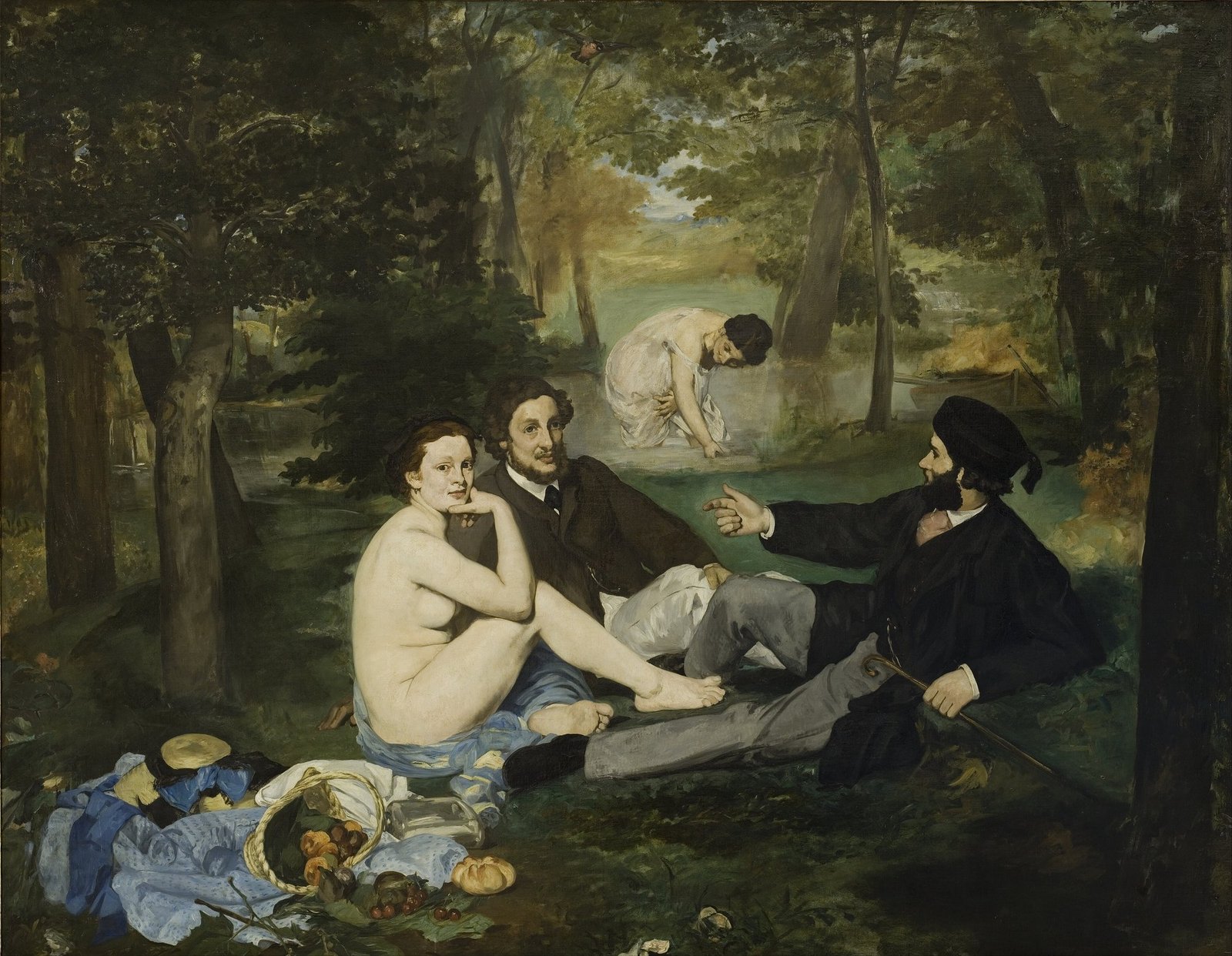
Manet removed the label. A naked woman sits on the grass beside two men in the frock coats and student caps of 1863, and looks straight out of the painting at whoever is standing in front of it.
That combination — contemporary clothing next to a contemporary nude — had no precedent, and no available explanation. Was it a picnic? An assignation? Nobody could say, and the ambiguity was the offence.
The handling made it worse. Manet lit the figure flatly, almost without half-tones, so the body reads as a pale shape rather than a modelled form. Critics said it looked unfinished, like a playing card.
Who the figures are
All three are identifiable, which surprises people.
The nude is Victorine Meurent, Manet’s principal model of the 1860s. She sat for Olympia, The Street Singer and The Railway.
The usual story that she died destitute and alcoholic is false. Research published in the 2000s established that she was a painter who exhibited at the Salon in 1876 — a year Manet was rejected — and again in 1879, 1885 and 1904. She died in 1927, aged eighty-three.
The man on the right is Eugène Manet, the artist’s younger brother, who later married Berthe Morisot.
The man reclining on the left is Ferdinand Leenhoff, a Dutch sculptor and the brother of Suzanne Leenhoff, whom Manet married in 1863 — the year of the painting.
So the scene is a family group with a professional model. That is one reason it unsettled viewers who knew the people involved.
Where the composition comes from
Manet was not improvising. He was quoting, deliberately and visibly.
The arrangement of the three figures derives from a group of river gods in Marcantonio Raimondi’s engraving of The Judgement of Paris, made around 1515 after a lost drawing by Raphael.
The setting — figures in a landscape, one nude, one clothed — comes from Giorgione and Titian’s Pastoral Concert, then in the Louvre and attributed to Giorgione. Manet could see it any day he liked.
The point of the quotation was to make the double standard visible. The same composition, in a Renaissance frame, hung in the national museum and troubled nobody. Transposed into the Bois de Boulogne it was obscene.
The Salon des Refusés
The circumstances of the exhibition are worth knowing, because they made the scandal possible.
In 1863 the Salon jury rejected around three thousand of the five thousand works submitted. The outcry was loud enough that Napoleon III intervened and ordered a separate exhibition of the refused works so the public could judge.
It opened in May 1863 in an annexe of the Palais de l’Industrie. Attendance was enormous — reportedly several thousand on the opening Sunday alone — and much of the crowd came to laugh.
Manet’s painting became the centrepiece of the ridicule. Caricatures ran in the press. The Emperor himself is said to have called it indecent.
The title was different then. Manet exhibited it as Le Bain. The name it now carries came later.
Two years later he submitted Olympia to the official Salon and the same thing happened again, worse.
What to look for
The gaze. Level, unembarrassed, aimed outward. She is not looking at either man.
The still life. Lower left: a spilled basket, a blue dress, cherries, figs, a bread roll. Painted more carefully than anything else in the canvas. Manet put a supposedly minor genre in the foreground of a major picture.
The bather. Behind the group, a woman in a shift crouches in the water. She is far too large for her position in the space. The perspective does not resolve, and it is not an error.
The bullfinch. A small bird hovers in the upper centre, against the foliage. Very easy to miss.
The frog. Lower left, in the grass below the still life. In the slang of the period grenouille meant a woman of loose morals — a joke Manet left for anyone who looked closely enough.
The light. There is no consistent source. The figures are lit from the front, the background from elsewhere. The space does not hold together, and the painting does not care.
About Édouard Manet
Born in Paris in 1832 to a senior judge and the daughter of a diplomat. He failed the naval entrance examination twice before being permitted to study painting under Thomas Couture, where he stayed six years.
Spain shaped him more than France — Velázquez and Goya above all.
He never exhibited with the Impressionists, though Monet, Degas, Renoir and Morisot regarded him as their starting point. He wanted the Salon’s approval and kept submitting to it for twenty years.
He received the Légion d’honneur in 1881, two years before his death. He died in 1883 at fifty-one, of complications of syphilis; his left leg had been amputated eleven days earlier.
Monet’s answer, and what came after
The reply from Monet is the best-known response, and it went badly.
In 1865 the twenty-five-year-old Monet began his own Déjeuner sur l’herbe — around four by six metres, intended for the Salon. He worked on it at Chailly, in the forest of Fontainebleau, with Bazille and Camille Doncieux posing.
He did not finish it in time. He left the rolled canvas with his landlord at Argenteuil against unpaid rent, and recovered it only in 1884. Damp had ruined much of it.
He cut out two sections and destroyed the remainder. Both fragments are now in the Musée d’Orsay, a few rooms from Manet’s painting. There is also a smaller complete study, in Moscow.
Later responses were more confident. Picasso made around 150 works based on the composition between 1959 and 1962 — paintings, drawings, and later concrete sculptures. Cézanne, Bazille and, much later, Alain Jacquet and Yasumasa Morimura all returned to it.
How it reached the museum
The painting remained with Manet, unsold, for years. It was bought in 1878 by the baritone Jean-Baptiste Faure, a singer at the Opéra and one of the most important early collectors of Impressionism.
In 1906 the state acquired it through the Moreau-Nélaton bequest and placed it in the Musée des Arts Décoratifs; it went to the Louvre and, in 1986, to the Musée d’Orsay.
Where to see it today
The painting is at the Musée d’Orsay, Esplanade Valéry Giscard d’Estaing, in the former Gare d’Orsay.
- Closed Mondays. Hours and prices change; check before travelling. There is one late evening a week.
- Book online — queues without a reservation are long.
- It is very large. Over two by two and a half metres. Reproductions make it look like an easel picture; it was scaled for the Salon wall.
- Find Monet’s two fragments in the same museum. Seeing the challenge and the wreck of the answer in one visit is the best thing this building offers.
- Olympia is a few rooms away — the two 1863 pictures that made Manet’s reputation and ruined his standing.
Frequently asked questions
Who are the people in the painting?
Victorine Meurent, Manet’s principal model, and two men from his own family circle: his brother Eugène Manet and Ferdinand Leenhoff, brother of the woman Manet married that year.
Why was it so scandalous?
Not the nudity — the Salon was full of nudes. It was that the woman was recognisably contemporary, sat beside men in modern dress, and looked directly at the viewer. There was no mythological subject to explain the scene.
What is it based on?
A group of river gods in Marcantonio Raimondi’s engraving after Raphael’s lost Judgement of Paris, and on the Venetian tradition of Pastoral Concert, then in the Louvre. Manet quoted respectable sources on purpose.
What was the Salon des Refusés?
An exhibition of works rejected by the 1863 Salon jury, ordered by Napoleon III after the scale of the rejections caused a public outcry. Crowds came largely to mock, and Manet’s painting drew most of the mockery.
What happened to Monet’s version?
He never finished it, left it with a landlord as security for rent, and recovered it years later damaged by damp. He cut out two fragments and destroyed the rest; both survive in the Musée d’Orsay.
What did Picasso do with it?
Between 1959 and 1962 he produced around 150 works based on the composition, including paintings, drawings and concrete sculptures installed in Sweden.
If this painting has caught your interest, look next at Olympia — made the same year, exhibited two years later, and the painting that turned Manet from a curiosity into a public scandal.
Image: Le Déjeuner sur l’herbe – Édouard Manet (1863). License: Public Domain. Source: Wikimedia Commons.