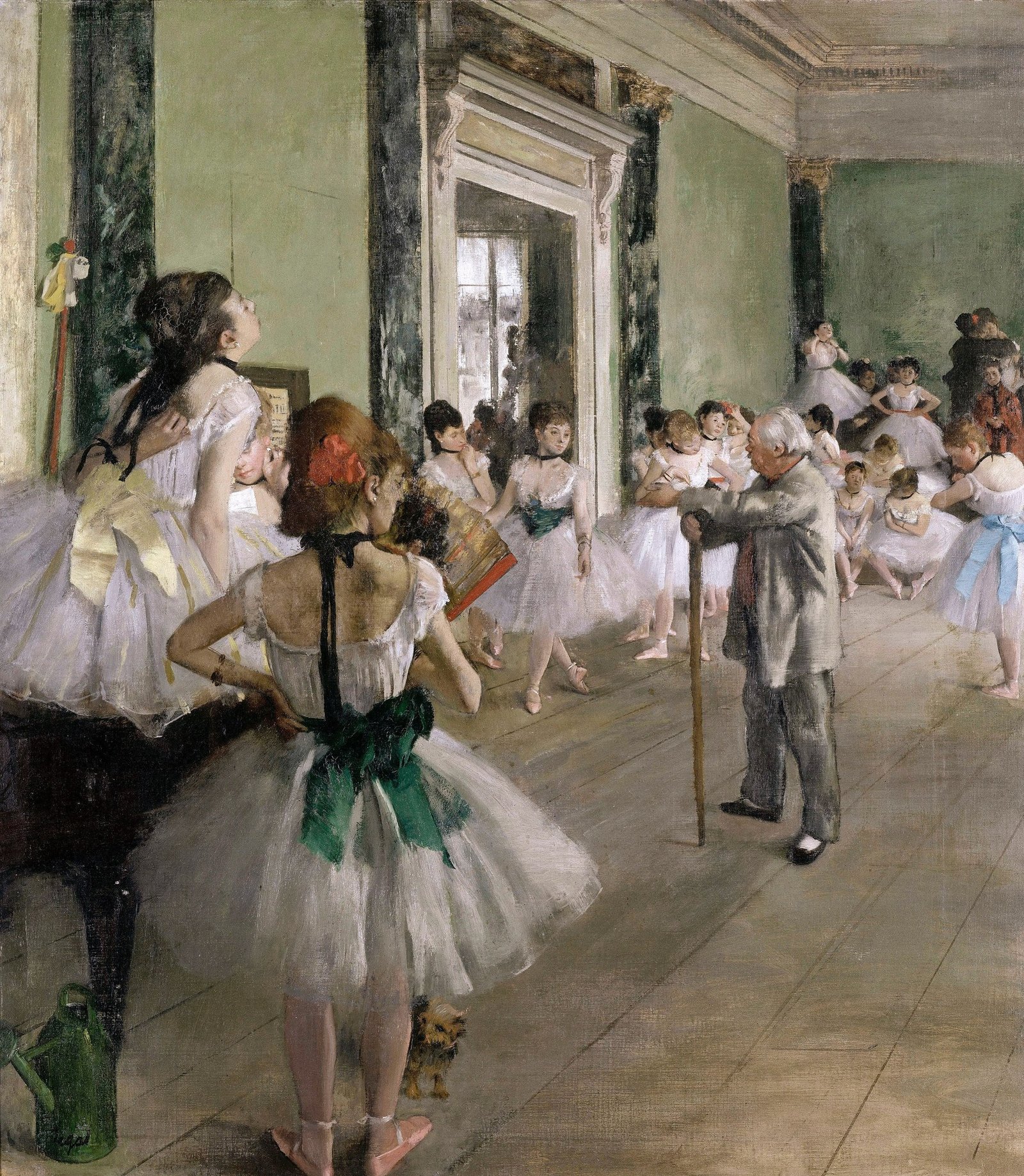
The Dance Class
The old man with the stick is not an anonymous ballet master. He is Jules Perrot — the choreographer of Giselle, one of the greatest dancers of the Romantic ballet, who had partnered Marie Taglioni and toured Europe as a star. By 1874 he was seventy-four, retired and largely forgotten. Degas painted him from a separate study and inserted him into a rehearsal room he probably never worked in.
Quick Facts
- Artist: Edgar Degas (1834–1917)
- French title: La Classe de danse
- Years: 1874, with later reworking
- Medium: Oil on canvas
- Dimensions: 83.5 × 77.2 cm
- Movement: Impressionism
- Location: Metropolitan Museum of Art, New York
What makes it unforgettable?
Ballet in nineteenth-century painting meant the stage: the moment of arrival, the arabesque, the applause.
Degas painted the room where none of that happens.
Look at what the dancers are actually doing. One scratches her back. One adjusts an earring. One sits on a piano. One yawns. A mother waits in the background with a newspaper. Almost nobody is dancing.
This is a workplace, and the painting treats it as one — with its boredom, its waiting, and its physical cost.
The composition is the other half of it. The floor tilts up towards the viewer, the vanishing point sits off to one side, and figures are cut by the frame. It looks like a glance through a doorway. It is nothing of the sort — Degas built it from dozens of separate drawings.
The room and the men who could enter it
This is context the painting depends on, and it is usually softened.
The dancers of the Paris Opéra were mostly girls from poor families, some as young as seven. They were known as petits rats. Training was long, competition brutal, and wages low.
Wealthy subscribers to the Opéra — the abonnés — held the right of access to the rehearsal rooms and the foyer de la danse behind the stage. Women were not admitted. The arrangement was understood by everyone: the men came to look at the dancers and to make arrangements with them or their mothers.
Degas held that access. He was there as an abonné and as an artist, and he painted the system from inside it.
His paintings do not condemn it. But they do not hide it either. In several of his ballet scenes a man in black stands at the edge of the frame, watching.
The mothers in the background are part of the same picture. They came to protect their daughters, and to negotiate.
Two paintings, not one
There are two closely related canvases and they are constantly confused.
This one, in New York, was begun in 1874 for the singer Jean-Baptiste Faure and reworked afterwards. Perrot stands at the centre; a dancer sits on the piano at the right.
The other, in the Musée d’Orsay, was painted between about 1873 and 1876. Perrot appears there too, in the same pose, taken from the same study.
The Orsay version is generally considered the earlier conception; the New York painting is the more worked one.
Both are set in the old Opéra on the rue Le Peletier — a building that burned down in October 1873, before either painting was finished. Degas was reconstructing a room that no longer existed.
What to look for
Perrot. Centre, leaning on a long stick. The stick was a working tool — ballet masters beat time with it on the floor.
The girl on the piano. Right side, seated on the instrument with her back partly turned, scratching. The single most quoted detail in the painting.
The mothers. Two women at the back, in street clothes, one reading. They do not belong to the world of the tutus and that is the point.
The dog. Small, at the lower edge, easily missed.
The watering can. On the floor at the left. Rehearsal rooms were damped down to keep the dust off the boards.
The floor. Wide and empty in the foreground, which is unusual and unbalancing. The eye is pushed towards the figures on the far side.
The ribbons and sashes. Thin notes of orange, red and green scattered through an otherwise white and grey painting. They hold the composition together.
Historical context
1874 was the year of the first Impressionist exhibition, which Degas helped organise.
He was, though, an awkward member of the group. He painted indoors, from memory and drawings, and detested the word Impressionist. He called himself a realist. He worked from studies in the studio, not from the motif.
His compositional sources were photography and Japanese woodblock prints — both of which suggested that a picture could be cut off at the edge, viewed from an odd angle, and organised around empty space.
France was three years out of the Commune. The Opéra was one of the institutions through which the Third Republic asserted that order had returned.
About Edgar Degas
Born in Paris in 1834 into a banking family; the name was originally de Gas. He trained in the classical tradition and copied in the Louvre and in Italy.
He worked in oil, pastel, monotype, photography and wax. Around half of his output concerns dancers — some fifteen hundred works.
His eyesight failed progressively from the 1880s, which pushed him towards pastel and modelling in wax, where touch mattered more than precision.
He never married and became increasingly reclusive. During the Dreyfus affair he took a vehemently antisemitic position and broke off lifelong friendships over it, including with the Halévy family. It is a part of his biography that ought not to be omitted.
He died in 1917, aged eighty-three.
Legacy and influence
Degas changed what a picture could be cropped like. The off-centre subject, the figure cut by the frame, the tilted floor — these entered photography and then cinema, and are now so standard as to be invisible.
His dancers also created a problem. They made the ballet world look charming. Reproduced on calendars and biscuit tins, the paintings turned into exactly the sentimental image Degas was working against.
The corrective came from an unexpected direction: his own sculpture, Little Dancer Aged Fourteen, which audiences in 1881 found ugly and disturbing. That work makes the economic reality impossible to miss.
Where to see it today
The painting is at the Metropolitan Museum of Art, Fifth Avenue at 82nd Street, in the European paintings galleries.
- Check hours before travelling. Admission is pay-what-you-wish only for residents of New York State and students from New Jersey and Connecticut; everyone else pays a set rate.
- Weekday mornings are quietest.
- Look at the right-hand side first. The girl on the piano is the key to the painting, and most visitors start at the centre and never get there.
- The Met holds a very large group of Degas pastels and several of his bronzes, including a cast of the Little Dancer.
- The companion painting is in the Musée d’Orsay in Paris.
Frequently asked questions
Who is the man with the stick?
Jules Perrot, a celebrated dancer and choreographer of the Romantic ballet and the creator of Giselle. By 1874 he was in his seventies and retired. Degas painted him from a separate study and placed him in the scene.
Is this a real room?
It is based on the old Opéra on the rue Le Peletier — which burned down in 1873, before the painting was finished. Degas reconstructed it from drawings and memory.
What is the difference between this and the Orsay painting?
They are two related canvases from the same period, both showing Perrot in the same pose. This one, in New York, was painted for the singer Jean-Baptiste Faure and reworked afterwards; the Orsay version is generally taken as the earlier conception.
Who were the dancers?
Mostly girls from poor Parisian families, some beginning training at seven. They were called petits rats. Wealthy male subscribers to the Opéra had the right to enter the rehearsal rooms, and the sexual dimension of that arrangement was widely understood.
Was Degas an Impressionist?
He helped organise the group’s exhibitions but rejected the label and called himself a realist. He painted indoors, from drawings, in the studio — the opposite of Monet’s practice.
What is the girl on the piano doing?
Scratching her back, in a gesture completely at odds with the elegance of her costume. It is the detail that tells you what kind of painting this is.
If this painting has caught your interest, look next at Little Dancer Aged Fourteen — Degas’s sculpture of a real fourteen-year-old from the same institution, which audiences in 1881 found genuinely repellent.
Image: La Classe de danse – Edgar Degas (1874). License: Public Domain. Source: Wikimedia Commons.