Little Dancer of Fourteen Years
For several weeks in 1881 the display case stood empty. Degas had shipped the vitrine to the Impressionist exhibition on time, with a label, and then failed to deliver the sculpture. Visitors came, read the catalogue entry, and looked at glass. He installed her only weeks after the opening — by which point the empty case had done its own work on the public’s expectations.
Quick Facts
- Artist: Edgar Degas (1834–1917)
- French title: Petite danseuse de quatorze ans
- Made: c. 1878–1881
- Medium: tinted beeswax over an armature, with real tutu, bodice, slippers and hair ribbon; hair from a wig
- Height: c. 98 cm
- Movement: Impressionism
- Original: National Gallery of Art, Washington, D.C.
- Bronze cast: Musée d’Orsay, Paris, among others
What makes it unforgettable?
In 1881 sculpture meant marble and bronze, gods and generals, and a surface you could not mistake for skin.
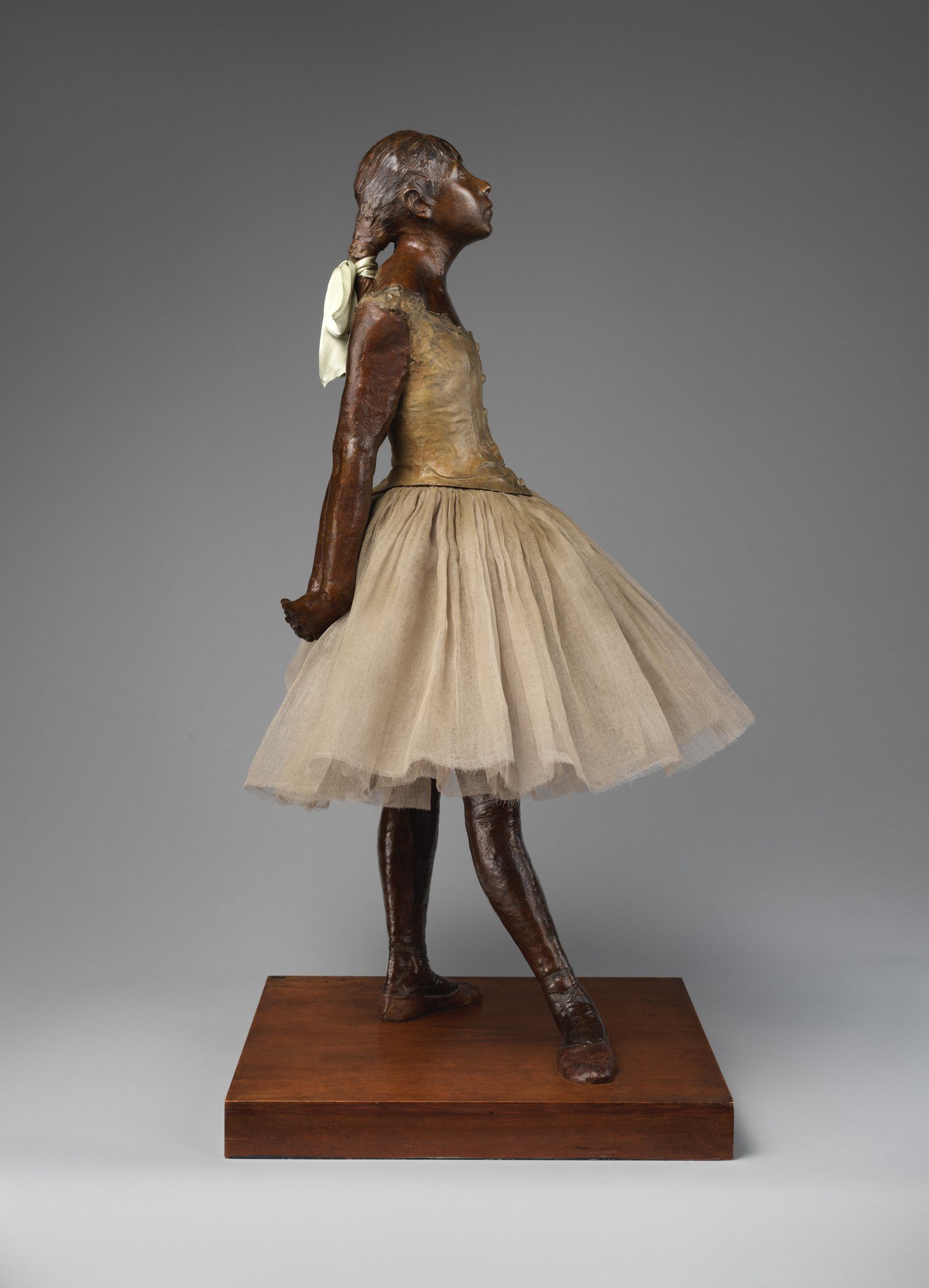
Degas made a girl out of wax, put a real cotton tutu on her, tied a real ribbon in real hair, and stood her in a glass case of the kind used for anatomical specimens and natural-history displays.
That case is part of the work. It framed her as a specimen, and contemporaries noticed.
The pose is a fourth position, arms clasped behind the back, chin raised, eyes nearly shut. It is not a step. It is the posture of someone waiting to be looked at, and enduring it.
What the critics actually said
The reaction is usually softened into “controversial.” It was worse than that.
Several reviewers described her face in terms drawn from criminal physiognomy — the pseudo-science, then fashionable, that claimed criminality was legible in facial features. One called her a flower of the gutter; another wrote of the face of a young monkey. Her forehead, jaw and half-closed eyes were read as markers of vice.
It is worth understanding why. Degas exhibited two other works at the same show: studies of the heads of convicted murderers, drawn at their trial. Critics saw them together and drew the obvious conclusion about what he was proposing.
The dancer was fourteen, poor, and in a glass case, and educated Parisians looked at her and saw a criminal type.
A few dissented. Joris-Karl Huysmans wrote that Degas had overturned the traditions of sculpture at a single blow, and called her the only genuinely modern attempt in the medium he knew.
Degas never exhibited a sculpture again. This was the only one he showed in his lifetime.
Marie van Goethem
She was a real person and her story is short and bad.
Born in Paris in 1865 to Belgian parents — a tailor and a laundress. Her father died; her mother, by several accounts, worked as a laundress and the family lived close to destitution.
Marie and her two sisters all entered the Opéra ballet school. The wage was the point. A place in the corps meant money coming into the household.
She posed for Degas at around fourteen, in his studio on the rue Fontaine.
She was dismissed from the Opéra in 1882, the year after the exhibition, for repeated absence. Press reports from the period place her at the Brasserie des Martyrs and the Rat Mort, cafés with a particular reputation.
After that there is nothing. No marriage record, no death record, no trace. One of the most recognisable figures in Western sculpture disappears from the archive at seventeen.
Her sister Antoinette was convicted of theft. Her sister Louise-Joséphine stayed at the Opéra and later taught.
What to look for
The ribbon. Real silk, in the original. On bronze casts it is the only part left as fabric — everything else is metal, and the ribbon jars deliberately.
The bodice. On the original wax it is coated in wax, which stiffened and yellowed it. It looks worn because it was.
The face. Chin up, eyes almost closed. Whether this reads as pride, exhaustion or defiance depends entirely on the viewer, and Degas left it that way.
The feet. In fourth position, but not correctly — the placement is slightly off, which is what a tired student’s fourth actually looks like.
The hands. Clasped behind the back, fingers interlaced and tense. The most expressive part of the figure.
The back. Walk round. The spine and shoulder blades are modelled with a precision the front does not show, and the pose reads quite differently from behind.
Wax, bronze, and where the original is
This needs setting out, because the location is widely misreported.
The original is wax, and it is in Washington, at the National Gallery of Art — part of the Mellon collection. It is fragile and rarely travels.
Degas made no bronze of it. After his death in 1917, around 150 wax and clay pieces were found in his studio, many damaged. His heirs commissioned the Hébrard foundry to cast them.
The bronzes of the Little Dancer were produced in the 1920s, in an edition of roughly two dozen plus proofs. Each was given a fabric tutu and a ribbon.
So the figure in the Musée d’Orsay, and those at the Met, the Tate, and elsewhere, are posthumous bronzes. They are not what the 1881 audience saw.
This matters more than it sounds. The scandal was partly about wax — a material associated with medical models and waxworks, not with art.
About Edgar Degas
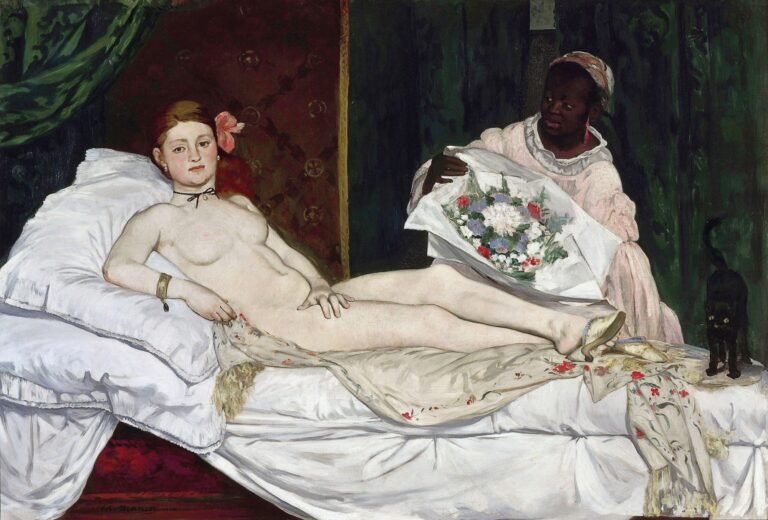
Born in Paris in 1834 into a banking family. Classically trained, he copied in the Louvre and in Italy before Manet pulled him towards modern subjects.
He rejected the label Impressionist and called himself a realist. He worked indoors, from drawings, in the studio.
His sight failed from the 1880s onward, which pushed him increasingly towards pastel and modelling in wax — media where touch compensated for what he could not see.
During the Dreyfus affair he took a vehemently antisemitic position and broke with lifelong friends over it. It belongs in any account of him.
He died in 1917, aged eighty-three.
Legacy and influence
The use of real materials on a figurative sculpture had almost no precedent and few immediate followers. It became normal only in the twentieth century.
The line runs to Duane Hanson and Ron Mueck — hyper-real figures that unsettle precisely because they hover between object and person.
Her silhouette is now everywhere: in fashion photography, in advertising, on ballet-school walls. The irony is considerable. A figure that audiences found repellent, made of a girl who was discarded by the institution that employed her, has become a decorative emblem of ballet.
Several novels and a 2014 stage musical have tried to reconstruct Marie’s life. All of them are inventing, because the record stops.
Where to see it today
The original wax is at the National Gallery of Art in Washington, D.C. Admission is free. It is not always on view — check before travelling.
Bronze casts are held by the Musée d’Orsay in Paris, the Metropolitan Museum in New York, Tate in London, the Museu de Arte de São Paulo and others.
- Walk all the way round. The front is the famous view; the back is the better one.
- Look at the ribbon and the tutu — the only soft things on a bronze figure, and the reason the sculpture still unsettles.
- In Paris, see her with Degas’s pastels of dancers in the same building. The two-dimensional and three-dimensional work were made from the same studies.
- Check opening hours and prices before you travel.
Frequently asked questions
Where is the original?
At the National Gallery of Art in Washington, D.C. It is wax, and fragile. The versions in Paris, New York and London are bronzes cast after Degas’s death.
Why did the sculpture cause a scandal?
Because of the materials — wax and real clothing, associated with waxworks and medical models rather than art — and because critics read the girl’s features through the pseudo-science of criminal physiognomy. Degas showed studies of convicted murderers at the same exhibition, which encouraged the connection.
Who was the model?
Marie van Goethem, born in Paris in 1865 to Belgian parents, a student at the Opéra ballet school. She was dismissed in 1882 for absenteeism and disappears from the record entirely thereafter.
Did Degas exhibit other sculptures?
No. This was the only one he showed publicly. Around 150 wax and clay pieces were found in his studio after his death, and the bronzes were cast from them by his heirs.
Why was the case empty at first?
Degas sent the vitrine to the 1881 exhibition but not the sculpture. It stood empty for several weeks, with the catalogue entry in place, before he finally installed the figure.
Is the tutu original?
On the Washington wax, the fabric has been replaced more than once for conservation reasons. The bronzes are each dressed in a new tutu and ribbon, which is why they differ from one another.
If this sculpture has caught your interest, look next at The Dance Class — the same institution, the same girls, painted a few years earlier, and far easier to look at.
Image: Petite danseuse de quatorze ans – Edgar Degas (c. 1878–1881). License: Public Domain. Source: Wikimedia Commons.