The Scream
Most people recognize The Scream instantly — but almost nobody knows that Edvard Munch was inspired to paint it after watching the sky turn blood-red during a real evening walk, an effect often attributed to the atmospheric fallout from the catastrophic 1883 eruption of Krakatoa.
Quick Facts
- Artist: Edvard Munch
- Year: 1893
- Medium: Oil, tempera, and pastel on cardboard
- Dimensions: 91 cm × 73.5 cm (35.8 in × 28.9 in)
- Movement: Expressionism
- Current location: National Museum, Oslo
What Makes The Scream So Unforgettable?
There is something almost unfair about how effectively The Scream communicates dread. Within a single glance, it bypasses rational thought and lands somewhere primal. That is not an accident — it is the result of an artist translating an intensely personal psychological crisis into a visual language so universal that it has endured for over a century without losing a single volt of its charge.
What truly sets this work apart is its honesty. Munch was not painting an allegory or a mythology. He was painting himself — or more precisely, the feeling of coming apart at the seams while the world continued spinning indifferently around him. That raw autobiographical urgency is something viewers sense even without knowing the backstory, and it is why the image refuses to become wallpaper no matter how many times you encounter it on a coffee mug or a Halloween mask.
The Scream also occupies a rare position in art history: it is simultaneously a deeply private confession and one of the most publicly legible images ever made. Very few works manage both at once.
Historical Context
The early 1890s were a period of profound turbulence — not just for Munch personally, but for European culture at large. Industrialization had uprooted traditional ways of life, Darwin had shaken the foundations of religious certainty, and Sigmund Freud was beginning to map the murky territories of the unconscious mind. Anxiety was not just a personal affliction; it was a cultural mood.
In the art world, Impressionism had already liberated painters from strict realism, but many artists felt that capturing light on a pond was not enough to express what it felt like to be alive in a rapidly changing, often terrifying world. Munch was among those pushing further — into inner states, emotional extremes, and psychological truth over visual accuracy.
When The Scream was first exhibited in Berlin in 1893 under the German title Der Schrei der Natur (The Scream of Nature), it scandalized and electrified audiences in equal measure. It would go on to become one of the founding documents of Expressionism, a movement that would reshape painting, theater, film, and architecture across the twentieth century.
Symbolism and What to Look For
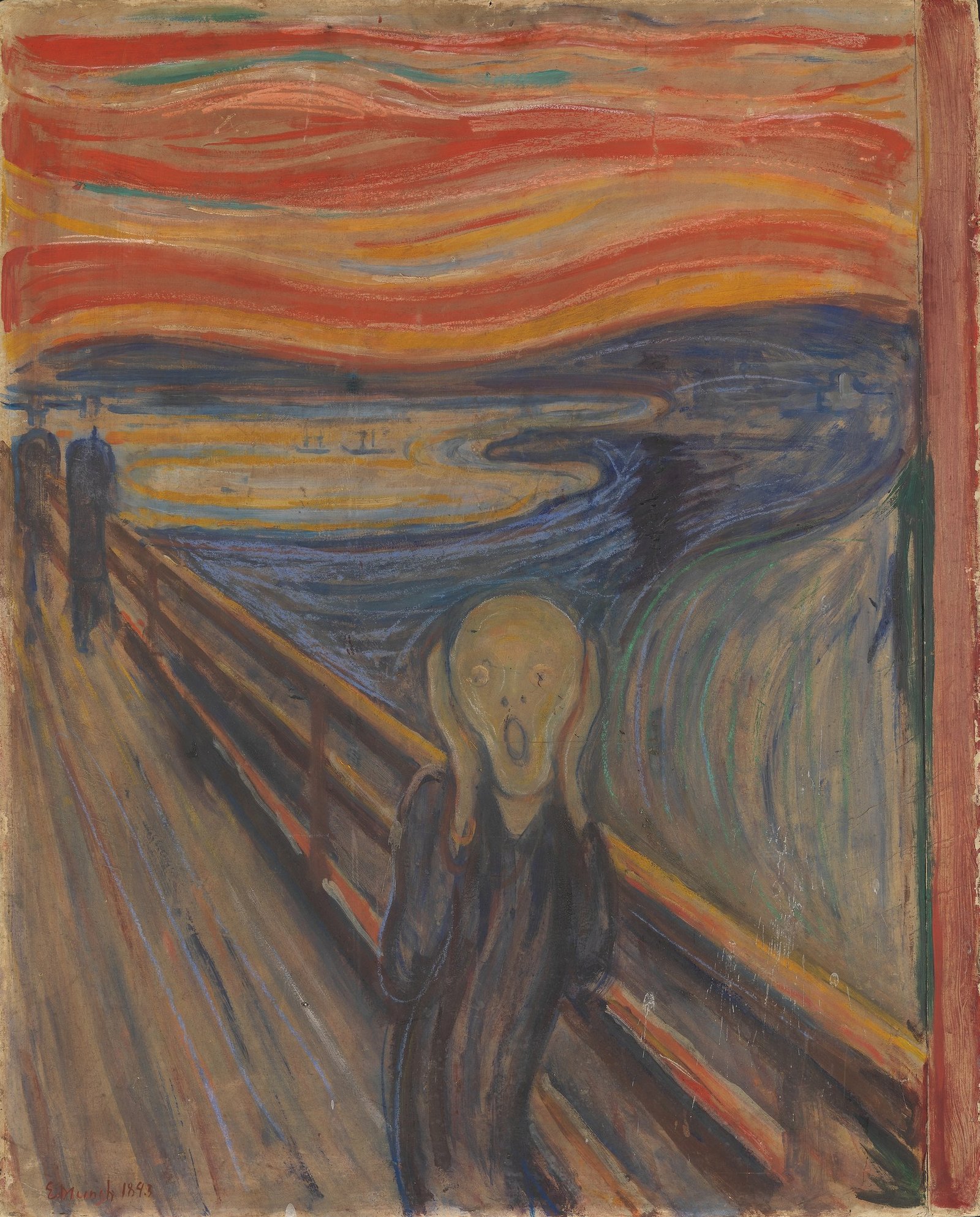
Stand in front of The Scream — or study a high-quality reproduction — and start with the sky. Those undulating bands of red, orange, and yellow are not decorative flourishes. They are the visual equivalent of a shriek: unstable, overwhelming, impossible to ignore. Munch recorded in his diary that he felt the sky had turned to blood and sensed an infinite scream passing through nature. Every wavy line in the composition echoes that scream outward from the central figure.
While you are looking at that sky, find the pencil line running across it in the upper left. It reads: can only have been painted by a madman. For most of the twentieth century it was assumed to be graffiti left by an offended visitor. In 2021 the National Museum published an infrared analysis comparing the letterforms with Munch’s own letters and diaries, and the conclusion was unambiguous — he wrote it himself, most likely in 1895, after a medical student argued publicly that his paintings proved he was not of sound mind. It is one of several recent findings that overturned what catalogues had said for decades. See the full list.
Where those colours came from is still argued over. The astronomer Donald Olson proposed in 2003 that Munch was recalling the lurid twilights caused by the 1883 Krakatoa eruption, which tinted skies across the northern hemisphere for months. Other researchers point to nacreous clouds, a rare high-altitude phenomenon that occurs at Norwegian latitudes and looks remarkably like the sky Munch painted. And a third camp argues that the search for a literal source misses the point entirely — Munch was an expressive painter with no obligation to record what he actually saw. All three readings are worth holding at once.
Now look at the figure itself. Notice that the face is deliberately simplified — almost skull-like, genderless, ageless. Munch stripped away any detail that might anchor the figure to a specific identity, because the feeling he was capturing belongs to everyone. The wide, hollow eyes and the open mouth create a void at the center of the painting that seems to pull the viewer in. And notice the hands: they are clamped over the ears, not framing a shout. The figure is not the one screaming. It is hearing something the rest of the scene cannot.
The two dark, upright figures in the background are Munch’s friends, walking calmly on the bridge while he experiences his private collapse. Their solidity and indifference amplify the central figure’s isolation. The railing of the bridge cuts a sharp diagonal through the composition, one of the only straight lines in the painting, grounding the swirling chaos in an uncomfortable reality.
Finally, look at the water and landscape below. The fjord is rendered in deep blues and greens, calmer than the sky but still rippling with unease. Munch uses color temperature masterfully — warm panic above, cool distance below — to trap the figure between two kinds of discomfort.
About Edvard Munch
Edvard Munch was born in 1863 in Løten, Norway, into a family shadowed by illness, death, and mental instability. His mother died of tuberculosis when he was five; his sister Sophie died of the same disease when he was fourteen. These early losses carved a permanent groove of grief into his personality and his art.
Munch studied in Oslo and later in Paris, where he encountered the work of the Post-Impressionists and absorbed their willingness to distort reality in service of emotional truth. But he always pushed further than his influences, developing a style of raw, almost violent emotional exposure that made him a polarizing figure in his lifetime and a towering one in retrospect.
He struggled with anxiety, alcoholism, and a nervous breakdown in 1908, after which he lived more quietly in Norway, still painting prolifically until his death in 1944. Today he is considered one of the most important artists of the modern era, and his exploration of psychological experience laid essential groundwork for the entire Expressionist movement.
Legacy and Influence
It is almost impossible to overstate how far The Scream’s influence has traveled. Expressionist painters like Ernst Ludwig Kirchner and Egon Schiele owe a direct debt to Munch’s willingness to make the inner world visible at any cost to conventional beauty. The distorted figures and emotionally charged color palettes that define Expressionism trace a clear line back to this single painting.
In popular culture, the image has become shorthand for anxiety itself. It appears in advertising, film, literature, and internet memes with a frequency that no other fine art painting can match. The 1996 horror film Scream borrowed the image directly for its iconic mask, cementing the painting’s place in mass culture. Despite — or perhaps because of — this ubiquity, the original work never loses its power. If anything, the constant reproduction makes the encounter with the real thing more startling.
The painting has also attracted extraordinary real-world drama. It was stolen from the National Gallery in Oslo in 1994 and again from the Munch Museum in 2004, each time triggering international headlines before being recovered. Even its theft stories read like art history.
Munch was painting a sensation rather than a scene, which is precisely the territory neuroscience has spent the last two decades mapping. Here is what brain imaging actually shows about why some paintings reach us and others leave us cold.
Where to See The Scream Today
The most celebrated version of The Scream — painted in oil, tempera, and pastel on cardboard — is now housed in the National Museum of Norway in Oslo, which opened its spectacular new building in 2022. The museum is centrally located near the waterfront at Brynjulf Bulls plass 3, and is easily walkable from Oslo’s main train station.
Plan to arrive early on weekdays to avoid the largest crowds. The museum offers audio guides that provide excellent context for Munch’s work, and the permanent collection is extensive enough to justify a half-day visit. While you are there, look out for other Munch works on display — seeing The Scream alongside his paintings Madonna and The Sick Child reveals the emotional universe this artist built across a lifetime.
If you want an even deeper Munch experience, the dedicated Munch Museum (MUNCH) on the Bjørvika waterfront — just a short tram or walk away — holds the largest collection of his work in the world, including additional versions of The Scream in pastel.
Frequently Asked Questions
Where is The Scream located?
The most famous painted version of The Scream is held at the National Museum in Oslo, Norway. A pastel version is also on permanent display at the nearby MUNCH museum in the same city.
When was The Scream created?
Munch created the primary painted version in 1893, though he returned to the subject multiple times, producing several versions in different media throughout the 1890s.
What does The Scream represent?
At its core, The Scream represents existential anxiety — the overwhelming feeling of dread and alienation that can descend without warning. Munch described the experience that inspired it as sensing an infinite scream passing through nature, making the painting as much about the world’s indifference as about personal anguish.
Is the figure in The Scream screaming?
Almost certainly not. The hands are pressed against the ears rather than cupped around the mouth, and Munch’s own account describes hearing a scream pass through nature rather than producing one. The title refers to the sound, not to the figure making it.
Who wrote the inscription on The Scream?
Munch did. The pencil line in the sky reading “can only have been painted by a madman” was long thought to be vandalism, but infrared analysis published by the National Museum in 2021 matched the handwriting to Munch’s own letters and diaries. Only the 1893 painted version carries it.
Why is The Scream so famous?
Its fame rests on a rare combination: a universally legible image of an emotion everyone has felt, executed with extraordinary artistic power. The simplified figure and swirling landscape speak across languages, cultures, and generations in a way very few artworks manage.
Was The Scream ever stolen?
Yes — twice. In 1994, thieves took a version from the National Gallery in Oslo; it was recovered three months later. In 2004, a different version was stolen from the Munch Museum at gunpoint and was recovered in 2006. Both incidents drew global media attention and led to significantly tightened security measures at Norwegian museums.
If The Scream has sparked your curiosity about Expressionism and the art of psychological intensity, explore our other posts on the artists and movements that have shaped the way we see the world. There is so much more to discover — and every great painting has a story worth knowing.
Image: The Scream – Edvard Munch (1893). License: Public Domain. Source: Wikimedia Commons.