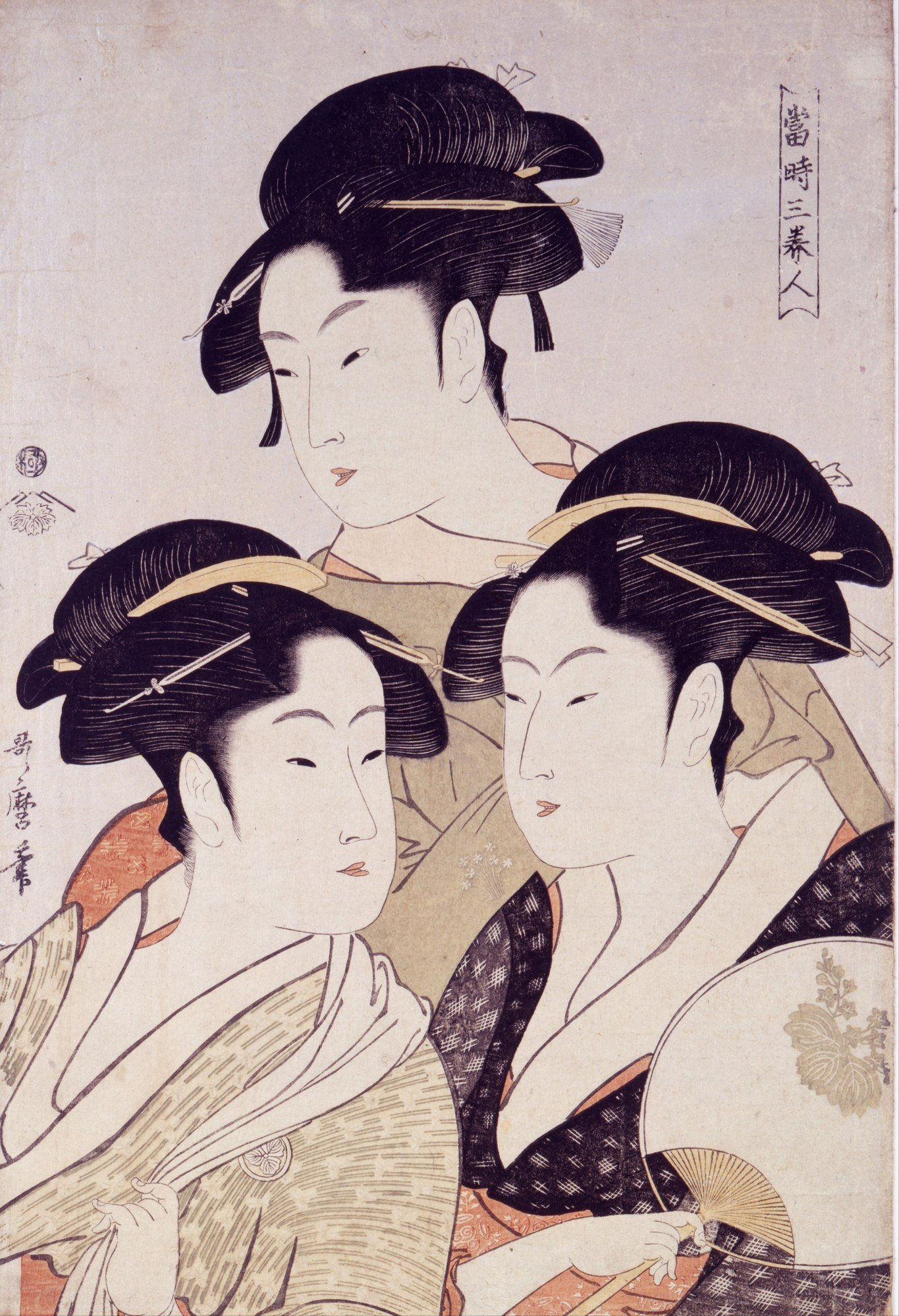
Three Beauties of the Present Day
These three women are not named on the print, because naming them had just been made illegal. In 1793 the shogunate banned the identification of women on woodblock prints — the argument being that it turned them into celebrities and encouraged vanity. Utamaro found a way round it. He identified each woman by her family crest on her kimono. Every buyer in Edo knew exactly who they were. The censor had nothing to object to.
Quick Facts
- Artist: Kitagawa Utamaro (c. 1753–1806)
- Japanese title: Tōji san bijin (当時三美人)
- Date: c. 1793
- Medium: Nishiki-e colour woodblock print with mica ground (kirazuri)
- Format: ōban, c. 38 × 25 cm
- Publisher: Tsutaya Jūzaburō
- Movement: Ukiyo-e, bijin-ga genre
- Where to find it: impressions at the Museum of Fine Arts, Boston, the British Museum, the Metropolitan Museum
Who they were
Three specific women, all recognisable in Edo.
Tomimoto Toyohina — at the top. A geisha and musician, a performer of tomimoto-bushi narrative song. Her crest is a paulownia leaf.
Naniwaya Okita — on the right. A waitress at a teahouse by the Asakusa temple. She was about sixteen and the most popular of the three; people went to the teahouse specifically to see her. Crest: a water chestnut leaf.
Takashima Ohisa — on the left. Daughter of the owner of a cake shop in Ryōgoku, where she also served customers. Crest: oak leaves in a circle.
None of them were courtesans. That is what separates this print from most bijin-ga — Utamaro portrayed women working in teahouses and a shop, people a passer-by could see that same afternoon.
One correction on the names: the honorific prefix means the correct forms are Okita and Ohisa, not Kita and Hisa.
How Utamaro got round the censors
This is the essential context for the print.
The Kansei Reforms, imposed from 1787 by Matsudaira Sadanobu, were intended to curb extravagance and loosening morals. Publishing was included.
In 1793 an edict banned naming women on prints, on the grounds that it made celebrities of them.
Utamaro responded immediately. Instead of inscriptions he placed mon — family crests — on the kimonos. In Edo Japan these were universally legible, rather as logos are now.
Buyers knew the crests from teahouse signs and from earlier prints. They knew precisely who was who. Formally, though, no name appeared on the sheet.
The censor won on paper; Utamaro won in practice.
What makes it remarkable
First, the ground. Utamaro used kirazuri — glue dusted with powdered mica, giving a metallic shimmer. On well-preserved impressions it is still visible; on worn ones the mica has rubbed away and the background simply looks grey.
Second, the composition. Three heads in a triangle, no background, no props, no interior. This is close to the bust format Utamaro popularised — ōkubi-e, “large head pictures.”
Third, the paradox of resemblance. The faces are nearly identical: the same oval, the same eyes, the same mouth. What distinguishes them is a slight tilt of the gaze, a set of the lips, and the crest.
Utamaro was not painting physical likeness. He was painting fame. Recognition worked through attributes, not through features.
That is a different logic of portraiture from the Western one, and it is worth registering.
Historical context
Late eighteenth-century Edo was probably the largest city in the world, with over a million inhabitants. Woodblock prints were a mass-market product — cheap, printed in the hundreds, widely circulated.
The publisher of this print was Tsutaya Jūzaburō, the most important publisher of the period. He made Utamaro’s career — and had himself been penalised a few years earlier for publications that breached the reforms, losing half his property.
Utamaro ran into the authorities himself in 1804, over a print depicting the sixteenth-century ruler Toyotomi Hideyoshi. He spent three days in detention and fifty in manacles. He died two years later; some scholars connect the two.
What to look for
The crests. Three different designs — paulownia, water chestnut, oak. These replaced the signatures.
The shimmer of the ground. On a good impression the background has a metallic sheen. That is mica, not pigment.
The hands. Only partly visible, with the elongated fingers that are a hallmark of Utamaro’s drawing.
The fan. Toyohina holds one with a visible design — an attribute of her profession.
The hairstyles. Three different arrangements, signalling status and occupation. In Edo a hairstyle was information.
Necks and napes. Utamaro always gave these attention. An exposed nape was considered particularly attractive in Japan, and the line of the neck is one of his recurring motifs.
This is a print, not a painting
Worth restating, because it changes how one thinks about the object.
Utamaro drew the design. A block cutter carved the blocks — one per colour — destroying the original drawing in the process. A printer pulled the impressions by hand. A publisher financed it and made the decisions.
Print runs went into the hundreds, and popular designs were reissued for years. Later impressions are markedly weaker: lines thicken, colours lose precision, the mica disappears.
There is therefore no single original. There are impressions of varying quality, scattered across museums worldwide.
About Kitagawa Utamaro
Born around 1753, probably in Edo. Little is known of his early life — not even his birthplace with certainty.
His career turned on the partnership with Tsutaya Jūzaburō, in whose house he initially lived. Utamaro developed the bijin-ga genre, introducing close-up framing and psychological differentiation.
He also produced work of an entirely different character: the Book of Insects, a set of natural-history studies of remarkable precision, and shunga erotic series, which form a substantial part of his output.
He died in 1806, leaving several thousand designs.
Legacy and influence
The idea at work here — a mass-reproduced image of a recognisable person, sold to her admirers — sounds familiar two hundred and thirty years later.
The Western impact came after Japan opened. Japonisme reshaped European painting at the end of the nineteenth century: flat colour, cropped framing, line instead of modelling.
Degas and Toulouse-Lautrec took the composition and the cropping. Klimt took the decorative flatness. Van Gogh copied Japanese prints in oil.
One thing is worth keeping in proportion, though. To Europeans these were sophisticated minimalism. To an Edo buyer they were a cheap print, bought much as one buys a photograph of a performer.
Where to see it
Impressions are held at the Museum of Fine Arts in Boston, the British Museum, the Metropolitan Museum in New York and the Tokyo National Museum, among others.
- Check whether it is on display before visiting. Works on paper are rotated, usually for a few weeks every few years. This is the commonest cause of disappointment.
- The MFA holds one of the largest ukiyo-e collections outside Japan — over fifty thousand objects, most of them digitised.
- High-resolution scans are available free online. For a print this is a reasonable substitute: you can see the crests, which are invisible through glass at normal viewing distance.
- The museum is on Huntington Avenue in the Fenway; allow two to three hours for the Japanese galleries.
Frequently asked questions
Who are the three women?
Tomimoto Toyohina, a geisha and musician; Naniwaya Okita, a teahouse waitress in Asakusa; and Takashima Ohisa, daughter of a cake-shop owner in Ryōgoku. All three were recognisable figures in Edo.
Why are their names not on the print?
Because in 1793 the shogunate banned naming women on woodblock prints. Utamaro circumvented the ban by placing family crests on their kimonos, which contemporary buyers read without difficulty.
Why do the faces look so alike?
Because Utamaro was not aiming at physical likeness. Recognition operated through attributes — crest, hairstyle, prop — rather than through features. It is a different logic of portraiture from the European one.
What is kirazuri?
A technique in which the background is coated with glue and dusted with powdered mica, producing a metallic shimmer. On worn impressions the effect has disappeared and the ground looks flat grey.
Is there a single original?
No. This is a woodblock print, pulled in hundreds of impressions from the same blocks. Surviving examples differ in quality — earlier ones are sharper and retain the mica.
What happened to Utamaro?
In 1804 he was punished for a print depicting Toyotomi Hideyoshi: three days in detention and fifty days in manacles. He died two years later.
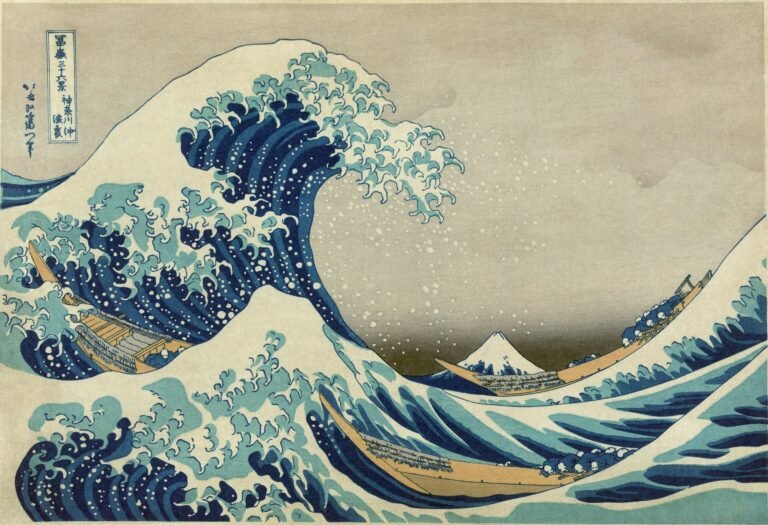
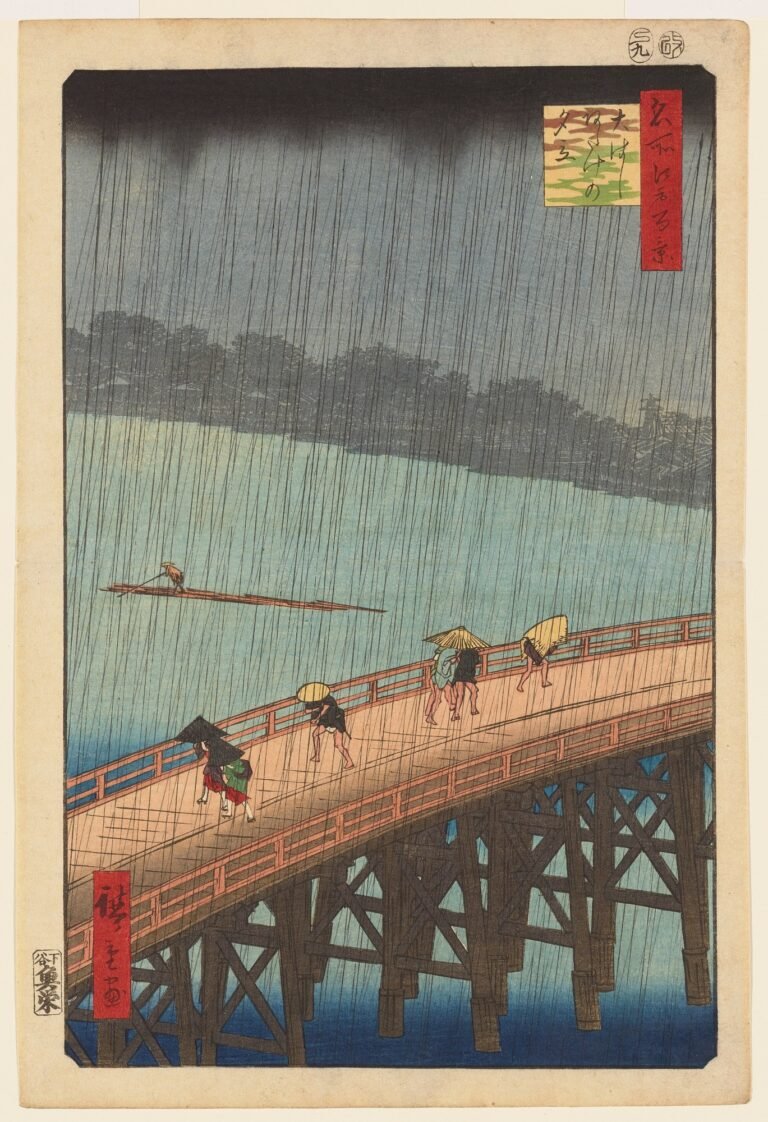
If this print has caught your interest, look next at The Great Wave off Kanagawa by Hokusai and Sudden Shower over Shin-Ōhashi Bridge by Hiroshige — three faces of the same technique and the same commercial market.
Image: Tōji san bijin – Kitagawa Utamaro, c. 1793. License: Public Domain. Source: Wikimedia Commons.