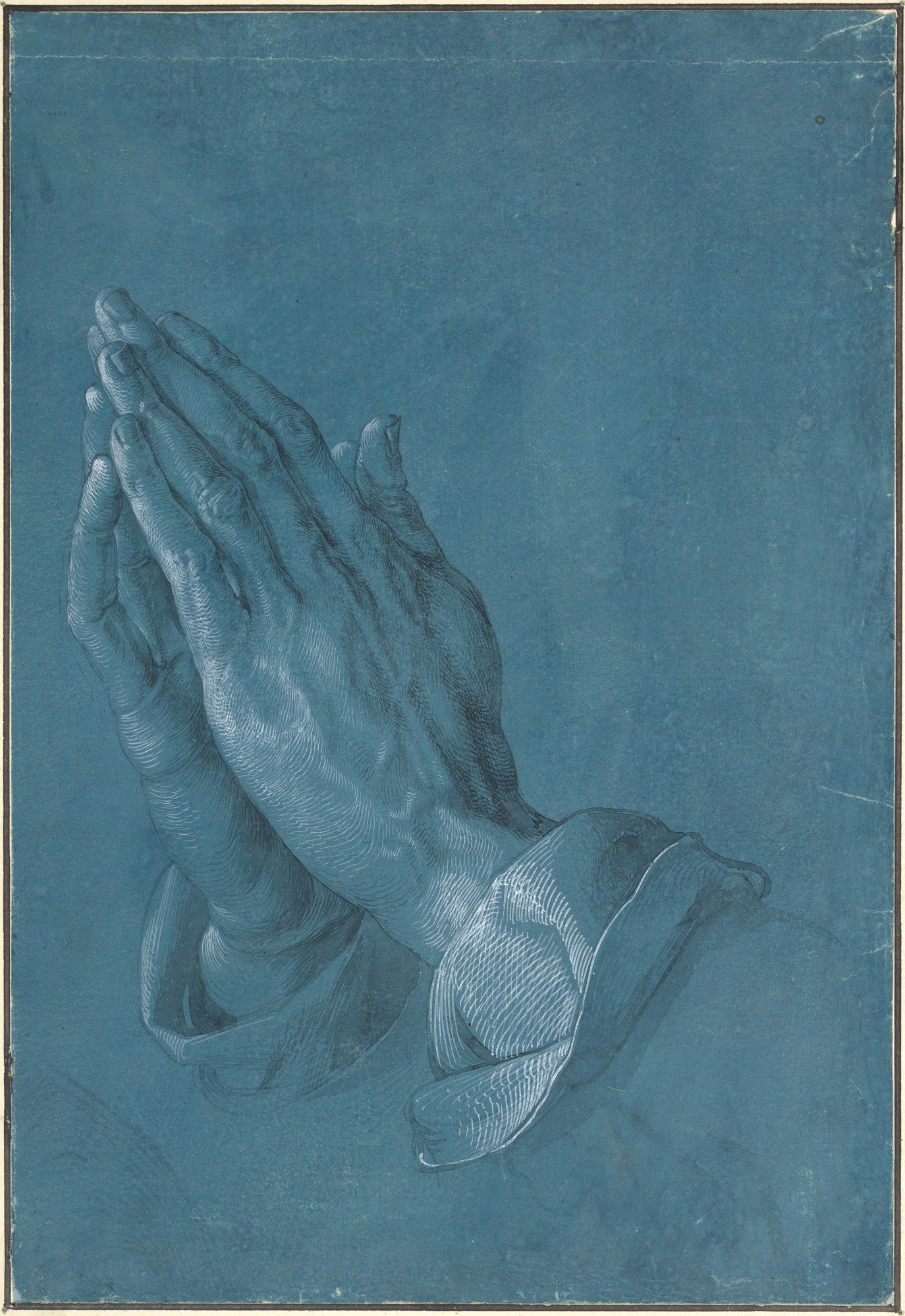
Praying Hands
The painting these hands were drawn for burned. Dürer spent more than a year on it and quarrelled with his client about money throughout — he wrote that painting this carefully did not pay, and that he would not take such work again. The panel was later sold to Bavaria and destroyed in a fire at the Munich residence in 1729. The study of a hand survived. The painting did not.
Quick Facts
- Artist: Albrecht Dürer (1471–1528)
- German title: Betende Hände
- Year: 1508
- Medium: pen and ink with white heightening on blue prepared paper
- Dimensions: 29.1 × 19.7 cm
- Movement: Northern Renaissance
- Location: Albertina, Vienna
What it was for
Worth starting here, because the most reproduced drawing in the world was a working note.
In 1507 the Frankfurt merchant Jakob Heller commissioned Dürer to paint an altarpiece for the Dominican church in Frankfurt. The subject was the Assumption and Coronation of the Virgin.
Dürer made a series of studies on blue paper: heads of apostles, folds of drapery, feet, hands. This is one of them.
The hands belong to an apostle in the lower part of the composition — a figure kneeling at the Virgin’s empty tomb and looking upwards.
The correspondence with Heller survives and is full of grievance. Dürer writes that he worked on the panel for over a year, that he used the most expensive pigments, and that at this price he was better off making prints than painting carefully. He eventually negotiated an additional payment.
What happened to the altarpiece
The story is dramatic and rarely told in full.
The altarpiece stood in Frankfurt for a century. In 1614 the Bavarian elector Maximilian I bought Dürer’s central panel, leaving a copy by Jobst Harrich in the church.
The original went to Munich. In 1729 it burned in a fire at the residence.
So the painting is known only through that copy — which hangs today in the Historisches Museum in Frankfurt — and through a dozen or so surviving Dürer studies.
The side wings, painted by the workshop and other artists, survive.
This is one of those cases where the sketch outlived the work and became more famous than it.
What makes the drawing remarkable
The technique is the starting point, not the end.
Dürer drew on paper prepared with a blue ground — a method he brought back from Venice. It lets you begin from a middle tone: shadows go in with ink, lights with opaque white. The result is faster and more plastic than working on white paper.
Every vein, knuckle and crease of skin is there. These are not ideal hands — the fingers are uneven, the joints prominent, the knuckles raised.
What matters most, though, is what is missing. No face, no body, no setting — and the hands still carry concentration and strain. Dürer reduced emotion to the minimum of form.
What to look for
The cuffs. At the wrists you can see the edge of a sleeve — part of the apostle’s costume, and proof that this is a fragment of a larger composition rather than an independent work.
The fingers. Not interlaced but pressed together and slightly parted at the tips. This is the Western prayer gesture, which only became standard in the later Middle Ages.
The thumbs. Crossed, one in front of the other. A small thing, and the reason the hands look natural.
The white. Applied in points on the knuckles, fingertips and the outer edge of the hand. Seen closely, these are separate, precise touches of the brush.
The direction. The fingers run past the top edge of the sheet. The eye follows them towards something not shown.
On the reverse are studies of the head and feet of the same apostle. Dürer used both sides of the paper.
The legend of the brother
This story has circulated for generations and is worth addressing, because it is false.
The tale runs that Dürer had a brother, that the two agreed one would study while the other worked in a mine to support him, and that after years the brother’s hands were too ruined by labour to hold a brush. Dürer is then said to have drawn those damaged hands.
None of it is true.
Dürer had a brother called Albert, but he was not a miner and made no sacrifice of the kind described. Another brother, Endres, became a goldsmith; a third, Hans, became a painter at the Polish court in Kraków.
The hands in the drawing show no sign of manual damage. They belong to a model posing in the studio, quite possibly Dürer himself or someone in his circle.
The legend first appears in the nineteenth century, in devotional literature, and spread widely through twentieth-century religious pamphlets.
It is worth knowing precisely because it is so common.
Historical context
1508. Dürer had recently returned from his second stay in Venice, where — as he wrote — he was treated as a gentleman, while at home in Nuremberg he was a nobody.
Europe was close to upheaval. Luther published his theses nine years later. Personal devotion and unmediated access to God were gaining ground.
At the same moment Michelangelo was at work on the ceiling of the Sistine Chapel and Raphael was beginning The School of Athens.
In the north the ideal was different: not the heroic body, but minute observation and concentrated devotion.
About Albrecht Dürer
Born in Nuremberg in 1471, the third of eighteen children of a goldsmith from Hungary. He trained with his father, then with the painter Michael Wolgemut.
He travelled to Italy twice, in 1494–95 and 1505–07.
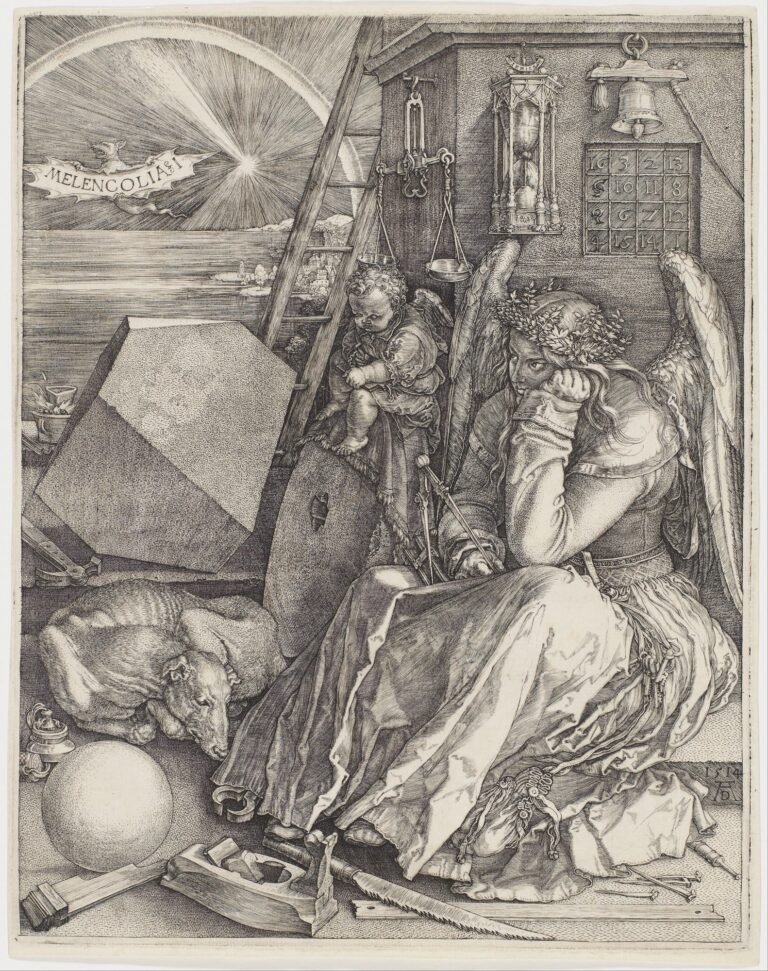
His fame rested on printmaking rather than painting. Woodcuts and engravings circulated across Europe in hundreds of impressions: the Apocalypse, Melencolia I, Knight, Death and the Devil, Saint Jerome in his Study.
He was also a theorist, writing the first German-language treatises on human proportion and on geometry for artists.
He died in 1528, aged fifty-six.
Legacy and influence
Few drawings have been reproduced so often. The motif appears on devotional cards, gravestones, tattoos, medals and album covers.
That popularity comes at a cost. The drawing now functions almost entirely as a symbol of prayer, detached from what it actually was: a study for one figure in one altarpiece.
A German note belongs here too. As with other work by Dürer, the motif was used in Nazi propaganda as an emblem of German spirituality. Recovering it for ordinary reading took decades after the war.
Where to see it today
The drawing belongs to the Albertina at Albertinaplatz 1 in Vienna — one of the largest collections of drawings and prints in the world, with over a million items.
- Check whether it is on display before you go. Works on paper are shown in rotation, briefly and under dimmed light. This is the commonest cause of disappointment.
- The Albertina holds around 140 works by Dürer, including the Young Hare and the Great Piece of Turf — both equally light-sensitive.
- The museum frequently displays facsimiles when originals are resting. It is worth knowing what you are looking at.
- Check hours and prices before travelling; there is late opening on some days.
- Nearby: the Kunsthistorisches Museum with Bruegel and Vermeer, ten minutes on foot.
The copy of the Heller Altarpiece, which shows what the lost painting looked like, is in the Historisches Museum in Frankfurt.
Frequently asked questions
What was the drawing made for?
As a study for an apostle on the central panel of an altarpiece commissioned by the Frankfurt merchant Jakob Heller. Dürer made a dozen or so such studies on blue paper.
What happened to that altarpiece?
The Bavarian elector bought Dürer’s central panel in 1614 and took it to Munich, where it burned in a fire at the residence in 1729. A copy by Jobst Harrich, made at the time of the sale, remains in Frankfurt.
Is the story about Dürer’s brother in the mine true?
No. It is a legend that first appears in nineteenth-century devotional writing. Dürer’s brothers were not miners — one was a goldsmith, another a painter. The hands in the drawing belong to a studio model and show no sign of hard labour.
Is it a drawing or a painting?
A drawing — pen and ink with opaque white on paper prepared with a blue ground. The technique comes from Venice and allows form to be built up from a middle tone.
What is on the back of the sheet?
Studies of the head and feet of the same apostle. Dürer used both sides of the paper.
Can I see the original?
Only when the Albertina chooses to show it. Because of the fragility of the paper and pigments, it is displayed rarely and for short periods.
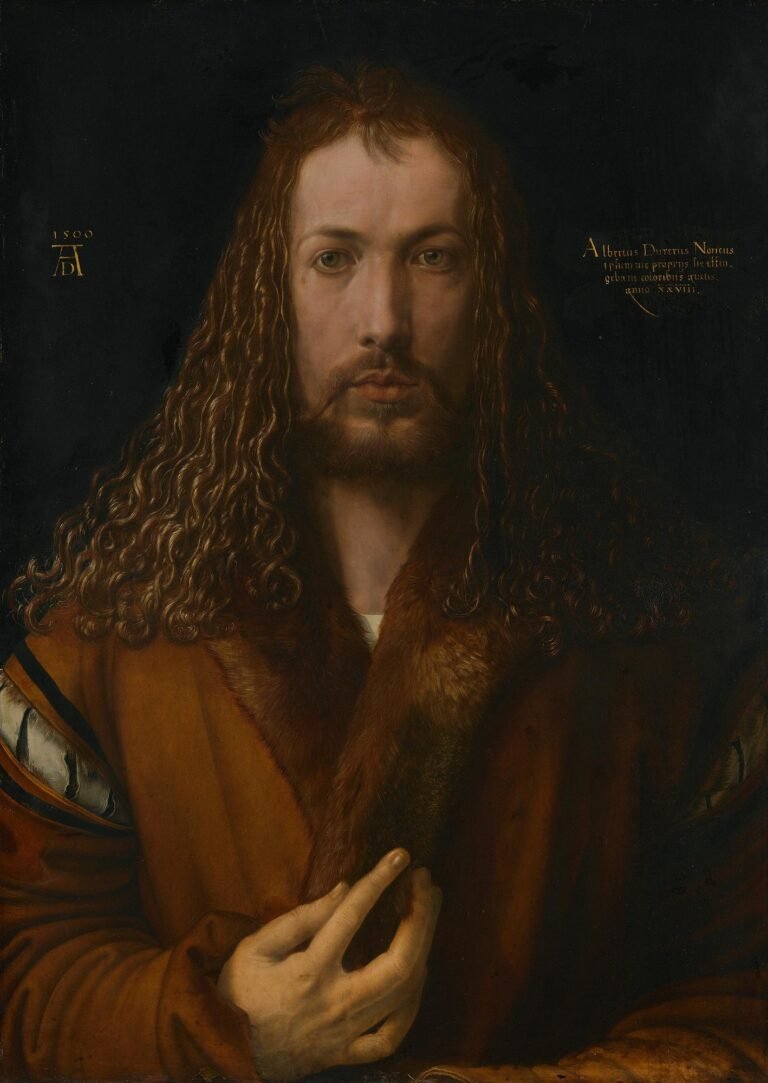
If this drawing has caught your interest, look next at Dürer’s Self-Portrait of 1500 — painted eight years earlier, and his most deliberate statement about what an artist is.
Image: Betende Hände – Albrecht Dürer (1508). License: Public Domain. Source: Wikimedia Commons.