The Hunters in the Snow
Few paintings in Western art history stop viewers in their tracks quite like The Hunters in the Snow – and here is the surprising part: the frozen village below the hunters is Flemish, but the jagged peaks on the horizon exist nowhere in the Low Countries. Pieter Bruegel the Elder painted them from an Alpine crossing he had made more than a decade earlier, and the join is invisible.
Quick Facts
- Artist: Pieter Bruegel the Elder
- Year: 1565
- Medium: Oil on wood panel
- Dimensions: 117 cm × 162 cm (46 in × 63¾ in)
- Movement: Northern Renaissance
- Current location: Kunsthistorisches Museum, Vienna
What Makes The Hunters in the Snow So Unforgettable?
Most Renaissance paintings celebrate gods, kings, and saints. Bruegel did something radical – he celebrated ordinary people doing ordinary things. In The Hunters in the Snow, the heroes are tired laborers trudging home through the cold, their dogs drooping beside them. There is no triumph here. Just the honest weight of a long day in brutal weather.
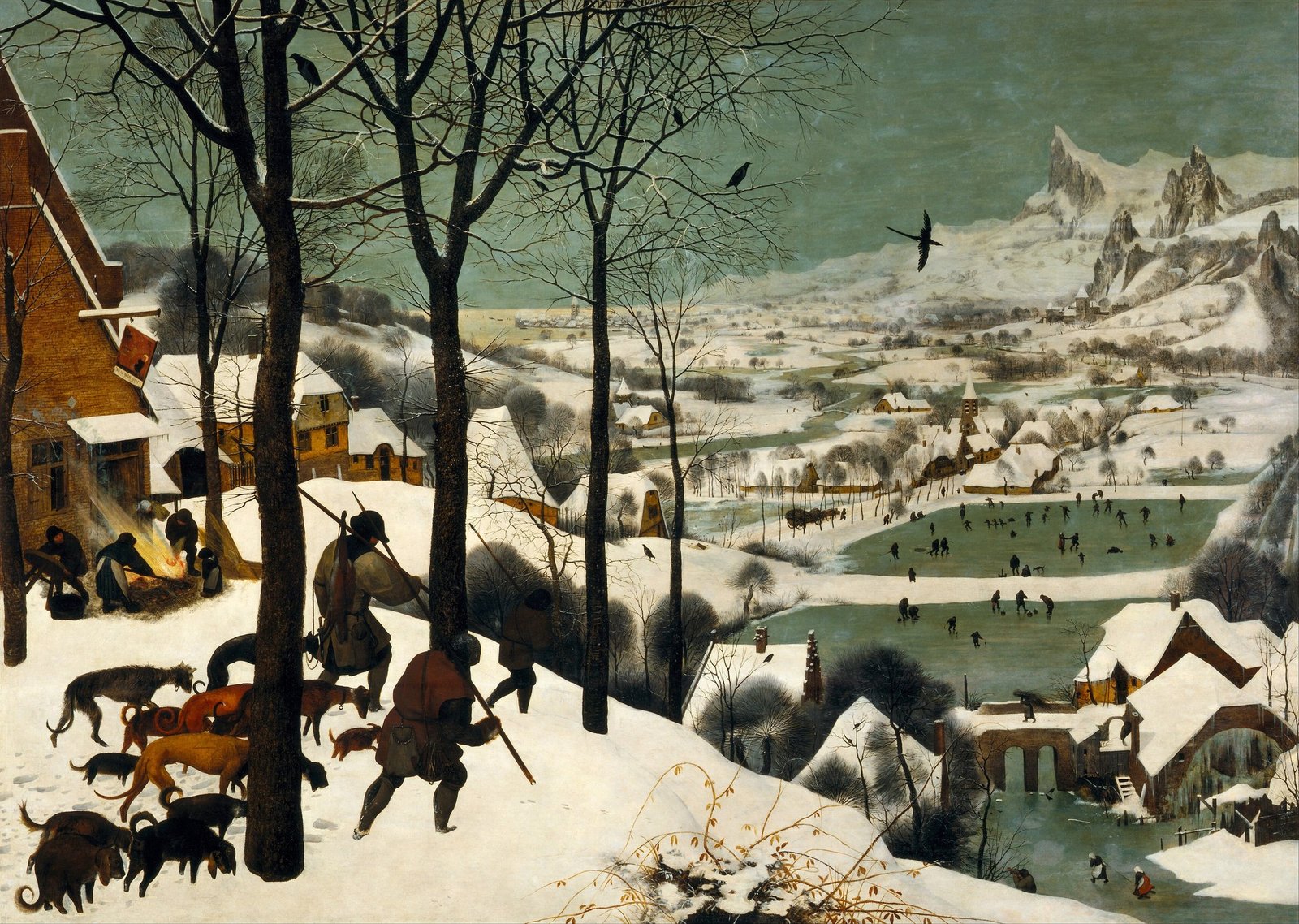
What truly sets this painting apart is its cinematic sweep. The eye moves from the hunched hunters in the foreground, down across a frozen village, and then soars outward into a vast panoramic valley of snow-dusted mountains. That single diagonal movement carries the viewer through three completely different scales of human experience – the intimate, the communal, and the cosmic – all within one frame.
In addition, Bruegel pulls off something technically astonishing. He captures the specific visual quality of winter light – muted, flat, colourless – at a time when most painters were dazzled by warm Italian sunshine. The Kunsthistorisches Museum calls it the first great winter landscape in European painting, and the claim is hard to argue with. The result feels modern. It feels true.
Historical Context
Bruegel signed and dated the panel 1565, and the winter of 1564–65 is recorded as the coldest of the sixteenth century in the Low Countries. Chroniclers in Brabant described paupers losing fingers and noses to frostbite and birds dropping dead from the sky. Historians link this stretch of extreme weather to the Little Ice Age, a cooling now dated by scientists to roughly 1300–1850, with the 1560s as its first decade of real severity. So when Bruegel painted frost, he was painting lived experience, not a romantic fantasy.
The painting forms part of a larger commission from the Antwerp merchant and collector Niclaes Jongelinck: a cycle of six panels that divided the year into six unequally long seasons, beginning on 1 March. Five survive; the spring panel is lost. Each one anchors a stretch of the calendar to the rhythms of peasant labor and landscape. This was itself a bold choice. The tradition of illustrating the months came from illuminated manuscript calendars, but Bruegel translated it onto monumental oak panels, elevating humble subject matter to the status of high art.
Meanwhile, the Habsburg Netherlands – Bruegel’s homeland, governed from Spain – was simmering with religious and political tension. The Duke of Alba would arrive two years later, in 1567, bringing brutal repression. Some scholars read Bruegel’s focus on ordinary, anonymous people as quietly subversive, a refusal to paint the powerful at a moment when power was becoming very dangerous indeed.
The Northern Renaissance, of which Bruegel stands as a towering figure, was also pushing back against Italian idealism. Therefore, painters in the Low Countries prioritized close observation, detailed realism, and local subject matter over classical mythology and idealized human forms.
Symbolism and What to Look For
Stand in front of The Hunters in the Snow and resist the urge to take it all in at once. That is not just advice about pleasure – what research on art and the brain actually shows is that the paintings which stay with people are the ones they return to rather than scan. Instead, start at the bottom left. Notice the three hunters and their pack of hounds. They carry their spears over their shoulders, and a single fox hangs from one of them – the entire catch. The hunt has not gone well. There is no swagger in their posture, only exhaustion.
Now follow the line of bare, dark trees that march diagonally into the middle distance. Bruegel uses these stark verticals to guide your eye deeper into the painting. They also create a strong graphic rhythm – like musical notation written across the snow.
Below, in the village, life continues despite the cold. Skaters glide across the frozen ponds, others push a ball across the ice with sticks, and one group is playing something close to curling. Outside an inn, whose signboard hangs crookedly from its bracket, a family is singeing a pig over an open fire. For Bruegel, winter is not only hardship. It is also community, play, and survival.
The colour palette is deliberately restrained. Greys, muted greens, and whites dominate. However, one flash of warmth – the orange glow of that fire – gives the eye somewhere to rest before moving on. This is masterful compositional control.
Finally, look to the horizon. Those sharp, dramatic mountain peaks in the far distance are not the Flemish lowlands. They are Alpine. Bruegel crossed the Alps on his return from Italy in the mid-1550s, and his early biographer Karel van Mander wrote that he had swallowed the mountains whole and spat them out again onto his panels back home. Whether or not he worked from surviving sketches, the mountains here are memory, and the village below them is observation.
About Pieter Bruegel the Elder
Born around 1525–1530 in the Low Countries, Pieter Bruegel the Elder became the most important Flemish painter of the sixteenth century. He was registered as a master in the Antwerp painters’ guild in 1551, traveled to Italy shortly afterwards, and returned home transformed – not by Italian Renaissance idealism, but by the Alpine landscapes he crossed on the journey.
Bruegel earned the nickname “Peasant Bruegel” for his affectionate, unsentimental focus on rural life. Yet he was no peasant himself. He moved in educated, humanist circles and counted scholars and map-makers among his friends. His apparent simplicity was a sophisticated artistic choice.
He moved to Brussels in 1563 and died there in 1569, probably in his forties, leaving behind a body of work that would influence painters for generations. His sons, Pieter Brueghel the Younger and Jan Brueghel the Elder, both became significant painters in their own right, carrying the family name into the seventeenth century.
Legacy and Influence
The Hunters in the Snow cast a long shadow across art history. Bruegel’s winter scenes launched a genre: Dutch and Flemish painters worked the frozen-landscape subject for the next century and a half. Much of that transmission ran through his own workshop – his elder son built a career copying and adapting the father’s winter compositions, and dozens of those copies circulated widely. Hendrick Avercamp later built an entire career on frozen river scenes that owe a clear debt to Bruegel’s icy world.
In the twentieth century, the painting appeared in Andrei Tarkovsky’s 1972 film Solaris, where it became a symbol of longing for Earth and home. That cinematic appearance introduced Bruegel to a whole new global audience. Today, The Hunters in the Snow is one of the most reproduced winter images in the world, appearing on everything from greeting cards to postage stamps.
Its influence extends beyond painting into photography and film. Directors and photographers consistently return to its compositional logic – the high vantage point, the diagonal recession, the small figures against vast landscape – because it works so powerfully to make humans feel simultaneously significant and tiny.
Where to See The Hunters in the Snow Today
The Hunters in the Snow hangs in the Kunsthistorisches Museum in Vienna, Austria, where it has been since the imperial collections absorbed it in the 1590s. You will find it in the Picture Gallery on the first floor, in the room dedicated to Bruegel. The museum owns twelve of his paintings – roughly a third of everything he is known to have painted, and the largest single holding in the world – so plan to spend real time there.
Two other panels from the same seasonal cycle hang in that room: The Gloomy Day, which covers early spring, and The Return of the Herd, which covers autumn. Seeing three of the five surviving panels side by side is something you can do nowhere else; the remaining two are in the Czech Republic and in New York.
The museum is located on Maria-Theresien-Platz, directly across from the Natural History Museum, and both are walkable from Vienna’s city center. Opening hours run Tuesday to Sunday, 10:00 to 18:00, with late opening until 21:00 on Thursdays – but the museum switches to seven days a week during the summer and other peak stretches of the year, so check the official website before you plan a Monday visit.
While you are there, look for Bruegel’s Tower of Babel, Peasant Wedding, and The Peasant Dance, all in the same gallery. Together, they give you the fullest possible picture of this extraordinary artist’s range and ambition.
Frequently Asked Questions
Where is The Hunters in the Snow located?
The painting lives in the Kunsthistorisches Museum in Vienna, Austria, where it has been part of the imperial and then the national collection since the end of the sixteenth century. It is displayed in the dedicated Bruegel room in the Picture Gallery, on the first floor.
Why are there mountains in The Hunters in the Snow?
Because Bruegel put them there from memory. There are no peaks like these anywhere in the Low Countries. He crossed the Alps returning from Italy in the mid-1550s, and his early biographer Karel van Mander wrote that Bruegel had swallowed the mountains whole on that journey and spat them out again onto his panels once he was home. The village, the pond, the skaters and the hunters are Flemish. The horizon is not.
Was The Hunters in the Snow painted during a real winter?
The cold in it was real, even though the panel itself was painted indoors. Bruegel dated the work 1565, and the winter of 1564–65 is recorded as the coldest of the sixteenth century in the Low Countries – rivers froze hard enough to hold markets, harvests failed, and chroniclers wrote of frostbite and of birds falling dead from the sky. Bruegel painted three more snow scenes in the same period.
When was The Hunters in the Snow created?
Bruegel signed and dated the panel 1565. It belongs to a cycle of panels depicting the seasons, all painted around the same time.
What does The Hunters in the Snow represent?
On one level, it represents the depths of winter, December and January, as experienced by working people in sixteenth-century Flanders. More broadly, it captures the relationship between human beings and the natural world: small, resilient, and bound to the turning of the seasons.
Why is The Hunters in the Snow so famous?
Its fame rests on a rare combination of emotional honesty, technical brilliance, and timeless subject matter. It is also widely regarded as the first great winter landscape in European painting – the work that made snow a subject rather than a background. And it speaks directly to anyone who has ever felt cold, tired, or dwarfed by the scale of the natural world, which is to say everyone.
Is The Hunters in the Snow part of a series?
Yes. It is one panel in a cycle of six commissioned by the Antwerp merchant Niclaes Jongelinck, dividing the year into six unequally long seasons. Five survive: The Gloomy Day (early spring) and The Return of the Herd (autumn) in Vienna alongside this one, Haymaking (early summer) at Nelahozeves Castle in the Czech Republic, and The Harvesters (late summer) at the Metropolitan Museum of Art in New York. The spring panel is lost.
If The Hunters in the Snow has sparked your curiosity about Bruegel and the Northern Renaissance, explore our related posts on his other masterpieces, his fascinating contemporaries, and the remarkable Kunsthistorisches Museum collection – there is always another extraordinary artwork waiting to be discovered.
Image: The Hunters in the Snow – Pieter Bruegel the Elder (1565). License: Public Domain. Source: Wikimedia Commons.