The Clothed Maja
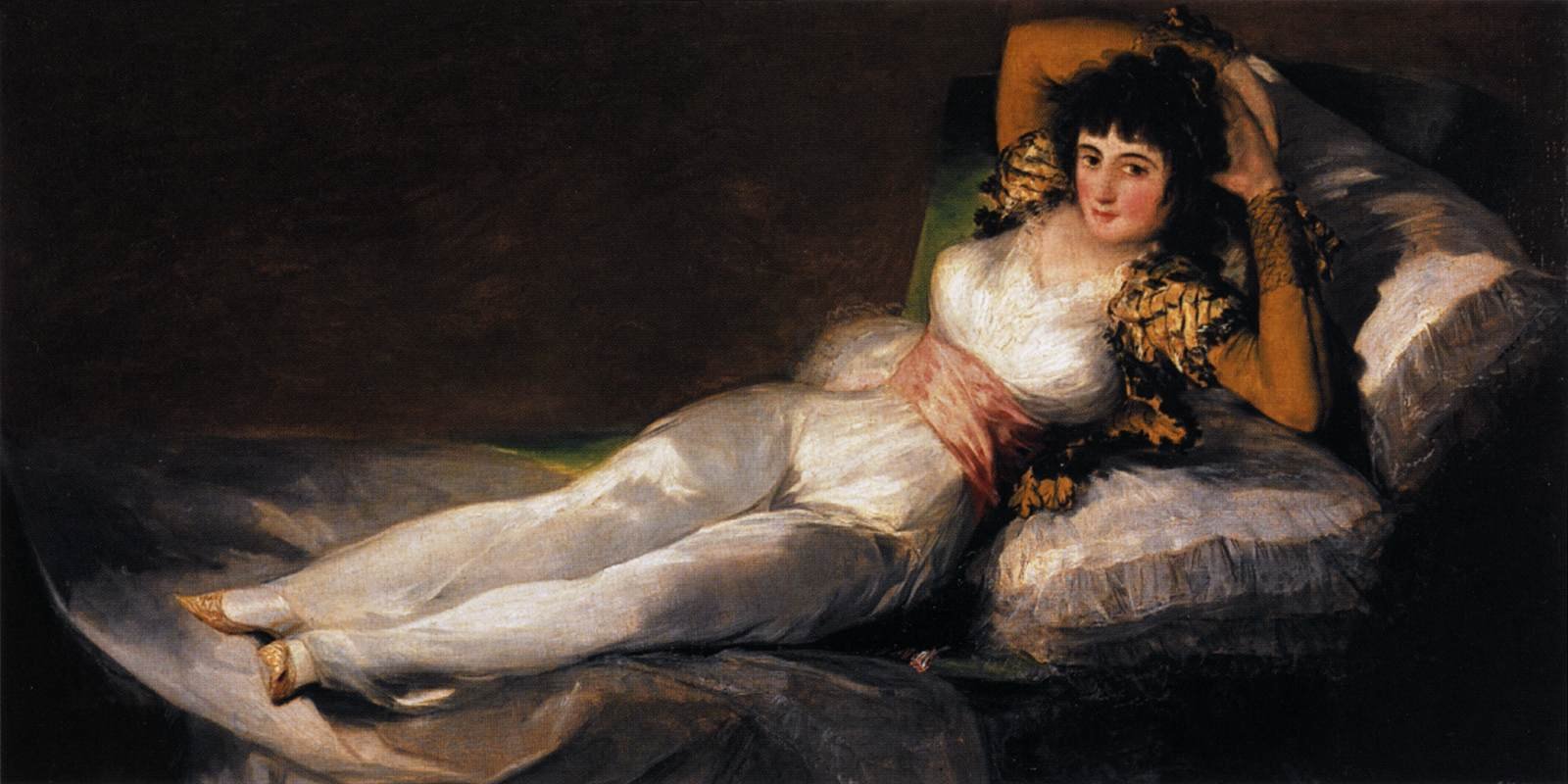
Many scholars consider this the better of the two paintings. Goya made it several years after the nude, and it shows in every stroke — the paint is laid on faster, broader, with far more freedom. The nude is smooth and worked up; the clothed maja is painted with bravura. If you only look at what is depicted, you miss half of it.
Quick Facts
- Artist: Francisco Goya (1746–1828)
- Spanish title: La maja vestida
- Date: c. 1800–1807
- Medium: Oil on canvas
- Dimensions: 95 × 190 cm
- Movement: Romanticism
- Location: Museo del Prado, Madrid
What is a maja?
Worth explaining, because the costume is the point of this painting.
Majos and majas were working-class Madrileños of the late eighteenth century, known for a distinctive style: particular dress, particular slang, a deliberate swagger. Imitating them became a fashion among the aristocracy, called majismo.
The outfit here is exactly that: a short chaquetilla jacket, a wide sash at the waist, a sheer white blouse. It is a costume, not everyday clothing — and a contemporary viewer would have read it as such. This woman is playing a part.
The choice also carried a political charge. Dressing as a maja signalled Spanishness at a moment when French fashion dominated the court.
Why this may be the better painting
This is a claim worth setting out, because it runs against intuition.
The nude came first, dated by the Prado to between 1795 and 1800. It is carefully worked, with porcelain-smooth flesh and finished modelling.
The clothed version came several years later, and technically belongs to a different Goya. The paint is applied broadly, in places almost as a sketch. The blouse is a handful of strokes. The sash is a plane of pink laid down in one movement. The embroidery on the jacket is indicated, not drawn.
This way of painting anticipates what came next — the Disasters of War, the portraits of the 1810s, and eventually the Black Paintings.
Put simply: the nude is an eighteenth-century painting. The clothed maja is not.
The mechanism and Godoy’s cabinet
Both canvases belonged to Manuel Godoy, chief minister to Charles IV, the queen’s favourite, and the most powerful man in Spain.
The nude is first recorded in November 1800, in a private cabinet in Godoy’s palace, alongside Velázquez’s Rokeby Venus and two Venuses then attributed to Titian. That description mentions the nude alone — the clothed version is not there. The two paintings first appear together in the inventory of Godoy’s property drawn up in 1808 by Frédéric Quillet, the agent in charge of collections for Joseph Bonaparte.
The most famous story about them is that the clothed maja hung in front of the nude, and that a pulley mechanism drew it aside to reveal the nude behind. It is repeated almost everywhere, but no contemporary document supports it. The inventories list the paintings; they say nothing about a device.
It is easy to see why the legend took hold. Two identical poses, one clothed and one bare, owned by a man with a reputation for libertinism: the idea of a theatrical reveal almost writes itself. But it remains a story, not a fact.
Historical context
Spain at the turn of the nineteenth century was in decay. The court of Charles IV was consumed by intrigue and real power lay with Godoy.
The Inquisition still had teeth. A nude image of a woman who was not a mythological figure breached the rules in force.
In 1808 Godoy fell with the regime and his collection was confiscated. In 1813 the two paintings were recorded among the confiscated goods, and in 1814, after the return of Ferdinand VII, they passed to the Inquisition.
In March 1815 the Inquisition ordered Goya to be summoned to identify the paintings and to explain whether they were his, why he had painted them, for whom, and to what end. What happened next is not known; no record of the outcome survives.
In 1836 the paintings moved to the Royal Academy of San Fernando in Madrid. The clothed maja could be seen there by visitors — the French writer Louis Viardot described it in 1843 — but the nude was kept out of public view. Both entered the Prado in 1901, and only then was the nude publicly displayed, nearly a century after it was made.
What to look for
The handling. Get close. The blouse, the sash and the slippers are broad and rapid; from a metre away they break into patches.
The head. The same as in the nude, and equally debated. The proportions of head to body do not quite agree, which has led some scholars to argue the face was painted separately.
The gaze. Direct, steady, without coquetry — identical to the nude version.
The arms. Folded behind the head, an open and confident posture rather than a modest one.
The green of the divan. Dark velvet against a pale costume. It usually disappears in reproduction.
Compare the two. They hang side by side. Look not at the clothing but at the brushwork — that is where the difference lies.
Who was the model?
Unknown, and two names recur.
Cayetana, Duchess of Alba — a close associate of Goya. The identification goes back to the nineteenth century: Louis Viardot reported in 1843 that visitors to the Academy recognised her in the clothed maja. There is no evidence for it.
Pepita Tudó — Godoy’s mistress and later his wife. This version has the advantage that the paintings hung in his private rooms, but it is no better documented.
The Prado regards both identifications as unfounded. X-rays made in 1945 showed that the face of the nude maja had not been repainted and that no other figure lies beneath it. A third possibility remains a composite or idealised figure.
About Francisco Goya
Born in Fuendetodos, Aragon, in 1746, the son of a gilder. He trained in Zaragoza and Madrid, became a royal painter in 1786 and First Court Painter in 1799.
A severe illness in 1792–1793 left him permanently deaf. From that point his output split between official portraiture and private work of increasing darkness.
He left for France in 1824 and died in Bordeaux four years later, aged eighty-two.
Legacy and influence
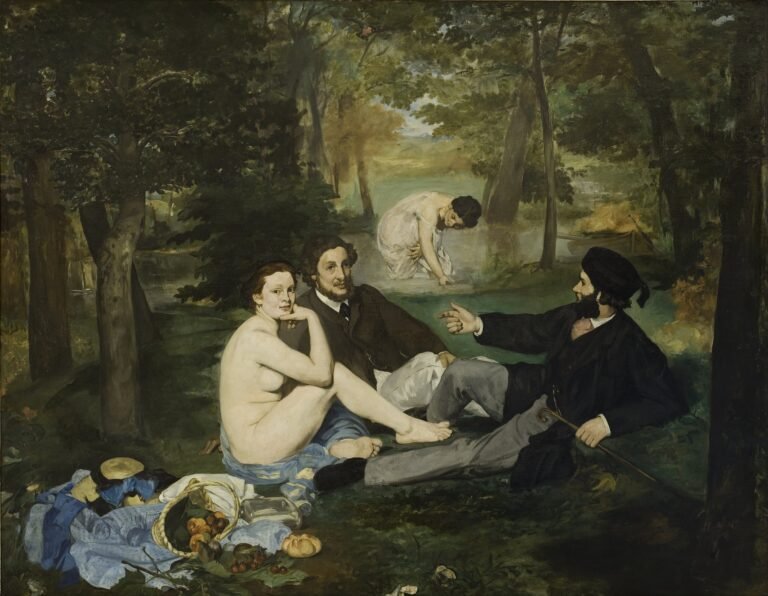
The pair is often compared with Olympia by Manet, painted in 1863 — a reclining nude who looks straight at the viewer, and a scandal sixty years later. The comparison needs care: the nude maja was hidden from public view at the time, and Manet only travelled to Madrid in 1865, two years after painting Olympia. He probably knew of the Majas by reputation rather than by sight.
The idea of two paintings commenting on one another was conceptually ahead of its time and anticipates later experiments with series and variants.
One point needs correcting. When Spain issued a set of postage stamps in 1930 to mark the centenary of Goya’s death, the image used was the nude maja, not the clothed one — the first female nude to appear on a stamp.
The clothed maja remains in her sister’s shadow, despite being, by many accounts, the stronger painting.
Where to see it today
The painting hangs in the Museo del Prado in Madrid, beside La maja desnuda.
- The Prado opens on Mondays as well: Monday to Saturday 10–20, Sundays and holidays 10–19. Hours change periodically.
- Admission is free for the last two hours; those places cannot be booked and a queue forms beforehand.
- Enter through the Goya door on the Paseo del Prado — the quickest route to his galleries.
- Do not compare the two paintings by their clothing. Compare them by the brush, and the difference becomes obvious.
- Also here: The Third of May 1808, The Family of Charles IV and the Black Paintings.
Frequently asked questions
Which came first?
The nude, dated by the Prado to 1795–1800. The clothed version followed several years later, between about 1800 and 1807. The difference is visible in the handling: the nude is smoother, the clothed maja painted much more rapidly.
Did the clothed maja really conceal the nude?
Probably not. The story of a pulley mechanism that drew the clothed version aside to reveal the nude is widely repeated, but no contemporary document mentions it. The earliest description of the nude, from 1800, records it on its own; the two paintings appear together only in the 1808 inventory, which says nothing about a device.
What does maja mean?
A working-class woman of Madrid, identifiable by dress and manner. Imitating majas became fashionable among the aristocracy. The costume in the painting is exactly that — a deliberate assumed identity, not everyday wear.
Who was the model?
Unknown. The Duchess of Alba and Pepita Tudó are the usual candidates, but the Prado considers both identifications unfounded.
Was the clothed maja on a stamp?
No — that was the nude. The 1930 stamp series marking the centenary of Goya’s death used La maja desnuda.
Why were the paintings hidden for so long?
After Godoy’s fall in 1808 they were confiscated, passed to the Inquisition in 1814 and to the Academy of San Fernando in 1836. The nude was kept out of public view there, and was only shown publicly after both paintings were transferred to the Prado in 1901.
If this painting has caught your interest, go to The Nude Maja — its inseparable companion — and to Olympia by Manet, which replayed the whole affair sixty years later.
Image: La maja vestida – Francisco Goya (c. 1800–1807). License: Public Domain. Source: Wikimedia Commons.